Wednesday, April 17, 2019

Amazing Wines from St. Estephe - Bordeaux Wine Tour Part 2

Chateau Lafon-Rochet

While in Bordeaux, we visited an interesting museum that has only been open since 2016. The Cité du Vin is part museum, part propaganda for the wine industry, part science world, and part wine bar.


For €20, we had access to the main exhibit which was the story of wine. There was a lot here - history, geography, different countries that make wine, different wine makers, advertising in wine, the aromas in wine - it was a very comprehensive exhibit that was interactive.

Enjoying a glass atop the Cité du Vin

The best part, however, was reminiscent of the Guinness Brewery in Dublin, We were given a special ticket at the beginning of our visit. At the top of the building, that ticket was good for one wine from a selection of many around the world. After we made our choice, we enjoyed our glass while we looked out over Bordeaux. Of course, I had picked a wine from Bordeaux...

Our second stop on our wine tour was Chateau Lafon-Rochet. I was looking quite forward to this as I bought a bottle of their 2015 wine at the Bordeaux release last year (and it currently resides in my cellar).


Chateau Lafon Rochet is in St. Estephe (Big brother Steven, when studying for my WSET). The wines here characteristically have a higher percentage of Cab Sauv and are higher in tannins that most other Bordeaux wines. I really enjoy them, even when they are young.

Our excellent guide, Bogdan, drove up to the chateau and we got out and met our winery guide, Mathilde. She spoke English well but had a wonderful French accent that was a pleasure to listen to.

After introductions, we talked about the grapes in the vineyard (just 45 hectares - not huge for Bordeaux) and about the different owners. The current owners, the Tesseron family, apparently did not think that it was that easy to see the winery from the road so they painted the chateau yellow - it is very easy to see from the road now! In fact, the labels on the wines are all bright yellow as well.

While stomping through the grounds, we were fortunate enough to meet the owner, Basile Tesseron. He was a very approachable man and took time to chat with us for a couple of minutes.


In the winery, we saw something that was not uncommon in some of the places we visited - concrete fermenters.

At home, in the Okanagan, most wineries use stainless steel to ferment their wines. In Bordeaux, we saw stainless steel but also those giant oak fermenters and, in Chateau Lafon Rochet, big concrete fermenters. They were popular many years ago and then fell out of favour but are becoming popular once again as a choice for fermenting at least part of the juice.


As you can see, stainless steel is also used in this chateau. This vat is 68 hectolitres which is 6800 litres and the wine, Les Pelerins, is the name of their second label.


They had quite the nifty computer terminal which showed all of the temperatures for all of the fermenters. There are alarms and other safeguards if there is a problem with the temperature at any point.


Mathilde was also able to use the screen to show us the different grapes planted in the different parts of the vineyard. Mostly Cabernet Sauvignon, followed by Merlot, with some Petit Verdot and just a soupçon of Cab Franc.


The barrel rooms may all look pretty similar, but I love them all. The smell and the feel of these areas are so distinct and enjoyable.


As with most of the wineries, they choose several different barrel makers from different regions of France to make slightly different barrels of wine which are carefully blended before bottling.


Ageing in this big barrel imparts less spicy oak flavour and tannins. The wineries are always trying out new things. We had the added benefit of being able to do a barrel tasting at Lafon Rochet! I find this fascinating as the wine is still very young and, while not ready to drink, you get an indication of where it is going. This wine will likely be an excellent vintage as there was definite fruit flavours as well as strong tannins.

If you ever get a chance to do a barrel tasting, I would strongly suggest that you go ahead. It really helps give you an understanding of the whole wine making process.


This clay amphora is another experiment that the winery is working on. I'm not sure why I was so surprised that even the most successful wineries of the world were busy trying to make their wines better.


After another excellent tour, Mathilde took us into the tasting room where we had three tastings - one of their second label, Les Pelerins, and a vertical of two of their first label, a 1997 and a 2008.


The first wine we had was their second label, Les Pelerins de Lafon-Rochet ($35). This was a 2015, the same year as the first label I bought last year. My first impression was - this is just their second label? Ooh la la!

There was a lot of fresh, black fruit on the nose and on the palate including black currant, plum, blackberry and blueberry. There were some oak flavours like tobacco, coffee and other spices. There were also wonderful ageing flavours like mushroom and leather. This wine had high alcohol, medium tannins, and a medium finish. It is suggested that you decant this wine an hour before serving.

This wine had definite fruit flavours that were quite tasty. It was not an overly complex wine or a wine that had astringent tannins. This was definitely the second label but that was fine - I enjoyed it and feel that it was one to drink now. Overall, I would rate this as Very Good.

I enjoyed this one so much that I decided to purchase one, considering I already have a first label at home.


The second wine was a bit of a treat - a wine from all the way back to 1997! The 1997 Chateau Lafon-Rochet ($164) is probably a drink now kind of wine although it could possibly spend a couple more years in the cellar. Mathilde said that this wine was a difficult vintage - it was a big challenge to get the grapes successfully off the vines - but they did it.

This wine had aromas and tastes of  cassis, black cherries,. plum, blueberry, and just a hint of jam.  There were oaky notes of cedar and tobacco and tertiary flavours of mushroom, forest floor, leather, and smoke. This was a complex and rich wine and was settling down nicely in terms of tannins thanks to 22 years in the bottle. A nice long finish helps give this wine a rating of Outstanding.


The final wine was a 2008 Chateau Lafon-Rochet ($60). This year was good in Bordeaux and this wine is a classic vintage that could be cellared for a while longer.

This was a good wine - not quite as tasty as the 1997, but still good. This wine was spicy  - along with black fruits like black currant and blackberry, there were tastes of cedar and pepper that really made themselves known. This highly tannic wine also had a bit of salinity which was a bit unusual. I would rate this wine as Very Good.

As I noted in my last entry about my guided trip, when I studied the four areas of Bordeaux (St. Estephe, Paulliac, St. Julien, and Margaux) I used the analogy of the three brothers (big, tough Steven, strong Paul, relaxed Julien) and their sister (soft and velvety Marg). While Lafon-Rochet wines did have some definite tannins, they were not overly extracted or too strong.

Maybe I don't have to wait until 2030 to have that first label from 2015?

Sunday, April 7, 2019

An Amazing Wine Tasting Evening with Friends

A group of friends in the midst of an amazing wine tasting.

WSET is not just for studying....

As I have alluded to before, people make great connections and friendships while doing the WSET course. We were all in it together, trying our best to pass the course, feeling the pressure of learning such a vast amount of information and feeling the pleasure of tasting wine together. 

But it finished in December!

Happily, the group that I have tasted with before - the friends that I have tasted with before - are continuing to get together. The first time, since our test, was a couple weeks ago when I was in France. 

The next time was just last Thursday.

Andrew was our host. He has taken both his WSET 3 and a comparable level of his CMS - Court of Master Sommeliers. He works at a restaurant but also works at a local independent liquor store and, therefore, can get a great deal on great wines!

Verity and her partner, Joey, were also in attendance. I took my WSET 3 with Verity - in fact, she related the story of our first class together - we had a champagne and some minor bubbles like Prosecco in a blind tasting. Both of us proudly announced that the Prosecco was the great wine, much to our chagrin! We both learned an awful lot more about wine since that first class. Verity also completed a comparable level of her CMS.

When I took my WSET, Sarah sat beside me every class - she was my WSET Buddy! It was great to see her at the tasting and reconnect with her once again.

A new person (for me), Steph, was working on the same level of CMS that Verity and Andrew had achieved. She is an actual Sommelier at a famous Vancouver restaurant! 

Finally, my buddy, Stewart, whom I have known since high school (when we used to drank a gallon bottle of Calona Medium White) came along as well.  Although he has not completed a formal wine course, Stew is well versed in the wine world (we've both come a very long way).


After everyone arrived, Andrew welcomed us with a glass of 2016 Crescent Hill Glennallyn Private Reserve Gewürztraminer from the Okanagan. As is common with this varietal, it was very aromatic and was a tasty, light way to start off our night. 

Andrew always does such a good job!

Our next wines were blind tastings. We had three whites and three reds.

Our first white was described by Steph, who spoke with such confidence that I was drawn in, hook. line and sinker, to what she thought the wines were. We tasted, and swirled, and spat. 


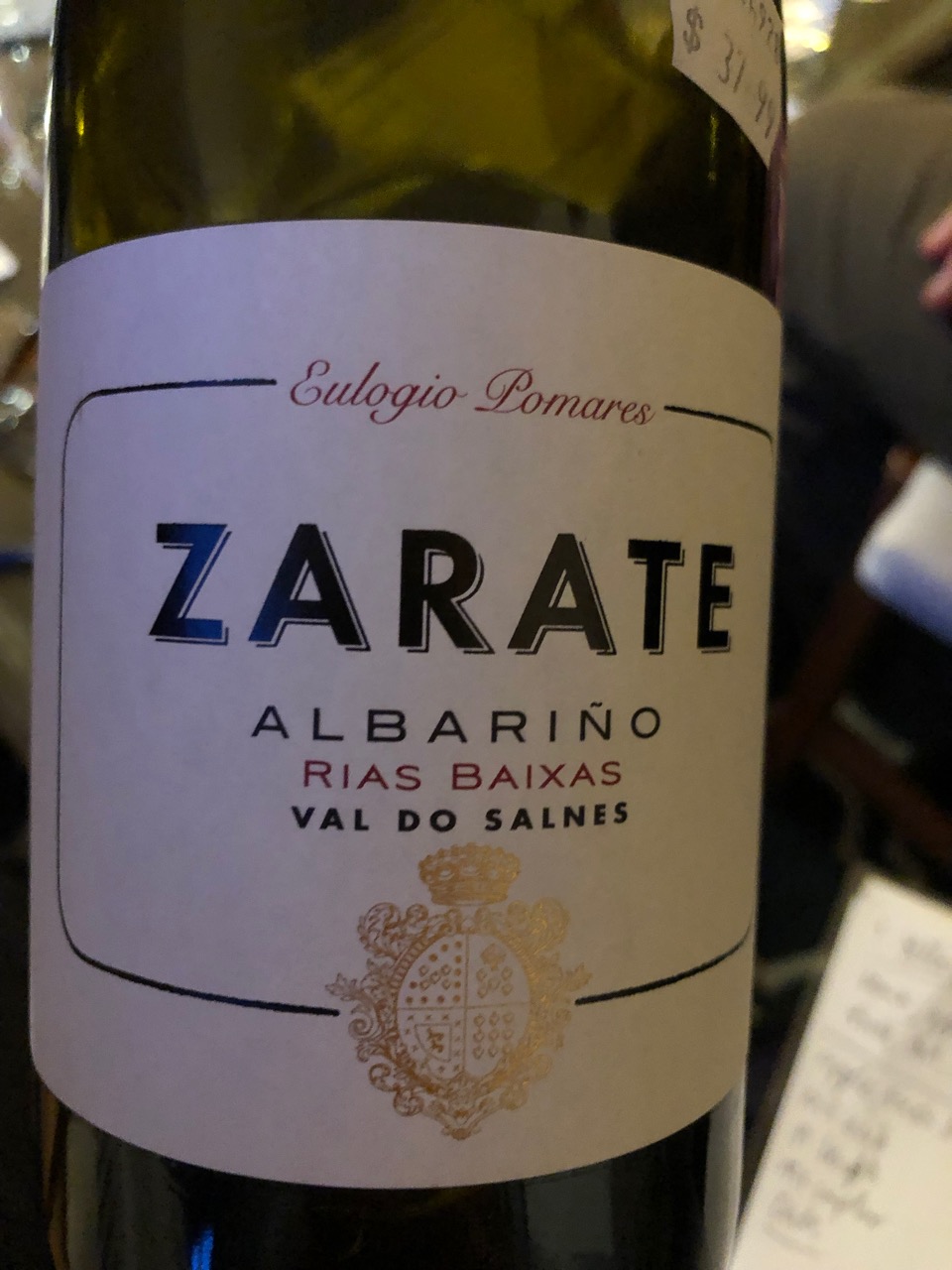
It was a Zarate Rias Baxas Albarino from Spain. It was not a strong wine and was not as full bodied as I thought it would be. 

Yellow, or lemon, in colour, this wine had aromas of lemon, apple, and had a minerality. These aromas were fresh, tart and ripe. On the palate, there were the same flavours - fresh or ripe apples, wet stone,  as well as medium plus acidity, medium length and medium complexity. There was also some oak on this wine.

As for all of the wines that we tasted, we all tried to come up with both the varietal and the place. Most people though this was a Chardonnay although some thought it was a Pinot Gris or something Italian. But we were all wrong. Albarino was just not on our radar! Overall, a Good wine.


Our next wine was another white and, this time, I nailed it. For me, petrol is an unmistakable aroma - and that means Riesling. Interestingly, unlike many of the petrol smelling Rieslings I have had in the past, this one was bone dry. This 2014  Howard Park Porongurup Riesling from Australia had additional aromas of rubber. pear, peach,. apple and a minerality. A complex nose with pronounced aromas.

On the palate, it was bone dry, as I said, with tastes of apple. It did not have the same mineral taste and was medium plus in alcohol and medium plus in acidity. This was a great dry Riesling - and I stated that to the group. Before the reveal I had also written down that I thought it was from Australia but hesitated to share that information. A Very Good to Outstanding wine.

Our final white was a real shocker. Verity described it as a 'giant in a sleeping bag' which means that it did not have a very pronounced aroma but when you got your nose close enough, there was an explosion of complex aromas. On the nose - and on the palate - were aromas like cloves, wood, popcorn, butter and vanilla. In fact, it smelled a little like a buttered popcorn Jelly Belly! It had medium acid, medium body and a very complex flavour.

Still, we didn't think it was all that fancy. We narrowed it down to Chardonnay but thought it was from California. You know, a big, oaky Chardonnay with lots of flavour.

Nope.


It was a Pouilly Fuiissé from the Maconnais region of Burgundy.  This 2014  Chateau Fuissé Le Clos Monopolé was not what we expected! It was probably the most expensive wine of the night, worth over $100. However, none of us found the elegance or refinement that we would expect from this kind of wine, although there was great complexity. I would rate this as Good to Very Good.

On to the reds!

Our first red of the night was a difficult one. Pale ruby in colour, it had aromas of mint and earth and a bit of an underbrush aroma. There were red fruits like cherry and raspberry as well as dried cranberry. On the palate, there were tastes of the same with the addition of some sort of leaf - like tomato leaf. It had medium plus acidity, medium minus tannins, and light bodied.


This Sangiovese wine was a 2015 Noelia Ricci Godenza Superiore from the Romagna area of Italy. It stumped us all. I thought it might be a cru Beaujolais although I couldn't detect the hallmarks of carbonic fermentation. There were some murmurings that it might be from Italy but no one had a strong feeling about that. Pinot Noir was another guess made by many of the group. It was certainly a surprise when the reveal came. This was a Very Good wine.


There next wine was probably my favourite. The 2015 Cannonball Merlot from Sonoma County had aromas of pepper, smoke, dark fruit such as plum and black berry,  jam, cedar and mushrooms. This wine had a pronounced intensity on its rather complex nose. On the palate was the same black, jammy fruits as well as some earthiness with medium acidity, medium plus tannins, and high alcohol. This wine had balance, complexity, length and intensity and I would rate this wine as Outstanding.  I first thought it was a Syrah, possibly from the Northern Rhone. My second guess was Merlot from California.


The final red for the night was another tricky one. The Chateau de Cherrière Bourgogne Pinot Noir was a very structured wine with medium plus acid and medium plus tannins, something I did not expect with a Pinot Noir. There were tastes and aromas of cedar, tobacco, farmyard, leather, mushroom, black fruit and black cherry. This was a real stumper as it had that Pinot Noir taste but such strong structure! I would rate this as Very Good.

One of the members of our group had something to celebrate so Andrew brought out a celebratory champagne style wine. The celebrant, Verity, then used a bread knife to sabre the wine! If you have a nice cold bottle of champagne (or other bubbly), you can use any kind of knife to open it. You simply slide the knife from the middle of the bottle up the seam of the bottle and, voila! The cork and some of the bottle will fly off the top!


Verity sabred a 1996 Summerhill Cipes Traditional Cuvée sparkling wine form the Okanagan ($80). I didn't do a formal tasting note at this point (we had finished the bottle leftovers at this point and were refraining from spitting or dumping) but I do recall that this was more than just a bready, yeasty tasting champagne. It had a beautiful golden colour. a nice fizz, and an exquisite taste that included a bit of a sherry.

A wonderful celebration to finish off a wonderful wine tasting evening!


Tuesday, April 2, 2019

Soft and Velvety Margaux - Bordeaux Wine Touring Part 1 - Chateau Brane-Cantenac


France is a marvellous country.

I just returned from a two week trip with my wife where we visited Lyon, Bordeaux and Paris. All were amazing places to visit (or, in the case of Paris, revisit) but for wine, Bordeaux was a dream come true. 

The view from our balcony.

We stayed in a wonderful apartment in Bordeaux - it was spacious, clean, centrally located and, most importantly, had a balcony, This was important because the weather while we were in Bordeaux was unseasonably warm - around 20°C. in the afternoon.  We managed to spend a couple of lunches with a baguette, cheese and a bottle of rosé sitting on the balcony, watching life unfold. 

How French!

One of the days we spend in Bordeaux was on a wine tour with Bogdan who is the guide for Bordeaux Vertigo. This was not a cheap day - the tour guide alone was €480 plus there were fees for tasting and the cost of lunch - but it was well worth it. It's not easy to get into the Chateaux in Bordeaux. They sell mostly to negociants who sell their wine and have no real desire to have people traipsing through the winery. For that reason, it is good to have a guide who can get you in and knows the ins and outs of getting appointments. 

Bogdan also knew his stuff - he was an expert on the region and we talked about many things - wine, schooling, the yellow vests, and politics to name a few. 

After picking us up at our apartment, we headed out from the urban centre of Bordeaux, a medium sized city, and watched the scenery change from buildings and pavement to fields and trees. Many of the wine areas are on reclaimed land, diked by the Dutch in the 1600s. The land that is still swampy sits empty of vines, with trees like poplar planted to suck up the moisture.

One of the many Bordeaux chateaux - this one is Chateau Brown-Cantenac
In Bordeaux, there is the left bank and the right bank. We were focusing on the left bank - where wines have a higher concentration of Cabernet Sauvignon than Merlot. The upper part of the left bank is called the Medoc. The better part of Medoc is the Haut Medoc (Upper Medoc). And the best parts of the Haut Medoc are named after the villages. 

The four main villages are St. Estephe, Paulliac, St. Julien, and Margaux - the three brothers Steven, Paul, and Jules and their sister Marg. 

Our first stop was in Margaux - the soft, velvety sister of the four siblings.


The winery we went to is called Chateau Brane-Cantenac. But first, some history. 

Way back in 1855, Napoleon (the third, not the guy with the hand in his jacket) wanted to catalogue all of the wineries in Medoc for a World Exposition - because even then Bordeaux had some of the best wine. The wineries that were part of this classification were given a classification of first, second, third, fourth or fifth growth of the Grand Cru Classé. With a minor exception, this has not changed since then. The first growths were the super famous chateaux like Lafite Rothschild. 

Chateau Brane-Cantenac is a second growth. 

As with most chateaux in Bordeaux, the double-barrelled name has meaning to it. Brane was the name of a Baron that bought the chateau in 1833. Cantenac is the name of the region. 


Our guide for this winery was Claire. We started outside, looking at the vineyards, and talked about the history of the winery and the grapes. The French have a passionate belief in the concept of terroir - that the varietal of the grapes is just one factor when growing grapes. The soil, weather, moisture, climate, slope, topography,. organisms, and sun exposure all affect the taste of the grape. 

The optical sorter, popular in many chateaux.

Once the grapes are ready to pick, at Brane-Cantenac they are sorted three times; once in the vineyard during the picking, again in the winery as they move through the sorting table and finally with this fancy machine called an optical sorter. It uses a laser to check the size, colour, weight, etc. and selects just the grapes that are perfect. 


The grapes are fermented in a number of different vessels in Bordeaux. At Brane-Cantenac they use either large oak vessels (which introduce some oxygen) or stainless steel tanks. Most of the wineries in the Okanagan use stainless steel for fermenting.


One thing that I noticed in almost every winery that we visited was that there was a concerted effort to try new things and to experiment. I guess I thought that they would just keep doing things the same way because their wines fetch such high prices but apparently not. At this winery, they are experimenting with fermenting in smaller oak barrels. 


Once the grapes have finished fermenting, and after a bit more time on the grape skins, the wine goes into barrels - both new and a year or two old - for ageing. Brane-Cantenac uses barrels from seven different producers and each barrel, even if they are the same French Oak, has a different flavour. 


A couple of the barrels are very cool as they have a glass 'stave' that you can see the wine. You can see how the density of the red colour changes over time as the wine matures.

Most chateaux have a first label, their wine that is the top wine, which is made from the best and oldest wines, and a second label which is usually wines made from younger vines. Chateau Brane-Cantenac has two second label wines. We tried three different wines in all. 


The first was their second label called Chateau Notton. They don't make this wine anymore as they have changed the name. This was a 2011 Chateau Notton. It was made from 55% Cabernet Sauvignon, 40% Merlot, 4.5% Cabernet Franc and 0.5% Carmenere. The average age of the vines is 35 years and the wine was aged for 12 months in oak, of which 20% were new barrels. 

There were tastes and aromas of jam, black berries, cassis and other rich, black fruit. This was a very enjoyable drinking wine and I quite enjoyed the taste of it at only 8 years old. It could probably stand a couple more years but was good to drink now. 


The second was the other second label, a 2008 Baron de Brane. This wine is 58% Cabernet Sauvignon, 40% Merlot, and just 2% Cabernet Franc.  It was aged 12 months in oak, of which 30% were new barrels. 

This wine had tastes and aromas of blackberry, black cherry, and cassis as well as some definite oak. It was more complex that the Notton and had some tertiary flavours such as forest floor and leather that weren't as noticeable with the first wine. This had some definite tannins that had rounded somewhat and could probably age for another five years.


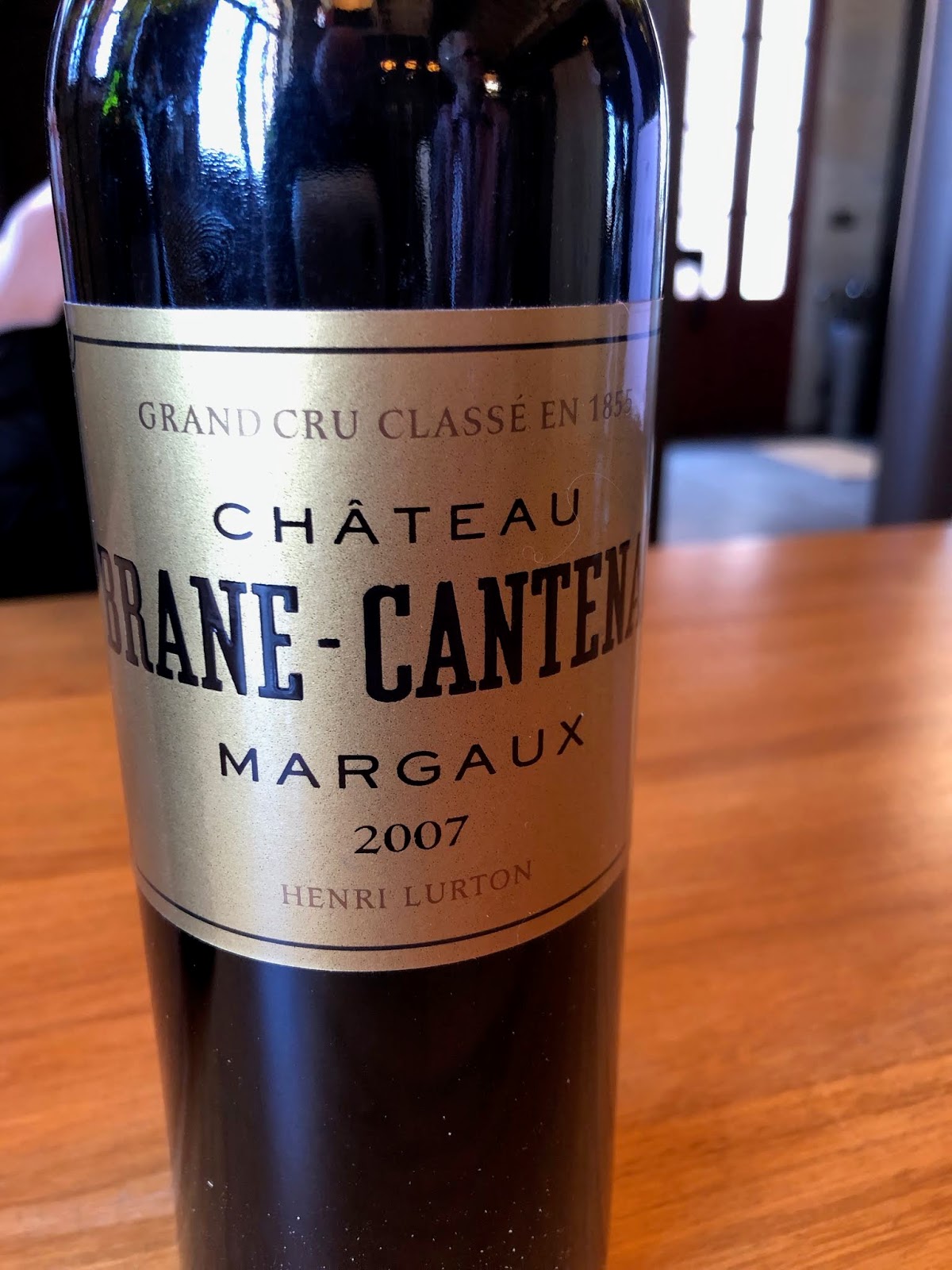
The final wine we tasted was the first label, the 2007 Chateau Brane-Cantenac. The year 2007 wasn't a particularly wonderful year because of a lot of rain earlier in the year but the summer ended up being dry and the grapes were actually pretty good by harvest time.  Claire wanted to show us how well it had aged and that it had turned out to be a really nice wine - which it was. It was 53% Cabernet Sauvignon, 39% Merlot, and 8% Cabernet Franc. This wine was aged a bit longer - 18 months in 60% French Oak. 

Claire, our wonderful chateau guide

Right from the first whiff, you could tell that this was a different wine. It had a powerful nose that really grabbed your attention. This complex wine had tastes and aromas of cassis, blueberries, raspberries, black cherries and a hint of violet. There were great tannins that made it supple and smooth with tertiary flavours of leather and cedar. This wine was already 12 years old but could probably sit in the bottle for another 5 years. I don't think I can wait that long, though, as I bought a bottle of it and will try to hang on for a couple more years. 

It was easy to see how passionate the people from the winery are about their wine. I remember when a tasting in the Okanagan was always preceded by a tour of the winery. Now, it's just a tasting and then onto the next one. In Bordeaux, the chateaux want you to see all the steps of how their grapes are grown and their wine is made so that you will have an appreciation of what goes in the glass.

Not a bad idea.


Friday, March 8, 2019

Vancouver Wine Festival 2019

wine from the festival
Wine from the festival!

This year I went to my second Vancouver International Wine Festival. Last year was my first year and, armed with the knowledge I had gleaned from having taken my WSET Level 2, I thoroughly enjoyed the event. 

This year, with the news that I had passed my level 3 fresh in my mind, I had another wonderful experience.

One of the unexpected pleasures last year was bumping into some of my fraternity brothers from UBC (almost 40 years later) - including Phil, who I spent four months with travelling around the US back in 1982 (precise details elude me as the entire trip is shrouded in a haze of comradery, frat parties and alcohol). This year, we all met up at Al Porto in Gastown for a pasta dinner, and a chance to catch up, before wandering over to the festival. 

Once we arrived at the festival, we bumped into even more people I knew including first, yet another fraternity brother and his wife, a sorority sister from years ago, second, the son of our close neighbours as well as his friends and girlfriend (who, incidentally, also has her WSET Level 3), and, third, two of the people from my WSET 3 course that were in my tasting group (and who also successfully completed Level 3)!

The Wine Festival has a diverse and interesting crowd. Some of the people  sip, swirl and then spit each glass. Others just slurp back every wine they sample, a sure recipe for wobbly legs and sore heads. I take the middle path - swirl, sip, drink a bit, and then dump the rest. I do feel a little relaxed by the end of the night but am still able to identify and process the different tastes and aromas of the wines. 

The featured wine region this year was California. We spent some time in Napa almost eight years ago and enjoyed their bold, flavourful wines. Unfortunately, we did not end up purchasing a lot of California wine at this year’s festival as some of the wines we tasted (including the St. Supery 2014 Napa Valley Estate Elu) were not available in the wine shop while others were very pricey (such as the Stag’s Leap Artemis at $85). We did end up with two that we were very happy with.


The first was the Benziger 2015 Cab ($25.49). While having dinner and trading notes before the festival, Dave, another one of my fraternity brothers, showed me his notes on this wine and I am very glad that I visited their booth. This wine is a steal for the price. A fantastic, black fruit, aged and rich Cab that is going to be wonderful to drink. I would enjoy this one on its own, or with a rich meal.


We visited Hess a few years ago in Napa and I’ve always enjoyed their wines. The Hess 2015 Allomi Cab Sauv ($38.99)  was probably our favourite of the evening. I’m not sure why we didn’t buy more! It had rich black fruit including black currants and blackberry as well as a nice long finish, with a smoothness that is so California!

Just a little side note - you may wonder why we bought so many different wines. In all, we ended up with 17 bottles (some we bought two of) at a little over $500. This is not a common occurrence (believe me!). However, most of the wines that we bought are not usually available at the BC Liquor store. Even the ones from the Okanagan were only available for the festival or direct from the winery.  You might not find these at the BC Liquor Store but you may see them at Everything Wine or one of the many private liquor stores.


Moving up the coast, we ended up in the Willamette (rhymes with damn it) Valley in Oregon. We really enjoyed our visit there last year and loved the Domaine Serene Evenstad Pinot Noir we bought - although the $75 US price tag was a bit steep. Happily, we found the Elk Cove 2016  Pinot Noir ($43.99). The Willamette Valley style of Pinot Noir that we have grown to love is a fruity but minerally wine. Some of the Pinot Noir that we tried at the festival was almost too dry or too smoky or lacked fruit but this one had punchy fruit and was not overly austere. There were two other wines made by this producer that were specialty Pinot Noir but their price point was significantly higher.


Who says you can’t have reruns? Closer to home was the Wines of Substance K Vintners 2015 Motor City Kitty ($52.99) from Walla Walla, Washington). We had this one last year at the wine festival and ended up making an eight hour detour on the way back from Las Vegas a few weeks later so that we could buy this wine at the winery. Not only was this on sale this year but we found out that this will now be available at the BC Liquor store! Really enjoyed Motor City Kitty  (oh, that's what MCK stands for!) as it is a very tasty and bold Washington State Syrah.

We ended up with a few wines from right here in BC. That’s because a lot of the smaller wineries only sell their wines at the winery or only produce a small amount of wine each year. 


The first wine we tried was the Time 2017 White Meritage ($22.99) in Penticton. This one was a blend of Sauvignon Blanc and Semillon and was one of the recommendations that Gismondi wrote about in the newspaper. Interestingly, when we were having dinner before the festival, Dave was telling me how he had spent time in a wine course in the 80s that was taught by Anthony Gismondi before he became famous! This white Meritage was delicious with tastes of pear and apple and had a nice acidity.


The Wild Goose 2017 Gewürztraminer ($19.99) was also another Gismondi recommendation and it is a fresh, spicy and slightly off dry wine that cries out for some tasty white meat, or fish…. or just a nice sunny patio! Their winery is located in Okanagan Falls. 


Roussanne is a grape that I’ve always wanted to buy as I have only tasted it in my WSET course - until now! I was excited to have the Lake Breeze 2017 Roussanne ($22.49) as it did not disappoint. Although not that acidic it had very nice stone fruit and apple flavours. Looking forward to having this accompany some tasty dish at home like chicken, pork or even salmon. This winery is also located in Naramata. 


My wife absolutely loves 8th Generation Winery and is a big Riesling fan. Their 8th Generation 2018 Riesling ($19.99) was crisp and a touch off dry. It would be a wonderful accompaniment to spicy foods or barbecued white meats.


Going a little more international, we went over the Uraguay’s lone participant. The Garzon 2016 Tannat $24.49 was another suggestion from Gismondi. I love Tannat and its super strong, tannic nature. Looking forward to popping this one with something really rich or fatty or, hopefully, both!


Italy is home to more grapes than anywhere else in the world. How many? Over 350 "authorized" varieties and another 500 documented varieties. I was keenly aware of that when I tried the Savian Lison Pramaggiore Refosco ($18.49). This  organic wine was a very interesting one because it was made from the Refosco grape which I have never had before. It had a taste of mostly red fruits like red cherry and raspberry, but also had some hints of dark fruit as well. An easy drinking wine, this would be great for pizza or pasta. Nice price, too!


Who doesn’t like Prosecco? Mionetto had four different Proseccos and we got to try them all. The Mionetto Valdobbiadene Prosseco ($22.99) was my favourite because of its crispness and hint of fruitiness with an overall dryness to the bubbles. This wine is a great sparkler that would go with just about anything!


The Italian wine with the most amount of body that I bought was the Nerube 2016 Montepulciano d'Abruzzo Riserva ($30.99). This wine, which is made from the Montepulciano grape, is very nice and would be a great one to bring to an Italian restaurant when you want to have a nice red wine to accompany your meal. Both red fruits and black fruits are evident along with some spice! It’s not one to age but it is one to enjoy!

I still think that France is one of my favourite - if not my very favourite - areas for wine in the world. There weren’t a ton of producers from France but I still managed to find some stunning wines.


The Haut Medoc is located on the Left Bank of the Gironde Estuary in Bordeaux - think Cab Sauv dominate with Merlot and Cab Franc. The Medoc is the general wine area with the Haut Medoc being the better part of that region. The 2015 Chateau Lachesnay ($31.99) was one of the four wines that we tasted from Ulysse Cazabonne (also a great year).  The company owns at least four châteaux and we had a chance to talk to the winemaker of this particular wine (notice the winemaker's signature on the bottle!). Although it was not a wine that is a cru , it was still very tasty and the price was quite good. The other wines that we tasted were also excellent but were a bit pricey. This one was a touch austere with lovely dark fruit flavours and aromas and a beautiful long finish. Probably a special occasion wine that could stand a few years ageing. 


Finally, the Chateau Pesquié 2016 Cote du Ventoux Artemia ($48.99) was a Syrah and Grenache blend. It was delicious with blackberry, black cherry, and other black fruits on the nose and on the palate. There was also some vanilla, tobacco, and even a hint of chocolate. Another excellent French wine that might deserve a special occasion or at least a special dinner. 

About to unbox our festival shipment!

Our wine ordered (the BC Liquor store will box and ship your order to your local liquor store for free - ours arrived less than a week later), my wife and I stumbled back to our hotel after having a late night snack along the way. We reflected, not only on the great wines that we had sampled, but also on the interesting mix of people, the friends that we had seen the we knew, and the conversations with the producers and winemakers. 

An extraordinary event. I already can’t wait until next year!

Cheers!


Tuesday, March 5, 2019

WSET 3 Final Results! Woo hoo!

The cherished Green Pin indicating I passed Level 3

So....got the final results for my WSET 3.

Not just that fancy green pin..... I also got my results for the two components of the test.

Just to refresh:

There was the blind tasting - which was two wines, a red and a white.

I was really, really, worried that I bombed the tasting. I did OK on the red but the white (which was a Sauvignon Blanc) tricked me.

Bad Sauvignon Blanc!

The second part was the knowledge tests.

The knowledge was split into two parts - the multiple choice which was 50 questions and the essay part which had four questions, each worth around 25 marks.

I felt that I passed the knowledge part - the multiple choice was pretty easy but the essay questions were hard - even though I had studied a lot.

How'd I do?


For the tasting, I got a Pass. No surprise there. I was really worried that I failed this part so to get a Pass was a relief.  It is a lot harder to taste and comment when you are in a room with a bunch of other people doing the same thing and the stress level is very high. And there's no cheese and crackers...

For the knowledge, I got Pass with Distinction! That means I got over 80%!! That was a surprise. I thought I'd maybe get Pass with Merit but had no idea that I'd nail the knowledge portion so well.  I guess all that studying paid off. Helps being a teacher and actually teaching kids how to study.


Overall, my grade was a Pass with Merit.

And I am happy with that. Really happy!

To get Pass with Distinction overall, I would have had to nail the tasting completely and I would have a difficult time doing that, unless the wines were, say, Beaujolais Nouveau and a Spätlese Riesling. Considering that I was off base with the Sauvignon Blanc, I am actually ecstatic that I did so well overall.

I will say it again - I am very happy with my results and am even happier that I am done!

Now, on to some nice wine....

Cheers!


Time to Taste an Albariño from Catalonia, Spain!

  Today we're drinking an Albariño — but there's an interesting twist. This 2024 Raimat Albariño doesn't come from the cool, Atl...