Showing posts with label sauvignon blanc. Show all posts

Friday, August 30, 2019

Cedar Creek - Renovated, Re-Opened, and Refined


Cedar Creek winery in Kelowna just re-opened - and it is well worth visiting!

Apparently the soft opening (for wine club members only) was last weekend but lots of other people caught wind of it and there were line ups out the door and down the path of the wine tasting room! I wasn't there that day but did go mid week and, I have to tell you, I was impressed!

In the whole Okanagan wine picture, I had previously considered Cedar Creek to be sort of in the middle to lower bracket. I hadn't tried a lot of their wine because of that and really didn't have an accurate reading on the winery.


Cedar Creek is owned by the Mark Anthony group, Anthony Von Mandl's company which also owns Mission Hill, Road 13, Checkmate and Martin's Lane, among others. The restaurant at Cedar Creek, Home Block, was also recently given a facelift but has been open for a while. I haven't eaten there but people that have are very positive about the food and service.

We were lucky enough to have both a tasting and a tour around the vineyard. Going through the vineyard was fabulous but it was a rather special opportunity that is not part of the standard wine tasting!

Cedar Creek has two levels of wine - their Estate series and their Platinum series.We had mostly the Estate level with the exception of our first tasting.

Courtesy Cedar Creek website

We started our wine tasting with a wonderful 2018 Block 1 Pinot Noir Rosé ($29.99). I love a good rosé, and this one was one of the best of summer. This had tastes and aromas of grapefruit, strawberries, cherries (those yellow and red Rainier ones) and watermelon and was made with two different pickings of grapes. Some was placed in neutral oak and was on the lees as well. This wine was not too sweet - it had good acidity but was still nice and fruity. This was my favourite wine of the day, perhaps enhanced by our racing along the vineyards in a golf cart while I was sipping on my rosė. Outstanding.

We then tried the 2018 Estate Sauvignon Blanc and the 2017 Gewürztraminer  (both were $18.99). I enjoyed both of these and thought the price point was pretty good. The Sauvignon Blanc was not too citrusy and had some grapefruit flavour that didn't overpower this bone dry wine. The Gewürztraminer was off dry and had a wonderful nose of pear and peach. It would be great with Asian food as well as slurping on the patio with your friends - or even by yourself! Both were Very Good.
Courtesy Cedar Creek website

Next was the 2016 Meritage ($24.99) which was Merlot dominant with about a quarter each of Cab Sauv and Cab Franc. I was quite excited to try this as the price point seemed rather reasonable but I was a little disappointed with the wine. There were flavours and aromas of cassis, plum, blackberry and vanilla but there was also a bit of roughness to the wine that I didn't enjoy. Maybe a year or two in the cellar might round out this wine a bit. Acceptable to Good.


The final wine was the 2016 Syrah ($24.99). The grapes for this wine are grown in the same place as the grapes for the Meritage (Haynes Creek Vineyard near Osoyoos) but these grapes were destined for greatness! The Syrah is made in a Rhone style, with a small bit (1%) of Viognier added. This wine had wonderful aromas and tastes  of violet, blueberries and plums. There were some vanilla notes amongst the explosion of red and black fruit. You could probably age this 5 or 6 years but I would be hard pressed to do so as it is so wonderfully tasty right now! Outstanding.


Next time, I think I'll have to cough up for a Platinum tasting - by the way, the Estate tasting has no charge!

By the way, I have started a wine touring business in the Okanagan. I do have this blog on my company website, but it just doesn't look as good as it is here! Please feel free to check out my website at wineandthensommwinetours.com !

Cheers

Friday, March 8, 2019

Vancouver Wine Festival 2019

wine from the festival
Wine from the festival!

This year I went to my second Vancouver International Wine Festival. Last year was my first year and, armed with the knowledge I had gleaned from having taken my WSET Level 2, I thoroughly enjoyed the event. 

This year, with the news that I had passed my level 3 fresh in my mind, I had another wonderful experience.

One of the unexpected pleasures last year was bumping into some of my fraternity brothers from UBC (almost 40 years later) - including Phil, who I spent four months with travelling around the US back in 1982 (precise details elude me as the entire trip is shrouded in a haze of comradery, frat parties and alcohol). This year, we all met up at Al Porto in Gastown for a pasta dinner, and a chance to catch up, before wandering over to the festival. 

Once we arrived at the festival, we bumped into even more people I knew including first, yet another fraternity brother and his wife, a sorority sister from years ago, second, the son of our close neighbours as well as his friends and girlfriend (who, incidentally, also has her WSET Level 3), and, third, two of the people from my WSET 3 course that were in my tasting group (and who also successfully completed Level 3)!

The Wine Festival has a diverse and interesting crowd. Some of the people  sip, swirl and then spit each glass. Others just slurp back every wine they sample, a sure recipe for wobbly legs and sore heads. I take the middle path - swirl, sip, drink a bit, and then dump the rest. I do feel a little relaxed by the end of the night but am still able to identify and process the different tastes and aromas of the wines. 

The featured wine region this year was California. We spent some time in Napa almost eight years ago and enjoyed their bold, flavourful wines. Unfortunately, we did not end up purchasing a lot of California wine at this year’s festival as some of the wines we tasted (including the St. Supery 2014 Napa Valley Estate Elu) were not available in the wine shop while others were very pricey (such as the Stag’s Leap Artemis at $85). We did end up with two that we were very happy with.


The first was the Benziger 2015 Cab ($25.49). While having dinner and trading notes before the festival, Dave, another one of my fraternity brothers, showed me his notes on this wine and I am very glad that I visited their booth. This wine is a steal for the price. A fantastic, black fruit, aged and rich Cab that is going to be wonderful to drink. I would enjoy this one on its own, or with a rich meal.


We visited Hess a few years ago in Napa and I’ve always enjoyed their wines. The Hess 2015 Allomi Cab Sauv ($38.99)  was probably our favourite of the evening. I’m not sure why we didn’t buy more! It had rich black fruit including black currants and blackberry as well as a nice long finish, with a smoothness that is so California!

Just a little side note - you may wonder why we bought so many different wines. In all, we ended up with 17 bottles (some we bought two of) at a little over $500. This is not a common occurrence (believe me!). However, most of the wines that we bought are not usually available at the BC Liquor store. Even the ones from the Okanagan were only available for the festival or direct from the winery.  You might not find these at the BC Liquor Store but you may see them at Everything Wine or one of the many private liquor stores.


Moving up the coast, we ended up in the Willamette (rhymes with damn it) Valley in Oregon. We really enjoyed our visit there last year and loved the Domaine Serene Evenstad Pinot Noir we bought - although the $75 US price tag was a bit steep. Happily, we found the Elk Cove 2016  Pinot Noir ($43.99). The Willamette Valley style of Pinot Noir that we have grown to love is a fruity but minerally wine. Some of the Pinot Noir that we tried at the festival was almost too dry or too smoky or lacked fruit but this one had punchy fruit and was not overly austere. There were two other wines made by this producer that were specialty Pinot Noir but their price point was significantly higher.


Who says you can’t have reruns? Closer to home was the Wines of Substance K Vintners 2015 Motor City Kitty ($52.99) from Walla Walla, Washington). We had this one last year at the wine festival and ended up making an eight hour detour on the way back from Las Vegas a few weeks later so that we could buy this wine at the winery. Not only was this on sale this year but we found out that this will now be available at the BC Liquor store! Really enjoyed Motor City Kitty  (oh, that's what MCK stands for!) as it is a very tasty and bold Washington State Syrah.

We ended up with a few wines from right here in BC. That’s because a lot of the smaller wineries only sell their wines at the winery or only produce a small amount of wine each year. 


The first wine we tried was the Time 2017 White Meritage ($22.99) in Penticton. This one was a blend of Sauvignon Blanc and Semillon and was one of the recommendations that Gismondi wrote about in the newspaper. Interestingly, when we were having dinner before the festival, Dave was telling me how he had spent time in a wine course in the 80s that was taught by Anthony Gismondi before he became famous! This white Meritage was delicious with tastes of pear and apple and had a nice acidity.


The Wild Goose 2017 Gewürztraminer ($19.99) was also another Gismondi recommendation and it is a fresh, spicy and slightly off dry wine that cries out for some tasty white meat, or fish…. or just a nice sunny patio! Their winery is located in Okanagan Falls. 


Roussanne is a grape that I’ve always wanted to buy as I have only tasted it in my WSET course - until now! I was excited to have the Lake Breeze 2017 Roussanne ($22.49) as it did not disappoint. Although not that acidic it had very nice stone fruit and apple flavours. Looking forward to having this accompany some tasty dish at home like chicken, pork or even salmon. This winery is also located in Naramata. 


My wife absolutely loves 8th Generation Winery and is a big Riesling fan. Their 8th Generation 2018 Riesling ($19.99) was crisp and a touch off dry. It would be a wonderful accompaniment to spicy foods or barbecued white meats.


Going a little more international, we went over the Uraguay’s lone participant. The Garzon 2016 Tannat $24.49 was another suggestion from Gismondi. I love Tannat and its super strong, tannic nature. Looking forward to popping this one with something really rich or fatty or, hopefully, both!


Italy is home to more grapes than anywhere else in the world. How many? Over 350 "authorized" varieties and another 500 documented varieties. I was keenly aware of that when I tried the Savian Lison Pramaggiore Refosco ($18.49). This  organic wine was a very interesting one because it was made from the Refosco grape which I have never had before. It had a taste of mostly red fruits like red cherry and raspberry, but also had some hints of dark fruit as well. An easy drinking wine, this would be great for pizza or pasta. Nice price, too!


Who doesn’t like Prosecco? Mionetto had four different Proseccos and we got to try them all. The Mionetto Valdobbiadene Prosseco ($22.99) was my favourite because of its crispness and hint of fruitiness with an overall dryness to the bubbles. This wine is a great sparkler that would go with just about anything!


The Italian wine with the most amount of body that I bought was the Nerube 2016 Montepulciano d'Abruzzo Riserva ($30.99). This wine, which is made from the Montepulciano grape, is very nice and would be a great one to bring to an Italian restaurant when you want to have a nice red wine to accompany your meal. Both red fruits and black fruits are evident along with some spice! It’s not one to age but it is one to enjoy!

I still think that France is one of my favourite - if not my very favourite - areas for wine in the world. There weren’t a ton of producers from France but I still managed to find some stunning wines.


The Haut Medoc is located on the Left Bank of the Gironde Estuary in Bordeaux - think Cab Sauv dominate with Merlot and Cab Franc. The Medoc is the general wine area with the Haut Medoc being the better part of that region. The 2015 Chateau Lachesnay ($31.99) was one of the four wines that we tasted from Ulysse Cazabonne (also a great year).  The company owns at least four châteaux and we had a chance to talk to the winemaker of this particular wine (notice the winemaker's signature on the bottle!). Although it was not a wine that is a cru , it was still very tasty and the price was quite good. The other wines that we tasted were also excellent but were a bit pricey. This one was a touch austere with lovely dark fruit flavours and aromas and a beautiful long finish. Probably a special occasion wine that could stand a few years ageing. 


Finally, the Chateau Pesquié 2016 Cote du Ventoux Artemia ($48.99) was a Syrah and Grenache blend. It was delicious with blackberry, black cherry, and other black fruits on the nose and on the palate. There was also some vanilla, tobacco, and even a hint of chocolate. Another excellent French wine that might deserve a special occasion or at least a special dinner. 

About to unbox our festival shipment!

Our wine ordered (the BC Liquor store will box and ship your order to your local liquor store for free - ours arrived less than a week later), my wife and I stumbled back to our hotel after having a late night snack along the way. We reflected, not only on the great wines that we had sampled, but also on the interesting mix of people, the friends that we had seen the we knew, and the conversations with the producers and winemakers. 

An extraordinary event. I already can’t wait until next year!

Cheers!


Sunday, December 9, 2018

Final Thoughts Before the Big WSET3 Exam - Wines from Australia, New Zealand, and South Africa - WSET 3.12, 13 and 14

Taking a Beaujolais Nouveau break between studying.

I've been so busy studying the last few weeks that I'm a bit behind. My exam is on Wednesday - two blind tastings, 50 multiple choice, and 4 essay questions.

And, no, I don't think I'm ready.

But we shall see, soon enough!

The last two weeks were a bit of a whirlwind of mock blind tastings, mock questions and looking at a variety of wines. Last week was Port, Sherry and Fortified Muscats while the week before was Sparkling. They were interesting and I did try some good wines but we tended to rush the actual tastings too much to allow for time to practice. I may cover some of those wines down the road but not right now.

This entry, I want to cover the last actual wine class - Australia, New Zealand and South Africa.


But first... we tried a simple red for the blind tasting that night - a 2018 Georges Du Boeuf Beaujolais-Villages Nouveau ($20). I have to say that I really did enjoy this slurping wine made from Gamay. It was great to taste the bubble gum, cinnamon, and banana that is characteristic of carbonic fermentation - that's when the fermentation vessel is kept oxygen free and the grapes start to ferment from their insides. They split open and then the whole mess is pressed and continues to ferment until ready. Tannins? Nope! Structure? Nope! Super easy drinking? Yup!


South Africa has some very hot climates but thanks to cooling currents from the ocean and higher altitudes, they also have a lot of wine production. One of the biggest grapes is Chenin Blanc which can be sweet or dry. The one we tried was a 2017 Cape of Good Hope Van Lill and Visser Chenin Blanc ($36). This youthful wine (and that was tricky - I thought it might age) had notes of grass, lemon, vanilla, toast an green apple. It was a dry wine with a long finish and high acid (characteristic of Chenin Blancs) and was rated as Very Good.


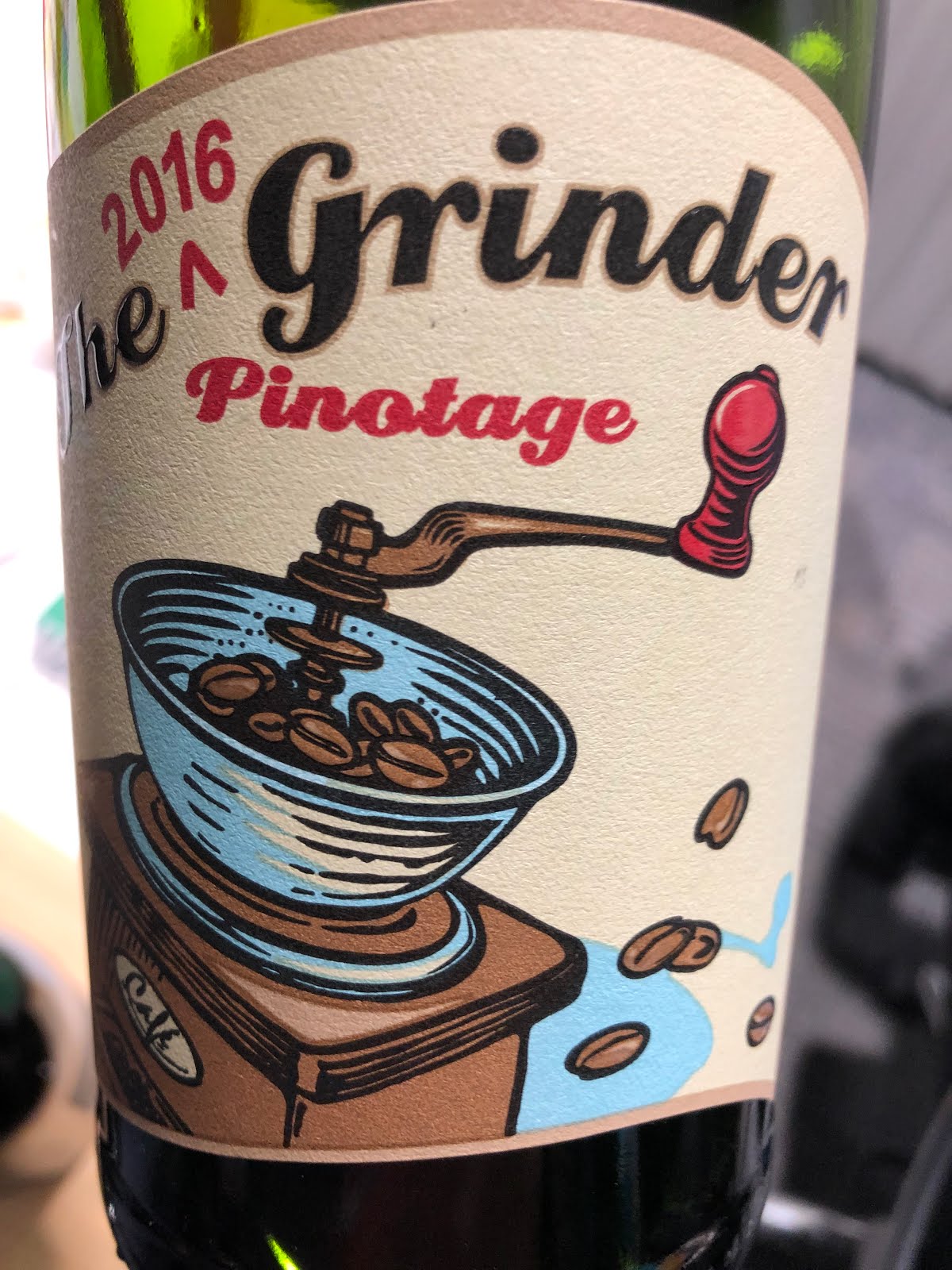
The other South African wine we had was their signature grape, Pinotage. Someone, a bunch of years ago, decide that, since it was too hot for Pinot Noir in South Africa, they should cross it with a hardier grape - say, Cinsault (also called Hermitage in South Africa).  They came up with what some call a franken-wine, Pinotage. It's got a bad rap - as many don't have the best taste - however, I have tasted a wonderful one in the Okanagan made my Stoneboat - but that's another story. The one we tried was a 2016 The Grinder Pinotage ($16). I would rather have another bottle of Beaujolais Nouveau, thanks. This did have a lot of aromas - cranberry, cherry, chocolate, coffee, gamey - and on the palate the coffee and blueberry tastes were rather intense. With high alcohol, it had medium acid, intensity, and body with a pretty short finish. I didn't mind it so much during my WSET 2 but now, it was just Acceptable.

A wine down under from a land down under.


Actually, Australia produces scads of wine and most of it is from the South East part. It's a hot country but there are lots of cool breezes to moderate the areas that grow wines that need moderating. Our first wine from Australia was a 2014 Mitchell Clare Valley Riesling. On the nose, it was, "WOW PETROL!" There was also rubber, pear, green apple and wet stone but I had a hard time getting past that petrol smell. On the palate, it was dry like most Australian Rieslings and had apple and spice - probably from lees stirring - as well as high acid, high alcohol, a medium finish, and a pronounced intensity of flavours. That petrol smell is a great indication that this is a developing wine tat could age a long time. It was rated as Very Good.


We had a Very Good Hunter Valley Semillon - which is an interesting wine. It is a rather neutral wine in its youth but develops amazing flavours of toast, nuts and honey. The one we had was a 2011 Tyrrell's Vat 1 ($68). I struggled with the notes on this - but there were notes of grapefruit, peach and brioche as well as some toast and honey. It had medium alcohol and medium plus intensity on the palate as well as high alcohol and a fairly strong finish. This wine could age for 10, 20, even 30 more years!


I do like a tasty Cab Sauv, as you may or may not have noticed from my blog. I love Bordeaux wines and I love Meritage blends from the Okanagan and I love big California Cab Sauvs. Well, add to that ones from Coonawara in Australia which may be hot but, man, they make great wine. We had a 2014 Yalumba "The Menzies" Coonawara Cab Sauv ($99). It was wonderful! On the nose was black currant, black plum, smoke, barnyard, black pepper, menthol and eucalyptus. On the palate, there was also spice and tobacco. This dry wine had strong tannins, high acid, high alcohol, almost full body, a medium plus finish and a pronounced intensity. It could definitely age for awhile and it was rated Outstanding - maybe a good splurge?


Australia has been famous for it's big, bold Shiraz wines - and so we tried a 2015 Glaetzer "The Bishop" Shiraz from the warm Barossa Valley ($51). This had some good aromas including blueberry, vanilla, pepper and black plum as well as an overall jammy taste. I don't mind a little jam but it does take it away from the "Outstanding" category. On the palate there was blueberry and charred wood as well as medium plus tannins and acidity. This wine was fine to age with its long  finish and strong intensity of flavours and was rated as Very Good. 

There are also more restrained Shiraz wines form Australia but we didn't try one  in class. 


Finally, we went to New Zealand. It's not a huge place but they make a heckuva lot of wine. On the cooler South Island is where Marlborough is - and that means, Sauvignon Blanc, New Zealand's most famous grape. We tried a 2017 Cloudy Bay Sauvignon Blanc ($36).  This wine had lots of green fruit, asparagus, grapefruit, and lemon on the nose with similar tastes on the palate. It had high acid, medium body, medium alcohol, and a pronounced intensity of flavour as well as a longish finish. This was a youthful wine and, like most Sauvignon Blancs, didn't have any ageing potential but was still a Very Good wine. 


Also from Marlborough, we tried a 2017 Villa Maria Pinot Gris ($22) which was OK. I also struggled with this one a bit but there were notes of peach, apricot, lemon, honey and floral aromas. This was an off dry wine and had high acidity, medium alcohol, as well as medium intensity and finish. Not suitable for ageing, this wine was rated as just Good. 


Finally, we had a wine, also from the South Island, but away from the effects of the ocean. From Central Otago we had a 2016 Matua Pinot Noir ($42 - pretty label award). This was a pretty standard Pinot Noir with red cherry, cranberry, and strawberry notes. It was mostly medium although it had a longish finish. Overall this was just a Good wine - and definitely not worth the price. 

Well, that's it for my WSET 3 classes. All that's left is the test. I have been studying hard and have these things to say on the three parts. 

The blind wine tasting: This all depends on my palate - some classes I have been bang on and some I have been right off. I need to focus on the aromas and tastes rather than trying to jump to conclusions and try to figure out the varietal. 

Multiple choice: I think this will be my strongest part. I have gone over the book many times as well as flashcards from me, my son-in-law Dan, and online cards. I have a very good general knowledge of wines of the world. 

Essay questions: This is my big worry. Even doing the few practice ones online, I find that I can't always think of everything that a question asks - and sometimes I draw a blank. I spent time today doing comparative analysis of the same grapes from different countries so I am hoping that will help me study for the last few days. 

I keep remembering what my classmate, Sarah, said during our tasting group and, again during last week's class - at the end of the day, we have learned so much about wine, tasted some fantastic wine, and met some wonderful people. 

But, damn it, I really want to pass!

Wish me luck...


Friday, October 5, 2018

WTF! Wine Tasting Fiasco! WSET 3.5


This week's class marks the one third point in our course. I have been feeling pretty good about my tasting ability.

Until this week....

Our first wine region was the Loire valley. This is a big area that stretches from the ocean (maritime climate) to the centre of France (continental climate). The main grapes are pretty easy to remember. 3 blancs and a franc - Sauvignon Blanc, Chenin Blanc, Melon Blanc (or Muscadet) and Cabernet Franc. Some of the famous areas in the Loire include Chinon (Cab Franc), Muscadet and Vouvray Chenin Blanc).  There's also two really famous Sauvignon Blanc regions, Sancerre and Pouilly-Fumé.  A great deal for Sauv Blanc is in Menetou-Salon which has great wine but not the same expensive price.

Our first wines were the three whites. Unfortunately, I had a really difficult time figuring out which was which. For example, I thought the Sauv Blanc was Chenin Blanc until I tasted what I thought was Sauv Blanc - and it was sweet! Threw me off completely!

Oh well, here's the wines:


Our first was a wine that had gooseberry, flint, stone, lemon and grass on the nose. It was definitely a youthful wine that also had apple and pear on the palate. It was a 2017 Domaine Delaporte Chavignol Blanc ($38). This wine had high acidity, medium alcohol, and medium (+) intensity of flavour. We rated this wine as Very Good and was a 'drink now' wine. I initially thought it was the Melon Blanc.


The second of the trio was a 2017 Domaine de la Pepiere  Muscadet Sevre et Maine ($26) which is the best of the Muscadets. This Melon Blanc had peach, apricot, melon (ha! melon for a Melon Blanc!), lemon peel and a bit of grassiness on the nose with some yogurt flavours from being on the lees on the palate. Despite the time on the lees, I felt that although this wine was balanced and complex, it did not have a particularly long finish and was not all that intense so was rated as merely Good. This wine is good to drink now and is not suitable for ageing.  Unhappily, I thought this was initially a Chenin Blanc.


The final wine of my three initial errors was a 2016 Maison Darragon Hautes des Ruettes Vouvray made from Chenin Blanc ($28). By the way, if it says Vouvray on the label, it has to be Chenin Blanc. I really enjoyed this one as it had pronounced intensity and something that I had a hard time defining, on the nose. The smell was wet wool which is textbook for a Chenin Blanc. There were also aromas and tastes of ripe apple, honeysuckle, honeydew, and honey. It was a balanced wine that was pretty intense, complex, and had a fairly long finish. I would put it between Very Good and Outstanding. When I first smelled this one, I thought it was a Sauvignon Blanc because of the funky smell, By the way, if you're ever in the Okanagan, Road 13 makes an amazing Chenin Blanc sparkler.

As you can see, the first three wines did not go well. I fared better, however, with the next two.

Moving East and South from the Loire valley, we ended up in Burgundy, home to the world's most expensive wines. In Burgundy, they make Pinot Noir and Chardonnay and that's about it. The north part does mainly Pinot Noir and the south part does mainly Chardonnay, although there are exceptions. Beaujolais is actually considered part of Burgundy but it's such a different kind of region, I have separated it out.

The first two wines were Chardonnay wines. Chardonnay is made from such famous places as Chablis, Mersault, Puligny-Montrachet and Chassage-Montrachet. I was able to figure out which was from Chablis and which was from the Cote de Beaunne - thank goodness something went right this week!


The first of these wines was a 2017 Jean-Paul and Benoit Droin Chablis ($58).  This had tastes of apple, grapefruit, lemon, butter and stone and was a high acid, bone dry wine. It was balanced, had complexity and was fairly intense but lacked a long finish so we gave it a Very Good rating (and a pat on the back for my first correct wine of the night). Drink this one now as it is not suitable for ageing!


The second wine was heaven! This one was a 2014 Chassagne- Montrachet ($131) and is a Monopole wine which means that this is one that the negociant produces from their own vineyards and is their flagship wine. There was a lot of different fruit going on here but the best was the secondary and tertiary characteristics such as vanilla, butter, roasted nuts, mushroom and popcorn. It had all the hallmarks of an Outstanding wine and was one that you could drink now but wold also really benefit from ageing.

Staying in Burgundy, we then looked at some Pinot Noir. There are many different houses that make first rate Pinot Noir including Gevrey-Chambertin, Nuits St. Georges, and the incredible but incredibly expensive, Pinot Noir. Domaine Romanee Conte which is a winery that demands some of highest prices for a bottle of wine anywhere.

Unfortunately, I was back to my old tricks again and mixed these up!


The first was a 2015 Joseph Faively Bourgogne Pinot Noir ($32). This had a fair bit going on including red plum, cranberry, cedar, smoke, and red cherries. On the palate, there was a pronounced intensity of flavours. It met some of the criteria for the assessment of quality and was rated Good.


The other Pinot Noir was a 2015 Domaine Daniel Rion et Fils Premier Cru from Nuits St. George ($100). This wine also had some great fruit on it including red plum, raspberry, cranberry, strawberry, and something vegetal - mushroom? - as well as strong tannins. This wine was less austere than the first one (which is maybe why we guessed wrong) and has some wonderful fruit flavours. Despite the age on it already, it would definitely benefit from ageing. It was rated Very Good - bordering on Outstanding.

I was on more solid ground for the last two wines. One was from the Loire - from Chinon - so a Cab Franc - and one was from Beaujolais - so a Gamay Noir. Beaujolais is one of those wines (like Pinot Noir) that's a great one to order if everyone at a restaurant orders something different. There's also Beaujolais Nouveau which is released this year on November 15th. It is a super light, bubble gummy wine (from carbonic maceration) and is supposed to be lots of fun - I've never had a Beaujolais Nouveau so I will definitely try it out next month. 


The Beaujolais that we did have was a 2016 Close de Roilette from Fleurie ($30), one of the ten crus of Beaujolais. It had flavours of stewed fruit, black cherry, bubble gum, and a bit of pepper. There was medium tannins, alcohol, and intensity with maybe a bit higher than medium acidity, It was very good but should be consumed now.

Courtesy BK Wine Photography
Fun fact - most vines in Beaujolais are trained in the gobelet style where the spurs are pushed up and tied together - sort of like braiding your hair and tying the braids together on the top of your head. 


The final wine was a 2016 Bernard Baudry Les Granges Chinon from the Loire valley ($27). It had flavours and aromas of black currant, red plum, eucalyptus, and smoke. This wine was high in acid and in tannins and had some cedar on it as well that meant it could age. It wasn't all that balanced and the length was OK so the question would be, would you bother ageing it as it was only a Good wine? 

Good question.

And so, my evening ended with me mis-identifying 5 of the 9 wines and missing out on a variety of aromas - or just getting them wrong. I will definitely have to refine my palate over the next few weeks. 

Will Taste Feverishly.


Saturday, September 29, 2018

Je t'aime, Bordeaux! WSET 3.4


I loved this week's class.

This week was all about Bordeaux - and I think Bordeaux is my very favourite wine.

Bordeaux is on the west coast of France and is split into two main regions, the left bank and the right bank.

The right bank is mostly clay soil so Merlot is the primary grape with some support from Cab Sauv and Cab Franc. There are places like Pomerol and St. Emillon that are very famous producers of this style of wine. It is excellent wine, undoubtedly, but my preference is for the other side of the Garonne River.

The left bank, ooh - la - la, is the home of the Cabernet Sauvignon focused blends which grow in more gravelly soils. There is still Cab Franc and Merlot (and, optionally, Malbec and Petit Verdot) but the driving force of these grippy, structured wines is Cabernet Sauvignon. The famous places include St. Estephe, Paulliac, St. Julien, and Margaux in the upper (Medoc) region and Pessac-Leognan, and Graves to the south. These might possibly be my favourite wines to drink in the world.

Courtesy the Wine Cellar Insider
Bordeaux wines can be pretty pricey - there are some that are thousands of dollars - but you can pick up a decent one for $40 to $60 - particularly something like a Cru Bourgeois, which chateaux have to apply for each year based on the quality of their wine. If you were to spend around $100 (definitely special occasion) you could find some exceptional wines. Only thing is, you probably would want to wait five to ten years to drink them!

The ranking system is interesting. In Medoc only, the top wines are called Grand Cru Classé. This category is divided into five 'growths' with first growth being the top wines. All of this ranking came from Napoleon III and the classification he directed in 1855. Little has changed since then. There's also Cru Bourgeois for those wineries that were too small or weren't around 150 years ago. In Graves, the better wines are just called Cru Classé - there are no growths. And in St. Emillon, they have another system with St. Emillon AOC at the bottom, then, St. Emillon Grand Cru Classé, and finally Premier Grand Cru Classé which is divided into A and B. All of these classifications had had their problems over the years.

Courtesy Wander and Wine
The other area we looked at was Alsace, a region of France bordering on Germany, which is home of mostly white wines including Riesling (dry style), Gewürztraminer, Pinot Gris, Muscat and some other grapes (Auxerrois, Pinot Blanc, Sylvaner). It is the only French region that I am aware of that has the varietal of wine on the label. They do have some sweet wines - Vendages Tardine which is basically Late Harvest wine where the grapes have undergone passerillage (drying of grapes on the vine) and Selection de Grains Nobles where wines have undergone Noble Rot.

When buying an Alsace wine, there is the Alsace AOC (must be 100% varietal) and then the Alsace Grand Cru AOC (which must be made from one of the four Noble Grape varieties (Riesling, Pinot Gris, Gewürztraminer, Muscat). Much simpler than Bordeaux!

And now, some tasting....

We started off with wines from Alsace. We were given three and told that each was a different Noble Grape. Our group was able to easily figure out which wine was which.


The 2015 Trimbach Riesling ($60) was a bone dry Riesling with high acid, high alcohol, medium body, medium plus flavour and a medium finish. Definite tastes of apple, lemon, honey, flint and even a bit of petrol. I couldn't decide between Good and Very Good but this one could probably age a bit.


The Pinot Gris was a 2016 Domaine Mersiol ($36) from Alsace, of course. It had some nice fruit flavours including peach, apricot, nectarine and honeysuckle as well as some floral notes. Lynn, our instructor,  felt it was a Very Good wine and had ageing potential although I really like my Pinot Gris wines to be as fruity and floral as possible. I feel that way about most white wines.


The final wine of the three was a 2017 Late Harvest Gewürztraminer from Kuhlmann-Platz ($25). Although youthful, this wine had a complex array of flavours including peach, apricot, pineapple, lychees, roses and ginger. I thought it was high alcohol but Lynn, our instructor, said that it was probably because of the ginger that I was tricked into thinking it was higher than it actually was. I thought it was Outstanding but I think the consensus was Very Good as not everyone felt it had a long enough finish. It was, however, balanced, intense, and complex. A steal for $25!

The next three were from Bordeaux - my faves! One was a white, one was left bank and one was right bank.


The white was a Sauvignon Blanc and Semillon blend (about 80% SB) and was a 2011 Les Hauts de Smith from Pessac Leognan ($83). This wine had some great flavours but I missed a few of them so I will put what the class consensus was - grass, peach, lemon, pear, toast, mushroom, and vanilla. This was aged in barrels on the lees to give it a nice, buttery finish. This is another wine that had ageing potential and was rated Outstanding (although I had only rated it as Very Good).


The right bank wine was a 2012 Chateau Barde-Haut Grand Cru from St. Emillon ($96). There was both red and black fruit on this including cherries and plums as well as toast, leather, and wet leaves. It had less tannins than the next wine, surprising as it is two years younger, and also had a wonderful velvety mouth feel. If all Merlots tasted like this, I would drink it a LOT more often!


The left bank wine was a 2010 Chateau Capbern Gasqueton from St. Estephe ($126). I tasted black cherry, black plum, cedar, tobacco, and green pepper. It was an earthy wine that had some grippy tannins but still had great structure to it. Definitely could age and was rated Outstanding. My favourite wine of the course so far....

We had another Bordeaux and a wine from Cahors to round out the reds.


The Bordeaux wine was a 2010 Cru Bourgeois from Chateau Dasvin-Belair in Haut Medoc ($45). This was a great price and it had some interesting aromas and tastes including red cherry, green paper, pepper, black plum, toast, tobacco and cedar. Although its finish wasn't as long as the previous two, it was balanced, intense, and complex and definitely ready to drink - Very Good!


The wine from Cahors was a 2016 Gouleyant Malbec. It was OK - red berries, red currant, cranberry, and some smoke - but was a bit of a let down after the previous three. It was a Good wine and was ready to drink. 


Finally, we had a sweet wine from Sauternes. Unfortunately, this 2013 Chateau Armajan Des Ormes  ($39) at the end of the class and was a bit rushed. Suffice it to say that it was quite sweet due to noble rot and had oak and vanilla amongst its flavour profile as well as high acid.

A good wine but Bordeaux reds is where my heart is.

This weekend, our provincial liquor stores are having a release of the 2015 Bordeaux wines. I already bought a couple last week at Everything Wine but I have my eye on two or three in the special catalogue that they produced. Looking forward to some grippy, structured, wonderful wines!

Time to Taste an Albariño from Catalonia, Spain!

  Today we're drinking an Albariño — but there's an interesting twist. This 2024 Raimat Albariño doesn't come from the cool, Atl...