Showing posts with label beaujolais. Show all posts

Sunday, December 9, 2018

Final Thoughts Before the Big WSET3 Exam - Wines from Australia, New Zealand, and South Africa - WSET 3.12, 13 and 14

Taking a Beaujolais Nouveau break between studying.

I've been so busy studying the last few weeks that I'm a bit behind. My exam is on Wednesday - two blind tastings, 50 multiple choice, and 4 essay questions.

And, no, I don't think I'm ready.

But we shall see, soon enough!

The last two weeks were a bit of a whirlwind of mock blind tastings, mock questions and looking at a variety of wines. Last week was Port, Sherry and Fortified Muscats while the week before was Sparkling. They were interesting and I did try some good wines but we tended to rush the actual tastings too much to allow for time to practice. I may cover some of those wines down the road but not right now.

This entry, I want to cover the last actual wine class - Australia, New Zealand and South Africa.


But first... we tried a simple red for the blind tasting that night - a 2018 Georges Du Boeuf Beaujolais-Villages Nouveau ($20). I have to say that I really did enjoy this slurping wine made from Gamay. It was great to taste the bubble gum, cinnamon, and banana that is characteristic of carbonic fermentation - that's when the fermentation vessel is kept oxygen free and the grapes start to ferment from their insides. They split open and then the whole mess is pressed and continues to ferment until ready. Tannins? Nope! Structure? Nope! Super easy drinking? Yup!


South Africa has some very hot climates but thanks to cooling currents from the ocean and higher altitudes, they also have a lot of wine production. One of the biggest grapes is Chenin Blanc which can be sweet or dry. The one we tried was a 2017 Cape of Good Hope Van Lill and Visser Chenin Blanc ($36). This youthful wine (and that was tricky - I thought it might age) had notes of grass, lemon, vanilla, toast an green apple. It was a dry wine with a long finish and high acid (characteristic of Chenin Blancs) and was rated as Very Good.
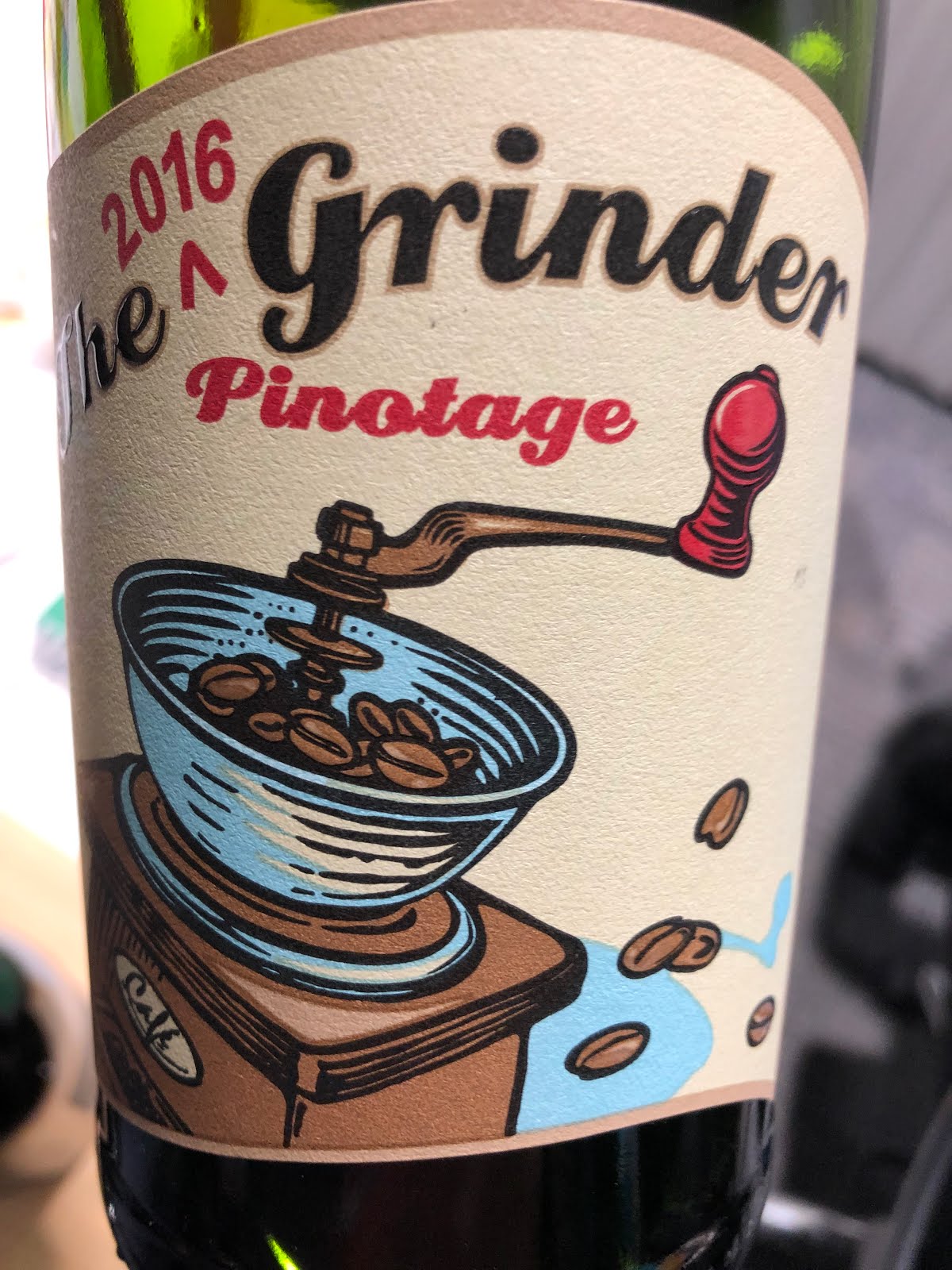

The other South African wine we had was their signature grape, Pinotage. Someone, a bunch of years ago, decide that, since it was too hot for Pinot Noir in South Africa, they should cross it with a hardier grape - say, Cinsault (also called Hermitage in South Africa).  They came up with what some call a franken-wine, Pinotage. It's got a bad rap - as many don't have the best taste - however, I have tasted a wonderful one in the Okanagan made my Stoneboat - but that's another story. The one we tried was a 2016 The Grinder Pinotage ($16). I would rather have another bottle of Beaujolais Nouveau, thanks. This did have a lot of aromas - cranberry, cherry, chocolate, coffee, gamey - and on the palate the coffee and blueberry tastes were rather intense. With high alcohol, it had medium acid, intensity, and body with a pretty short finish. I didn't mind it so much during my WSET 2 but now, it was just Acceptable.

A wine down under from a land down under.


Actually, Australia produces scads of wine and most of it is from the South East part. It's a hot country but there are lots of cool breezes to moderate the areas that grow wines that need moderating. Our first wine from Australia was a 2014 Mitchell Clare Valley Riesling. On the nose, it was, "WOW PETROL!" There was also rubber, pear, green apple and wet stone but I had a hard time getting past that petrol smell. On the palate, it was dry like most Australian Rieslings and had apple and spice - probably from lees stirring - as well as high acid, high alcohol, a medium finish, and a pronounced intensity of flavours. That petrol smell is a great indication that this is a developing wine tat could age a long time. It was rated as Very Good.


We had a Very Good Hunter Valley Semillon - which is an interesting wine. It is a rather neutral wine in its youth but develops amazing flavours of toast, nuts and honey. The one we had was a 2011 Tyrrell's Vat 1 ($68). I struggled with the notes on this - but there were notes of grapefruit, peach and brioche as well as some toast and honey. It had medium alcohol and medium plus intensity on the palate as well as high alcohol and a fairly strong finish. This wine could age for 10, 20, even 30 more years!


I do like a tasty Cab Sauv, as you may or may not have noticed from my blog. I love Bordeaux wines and I love Meritage blends from the Okanagan and I love big California Cab Sauvs. Well, add to that ones from Coonawara in Australia which may be hot but, man, they make great wine. We had a 2014 Yalumba "The Menzies" Coonawara Cab Sauv ($99). It was wonderful! On the nose was black currant, black plum, smoke, barnyard, black pepper, menthol and eucalyptus. On the palate, there was also spice and tobacco. This dry wine had strong tannins, high acid, high alcohol, almost full body, a medium plus finish and a pronounced intensity. It could definitely age for awhile and it was rated Outstanding - maybe a good splurge?


Australia has been famous for it's big, bold Shiraz wines - and so we tried a 2015 Glaetzer "The Bishop" Shiraz from the warm Barossa Valley ($51). This had some good aromas including blueberry, vanilla, pepper and black plum as well as an overall jammy taste. I don't mind a little jam but it does take it away from the "Outstanding" category. On the palate there was blueberry and charred wood as well as medium plus tannins and acidity. This wine was fine to age with its long  finish and strong intensity of flavours and was rated as Very Good. 

There are also more restrained Shiraz wines form Australia but we didn't try one  in class. 


Finally, we went to New Zealand. It's not a huge place but they make a heckuva lot of wine. On the cooler South Island is where Marlborough is - and that means, Sauvignon Blanc, New Zealand's most famous grape. We tried a 2017 Cloudy Bay Sauvignon Blanc ($36).  This wine had lots of green fruit, asparagus, grapefruit, and lemon on the nose with similar tastes on the palate. It had high acid, medium body, medium alcohol, and a pronounced intensity of flavour as well as a longish finish. This was a youthful wine and, like most Sauvignon Blancs, didn't have any ageing potential but was still a Very Good wine. 


Also from Marlborough, we tried a 2017 Villa Maria Pinot Gris ($22) which was OK. I also struggled with this one a bit but there were notes of peach, apricot, lemon, honey and floral aromas. This was an off dry wine and had high acidity, medium alcohol, as well as medium intensity and finish. Not suitable for ageing, this wine was rated as just Good. 


Finally, we had a wine, also from the South Island, but away from the effects of the ocean. From Central Otago we had a 2016 Matua Pinot Noir ($42 - pretty label award). This was a pretty standard Pinot Noir with red cherry, cranberry, and strawberry notes. It was mostly medium although it had a longish finish. Overall this was just a Good wine - and definitely not worth the price. 

Well, that's it for my WSET 3 classes. All that's left is the test. I have been studying hard and have these things to say on the three parts. 

The blind wine tasting: This all depends on my palate - some classes I have been bang on and some I have been right off. I need to focus on the aromas and tastes rather than trying to jump to conclusions and try to figure out the varietal. 

Multiple choice: I think this will be my strongest part. I have gone over the book many times as well as flashcards from me, my son-in-law Dan, and online cards. I have a very good general knowledge of wines of the world. 

Essay questions: This is my big worry. Even doing the few practice ones online, I find that I can't always think of everything that a question asks - and sometimes I draw a blank. I spent time today doing comparative analysis of the same grapes from different countries so I am hoping that will help me study for the last few days. 

I keep remembering what my classmate, Sarah, said during our tasting group and, again during last week's class - at the end of the day, we have learned so much about wine, tasted some fantastic wine, and met some wonderful people. 

But, damn it, I really want to pass!

Wish me luck...


Sunday, December 2, 2018

Come Together ... Right Now. ... Over Wine...

Red wines from our tasting nigh

I'm actually a bit behind in my WSET blog but I had such an enjoyable time this week, I thought I'd blog about a recent evening.

I was invited to a wine tasting evening with some of the people from my WSET class. Here's what comes to mind:

As the big test date looms nearer (less than two weeks), I have become more and more focussed on memorizing facts, practising questions, making charts and maps, and recording myself talking about important information and then playing it back.

Thursday night was a big break from that - and a reality check. Wine is not just about learning and memorizing information - it is about the social aspects of getting together with people, having a few drinks, talking, laughing and enjoying each others' company. Yes, we tasted and talked about the wines and commiserated about our mutual trepidations of the upcoming test but we also talked about each others' work and lives and history - the wine was a part of the evening but it was not the only part of the evening.

To paraphrase one member of the wine group, at the end of the day, we have learned so much about wine, have been exposed to so many wines, have a much improved palette and nose, and have made friends with a bunch of new people.  I want to do well on the test, but I've already had a rewarding experience, regardless of the result.

A great group of wine-experts-in-training.

There were four others in the group; Sarah, who sits beside me during my WSET class and is originally from London, Greg and Marilyn, also in my class, who are part of the family that owns Deep Roots Winery in Naramata, and Andrew, a very knowledgable wine-o-phile who was able to procure our wines for the evening. I really enjoyed spending the evening with these people and also enjoyed sipping and discussing the wines.


The first wine was a bit of a treat. It was a 1994 (yes, I said, 1994!) Moulin Touchais Coteaux du Layon Chenin Blanc from the Loire Valley ($57 on Vivino). This was a highly acidic, intensely sweet wine with tastes of honey, candied apricot, orange zest, almonds, and some earthiness like mushrooms, probably from botrytis. This Chenin also had the distinctive aroma of lanolin or wet wool. It was an amazing wine to start with but, because I was driving, I ended up dumping some of it in my spit cup (ugh!). Definitely an Outstanding wine. I really have grown to enjoy sweeter wines like this because they are balanced with the strong acidity - as opposed to stick sweet wines I had when I was younger like Baby Duck or Calona White.


The first wine was a bit of a teaser and we just enjoyed it without doing a serious tasting. Our second wine was the first real taste. I sort of sat back and watched what others did during the first two tastings but spoke up more after that. I actually guessed (in my head, of course) that this wine was a Torrontes but never said anything - so much for showing off. This was a 2015 El Porvenir Laroum Torrontes from Cafayate which is in the Salta region of Chile ($30). This had aromas and tastes of citrus fruits like grapefruit and lemon as well as peach and apple. It also had non-fruit aromas of fresh grass and honeysuckle. This youthful wine was medium in intensity, acid, alcohol, body and length and was rated as a Good wine which was ready to drink but not suitable for ageing. And, to be fair, Andrew did help us narrow down the wine varietal before I made my amazing guess (that I kept to myself).


Next was another wine that I guessed correctly after Andrew's coaching, again, in my head (what a chicken!).  This was a 2017 Granbazan Albarino Etiqueta Ambar from Rias Baixas, Spain ($40). I really got pineapple on this wine as well as stone fruits like peach and apricot. Unfortunately, I got a bit of vanilla on this which means I was fooled as this wine did not have any oak on it. When I taste a white wine, I am always trying to taste if there is vanilla or toast on it which is a product of oak ageing - and I seem to find it far too often! There was a floral aroma as well of orange blossom that some of the other tasters got but that I missed. I struggle with floral aromas and I probably should find some of these flowers in the next 10 days before my test! This light bodied wine had medium plus acidity, medium plus intensity, medium alcohol and a medium plus finish. Seafood would be a wonderful accompaniment to this wine and, although it is not suitable for ageing, it is ready to drink and is Very Good.


Every now and then, there is a wine that is so recognizable that I can place it immediately. The bubble gum, banana, and red liquorice aromas are unmistakably a Beaujolais Nouveau - in this case a fresh 2018 Louis Max ($20). This is a low tannin, medium minus body wine that's not strong in intensity and does not have a long finish but it is FUN to drink! I really like this style of wine, even though it is not exactly loved by some wine experts. It is easy to slurp back and is friendly enough to go with food that is really casual. Andrew completed his WSET test earlier this week and a Beaujolais Nouveau was the red wine for the blind tasting. I would be so happy if that were the case for our test! This wine is definitely ready to drink and should not be aged. It was a Good wine.


The next wine was a tasty one - a 2015 Klinker Brick Old Vines Zinfandel from Lodi, California ($40). I actually guessed this one too, but, wonder of wonders, I actually said something!  This had aromas of black currant, blackberry, blueberry, pepper, tobacco, cedar and jam. I thought there were some tertiary aromas of mushroom but that didn't seem to be the consensus of the group. I looked on Vivino later and some people did think there was some tertiary aromas like leather so I really am not sure if this was developing or not. This full bodied, high alcohol wine had a medium plus intensity of flavours and a medium plus finish and deserved a Very Good rating. Could you age it? I thought you could but who knows?


The last 'official' tasting wine was a 2014 Chateau de Jau Jaujau Cote de Roussillon red wine blend from the Languedoc Roussillon region of France ($48). We didn't know this was a blend which showed up in our differing notes. Some of us tasted black fruits and some red fruits and some both. On the nose, I found red plum, blueberry, and blackberry as well as black currant leaf, and cedar. This wine had medium plus body, a medium plus finish, and a medium intensity of flavours. A Very Good wine, it was a blend of Syrah, Grenach and Mourvedre. It was suitable for ageing - but was a bit pricey.


Greg and Marilyn brought a wonderful wine for our final, informal tasting. It was a 2014 Deep Roots Naramata Syrah (I think Greg said it was around $40 when released but there's none left now!).  I was asked, earlier in the evening, what my favourite wine was - I really do like Bordeaux so I went with that initially - but, having this wine, I was reminded that Syrah is another one of my favourite wines - especially Syrah done right - which this was. There were aromas and tastes of blackberry, blueberry, and black plum as well as smoke, tobacco, and a bit of leather. There was also some pepper on the nose. This wine was lovely - full bodied, strong intensity of flavours, and a wonderful long finish. I would rate this Syrah as Outsanding and could probably age for a few more years.

As we sat around and chatted and sipped from the remnants of wine, I reflected on how enjoyable an evening I had. We made some progress on our tasting and we discussed some of the more frightening aspects of our looming test but, by far, the most important thing was a group of people coming together over a common interest and having a great time doing it.

Cheers!


Friday, October 5, 2018

WTF! Wine Tasting Fiasco! WSET 3.5


This week's class marks the one third point in our course. I have been feeling pretty good about my tasting ability.

Until this week....

Our first wine region was the Loire valley. This is a big area that stretches from the ocean (maritime climate) to the centre of France (continental climate). The main grapes are pretty easy to remember. 3 blancs and a franc - Sauvignon Blanc, Chenin Blanc, Melon Blanc (or Muscadet) and Cabernet Franc. Some of the famous areas in the Loire include Chinon (Cab Franc), Muscadet and Vouvray Chenin Blanc).  There's also two really famous Sauvignon Blanc regions, Sancerre and Pouilly-Fumé.  A great deal for Sauv Blanc is in Menetou-Salon which has great wine but not the same expensive price.

Our first wines were the three whites. Unfortunately, I had a really difficult time figuring out which was which. For example, I thought the Sauv Blanc was Chenin Blanc until I tasted what I thought was Sauv Blanc - and it was sweet! Threw me off completely!

Oh well, here's the wines:


Our first was a wine that had gooseberry, flint, stone, lemon and grass on the nose. It was definitely a youthful wine that also had apple and pear on the palate. It was a 2017 Domaine Delaporte Chavignol Blanc ($38). This wine had high acidity, medium alcohol, and medium (+) intensity of flavour. We rated this wine as Very Good and was a 'drink now' wine. I initially thought it was the Melon Blanc.


The second of the trio was a 2017 Domaine de la Pepiere  Muscadet Sevre et Maine ($26) which is the best of the Muscadets. This Melon Blanc had peach, apricot, melon (ha! melon for a Melon Blanc!), lemon peel and a bit of grassiness on the nose with some yogurt flavours from being on the lees on the palate. Despite the time on the lees, I felt that although this wine was balanced and complex, it did not have a particularly long finish and was not all that intense so was rated as merely Good. This wine is good to drink now and is not suitable for ageing.  Unhappily, I thought this was initially a Chenin Blanc.


The final wine of my three initial errors was a 2016 Maison Darragon Hautes des Ruettes Vouvray made from Chenin Blanc ($28). By the way, if it says Vouvray on the label, it has to be Chenin Blanc. I really enjoyed this one as it had pronounced intensity and something that I had a hard time defining, on the nose. The smell was wet wool which is textbook for a Chenin Blanc. There were also aromas and tastes of ripe apple, honeysuckle, honeydew, and honey. It was a balanced wine that was pretty intense, complex, and had a fairly long finish. I would put it between Very Good and Outstanding. When I first smelled this one, I thought it was a Sauvignon Blanc because of the funky smell, By the way, if you're ever in the Okanagan, Road 13 makes an amazing Chenin Blanc sparkler.

As you can see, the first three wines did not go well. I fared better, however, with the next two.

Moving East and South from the Loire valley, we ended up in Burgundy, home to the world's most expensive wines. In Burgundy, they make Pinot Noir and Chardonnay and that's about it. The north part does mainly Pinot Noir and the south part does mainly Chardonnay, although there are exceptions. Beaujolais is actually considered part of Burgundy but it's such a different kind of region, I have separated it out.

The first two wines were Chardonnay wines. Chardonnay is made from such famous places as Chablis, Mersault, Puligny-Montrachet and Chassage-Montrachet. I was able to figure out which was from Chablis and which was from the Cote de Beaunne - thank goodness something went right this week!


The first of these wines was a 2017 Jean-Paul and Benoit Droin Chablis ($58).  This had tastes of apple, grapefruit, lemon, butter and stone and was a high acid, bone dry wine. It was balanced, had complexity and was fairly intense but lacked a long finish so we gave it a Very Good rating (and a pat on the back for my first correct wine of the night). Drink this one now as it is not suitable for ageing!


The second wine was heaven! This one was a 2014 Chassagne- Montrachet ($131) and is a Monopole wine which means that this is one that the negociant produces from their own vineyards and is their flagship wine. There was a lot of different fruit going on here but the best was the secondary and tertiary characteristics such as vanilla, butter, roasted nuts, mushroom and popcorn. It had all the hallmarks of an Outstanding wine and was one that you could drink now but wold also really benefit from ageing.

Staying in Burgundy, we then looked at some Pinot Noir. There are many different houses that make first rate Pinot Noir including Gevrey-Chambertin, Nuits St. Georges, and the incredible but incredibly expensive, Pinot Noir. Domaine Romanee Conte which is a winery that demands some of highest prices for a bottle of wine anywhere.

Unfortunately, I was back to my old tricks again and mixed these up!


The first was a 2015 Joseph Faively Bourgogne Pinot Noir ($32). This had a fair bit going on including red plum, cranberry, cedar, smoke, and red cherries. On the palate, there was a pronounced intensity of flavours. It met some of the criteria for the assessment of quality and was rated Good.


The other Pinot Noir was a 2015 Domaine Daniel Rion et Fils Premier Cru from Nuits St. George ($100). This wine also had some great fruit on it including red plum, raspberry, cranberry, strawberry, and something vegetal - mushroom? - as well as strong tannins. This wine was less austere than the first one (which is maybe why we guessed wrong) and has some wonderful fruit flavours. Despite the age on it already, it would definitely benefit from ageing. It was rated Very Good - bordering on Outstanding.

I was on more solid ground for the last two wines. One was from the Loire - from Chinon - so a Cab Franc - and one was from Beaujolais - so a Gamay Noir. Beaujolais is one of those wines (like Pinot Noir) that's a great one to order if everyone at a restaurant orders something different. There's also Beaujolais Nouveau which is released this year on November 15th. It is a super light, bubble gummy wine (from carbonic maceration) and is supposed to be lots of fun - I've never had a Beaujolais Nouveau so I will definitely try it out next month. 


The Beaujolais that we did have was a 2016 Close de Roilette from Fleurie ($30), one of the ten crus of Beaujolais. It had flavours of stewed fruit, black cherry, bubble gum, and a bit of pepper. There was medium tannins, alcohol, and intensity with maybe a bit higher than medium acidity, It was very good but should be consumed now.

Courtesy BK Wine Photography
Fun fact - most vines in Beaujolais are trained in the gobelet style where the spurs are pushed up and tied together - sort of like braiding your hair and tying the braids together on the top of your head. 


The final wine was a 2016 Bernard Baudry Les Granges Chinon from the Loire valley ($27). It had flavours and aromas of black currant, red plum, eucalyptus, and smoke. This wine was high in acid and in tannins and had some cedar on it as well that meant it could age. It wasn't all that balanced and the length was OK so the question would be, would you bother ageing it as it was only a Good wine? 

Good question.

And so, my evening ended with me mis-identifying 5 of the 9 wines and missing out on a variety of aromas - or just getting them wrong. I will definitely have to refine my palate over the next few weeks. 

Will Taste Feverishly.


Friday, September 21, 2018

Hands up! A wine class disaster ends up being sweet - WSET 3.3


My third  WSET 3 class was a bit of a disaster - at least at the beginning.

One of the things I look forward to is having a poké rice bowl before class at Pokerito. I left at 4:30, thinking I would get to BCIT in 45 minutes and, because there would be no line up that early, would have a good 30 to 40 minutes to enjoy my tasty dinner.

Unfortunately, it didn't work that way.

By the time I got to BCIT, it was after 5:30. I rushed to Pokerito and there was a line up of about six people. I finally got my bowl and then rushed back to BCIT and started gobbling down my meal. Then, Sarah, from last week, sat down across from me in the outer area and I couldn't be rude so I picked at my dinner while we chatted.

When I went into the room for the study session, things went pretty well until it was time to answer the study question. Unfortunately, I have already lost my name card so the instructor looked my way and called on 'Doug' to answer. I corrected her and then answered - problem is, the guy sitting across from me is actually named Doug and that's who she meant to call on!

Ugh!

This week's focus was on making wine - red, white, rosé and sweet. Although this is an area that I am familiar with, especially since I made wine in my basement for a few years, there are still many things such as winemaking options and the ways that specific varietals are treated that I really have to study. One thing that irked me - I took copious notes on the specific varietals and our instructor didn't go over it that much, although she alluded to the information during the tastings.

My notes that I made from the readings were pretty thorough and I used them to follow along during class. There's a lot of content, especially this past week, but I am hoping that the countries and regions, which are the focus for the next ten weeks or so, will be a bit easier to remember and give some context for what we have learned so far.

Onto this week's tastings....

The idea behind the tastings this week was to  try and figure out the choices made in the vineyard and by the winemaker. It was really difficult! Luckily, this isn't a focus on the tasting exam but it was good to try and be aware of the choices.

The first two wines were white wines.
Courtesy Cuvée Corner Blog
The 2015 Veramonte Sauvignon Blanc from Casablanca, Chile ($18) was a grassy almost clear wine. It had some citrus aromas and tastes such as grapefruit and lemon, was light bodied, and had high acidity. It was made without any oxygen (anaerobically) to preserve the fruitiness of the wine, has no oak, and was fermented at around 16 or 17°C. Ready to drink now, this wine was not terribly balanced, had a fairly short finish, had acceptable intensity, and was not a complex wine. This we rated as acceptable.


In contrast, the 2016 Mer Soleil Chardonnay from the Santa Lucia Highlands ($39) was much better. There were some interesting flavours and aromas including peach, nectarine, apricot, and vanilla. It was a wine that was fermented aerobically (with some oxygen). was oaked, had a bit of age on it, and was fermented at a higher temperature. It was a balanced wine with a long finish and great intensity but was not overly complex. This was rated as very good.

The next two wines were red wines.


The first was a Georges DuBoeuf Beaujolais made from Gamay ($16). I was a bit stumped on what this even was - some of my group thought pinot noir but I thought it was something else - but not merlot, cab sauv, or cab franc.  I remember drinking this for a while back before I really knew all that much about wine but near the end of my own wine making experience. It was a wine with black and red fruits as well as a candy or bubble gum taste. The main winemaking option was carbonic fermentation where the bunches of grape ferment in CO2 in a closed vat. This gives fruitiness, more colour and less tannins. Ready to drink, this wine was acceptable.


The second of this set was a 2011 Brovia Villero Barolo Nebbiolo ($124). I tasted a lot of red fruit on it which made me think it was a Pinot Noir but our instructor noted high tannins, mushrooms, violets, liquorice, and roses. This wine had gone through pre and probably post fermentation maceration (where the grape skins stay in the juice), cap management (where the grape must is punched down on a regular basis), oak, and light extraction of flavours. After Elena, our pourer, mentioned that it was an unexpected grape and gave the hint, "it's a wine that's old when it's young," I knew it was Nebbiolo! This wine was good to drink now but could spend lots more time in the cellar. This was an outstanding wine!

The next two wines were the same grape but treated (wildly) different. The grape was Zinfandel.


The first was a 2017 Gallo Family White Zinfandel ($9). This medium sweet Rosé was invented by Bob Trinchero in California and was the result of a mistake! I listened to this podcast recently on Grape Nation and actually enjoyed finding out the story behind this super sweet wine. That said, it is not my favourite wine. This acceptable wine is medium sweet with low alcohol, light body, candy red fruit and vanilla. In the winery. it was directly pressed with a short maceration and had the fermentation stopped so that not all of the sugar turned to alcohol, creating a sweet wine.


The second Zinfandel was a 2014 Ridge East Bench Zinfandel from Dry Creek, Sonoma ($63). This definitely had some oak on it as there were tastes of raspberry, cloves, liquorice, blackberry and spice. This high alcohol wine was dry, had good acid, and medium tannins - it was intense, complex and had a long length. We rated this wine as very good.  

Our final two wines were sweet wines. People often think that sweet wines (like the above White Zin) are for beginning drinkers and, if you can't feel the enamel coming off your teeth, it isn't a dry enough wine. I have since discovered, however, that there are sweet wines that are complex and wonderful and are wines for connoisseurs!


The first one, which I guessed correctly, was an ice wine. It was a 2015 Arrowleaf Vidal Ice Wine ($56 for a half bottle). This had some complex flavours including peach, nectarine, honey, fig, raisin and vanilla. Its sweetness was kept in check by its high acidity.The winemaking process included no oak, pure flavour and some pear drop flavours which would indicate lower temperature fermentation. I'm not a huge fan of ice wine but this one was pretty darn good.


The final wine was a lusciously sweet recioto - a 2014 Ben Ryé Donnafugata Passito di Pantelleria from Italy ($54 for half a bottle). With Recioto wines, the grapes are picked, then laid out in the sun and they become raisins, concentrating their sugars. This is called Passito style. When it is fermented, the fermentation is stopped early (unlike Amarone, another Passito style) so it is very sweet - but also highly acidic. This wine, made from Muscat, is definitely oxidized in the winemaking process (the colour was actually amber) and had considerable oak. The flavours including orange peel zest, raisin, fig, and marmalade. It was very tasty! This is my first Recioto but will definitely not be my last! Bonus - it supposedly pairs really well with chocolate!

Saturday, May 6, 2017

Don't wine about your homework!!


I have mixed feelings about homework.

As a kid, I did not like it and would procrastinate and complain and wheedle to avoid having to do it....

....except when it was a project I really enjoyed. I remember when I was in Grade 5 or 6 and I did a project on the history of Vancouver. This was long before the time of the internet and I had to work really hard to find old photos and find information of how the city began and grew.  I spent hours writing in my best handwriting, cutting and pasting photos, and drawing my own versions of maps and pictures. It was a labour of love.

Now that I am a teacher, I still have mixed feelings. On one hand it teaches students independence and study skills. On the other hand, it has little research to validate the practice and can be an endless battle of compliance. But, every so often, a student gets so into a project that they are happy to do hours of extra work at home.

Our homework this week in wine class for the WSET Level 2 course was another absolutely enjoyable one. We were supposed to drink a wine from a warm climate and a wine from a cool climate.

Today we were at my father-in-law's to help him sort through his collection of family heirlooms.  He encouraged me to select some wine for dinner so I chose a red and a white that I hoped would go with pulled pork sandwiches. I also hoped to fulfill my homework requirements!


The first was a Beaujolais from Georges DuBoef ($13.99). I had chilled the wine earlier, hoping to get it near the optimal temperature of 13°C. I used to think that Beaujolais was a grape varietal, even when I made wine in my basement, but more recently found out that the Gamay Noir grape is the varietal for Beaujolais. It was my hot climate wine but I later found out that Beaujolais is more of a moderate climate wine.

The colour was ruby and was pale.

The nose was medium to pronounced - so I guess I'd have to settle on medium. It was fairly complex for a Beaujolais as I tasted red cherry, plum, cranberry (sort of like craisins), raisin and strawberry jam.

I tasted similar flavours on the palate with light tannins, medium acidity, and light body. The wine had a rather short finish which was a bit disappointing.

Looking at the BLICE rating - it was balanced, not long, not that intense, somewhat complex and probably expressive for the region. I would rate it as Good or even Very Good.


The second was a cool climate wine - even though it comes from the Okanagan! I consider the Okanagan a hot place in the summer but, thanks to its cool nights and plentiful lakes, I think it is actually considered cool. Possibly I really screwed up and ended up picking two moderate wines....

The wine was an Ancient Hill  Gerwurztraminer from 2011 (not sure of its value but a 2014 goes for $16.50). It was a clean wine, lemon in colour, that was pale.

On the nose was green apple, lemon and floral notes.

On the palate, apple, caramel, and buttery flavour, and flowers. The body was medium body and had a medium finish.

According to BLICE, it was balanced well, had OK length, was not terribly intense, was not overly complex and was pretty expressive for its region.

I would rate this one as Good.

Ah, Homework!


Thursday, April 27, 2017

Wine Tips From the Master - WSET Class 1 - Part 2

After a brief break (checking to make sure I hadn't spit Riesling down my shirt), the owner of Fine Vintage, James Cluer, Master of Wine, spoke to our group. He is an interesting speaker and I would be happy to have him as a teacher in a future course.

He talked about a few things but what stuck with me were his tips - and here they are:

  • concentrate - really concentrate - on the first smell you have of the wine
  • "two sips and you're out" - by the time you get to the third sip, your palate has become used to the wine and you will start to miss flavours
  • move the wine up and down your mouth, and rub your tongue across the roof of your mouth to check for tannins
Then we started tasting some reds......

The first was purply and pale (I thought it was deep but realized that if you can see the page underneath on a piece of paper, it's pale). It was light in intensity and had lots of red fruits in it. It was high in acidity and had a short to medium finish. I also tasted tannins - but that was an error. The problem is that when you have had white wine and it is still on the palate, even a mild red wine will taste of tannins. "First red wine of the day, you will taste tannins."

This wine was a Bouchard Aîné and Fils  Beaujoulais from France which is made from the Gamay Noir grape. it was a 2015 that goes for $14. 


The wine we compared it to was actually garnet (sort of an orangey red colour) and was pale ( I was wrong again). Although the nose tasted of red fruit, once I tasted it, black fruits like cherry and baked prunes seemed to show up. It was high in tannins (blew the Beaujolais away) and high in acidity and was really full bodied. It had a long finish and was a very good wine. 

This was a Comm G.B. Burlotto Barolo - made from the Nebbiolo grape from Italy and was a 2011 - and came in at $86. 

Comparing the two, the Barolo was wonderful but would be more difficult to pair - it would need to go with a steak or some game. The Beaujolais, on the other hand, would pair with many things including some fish, chicken, pork, pasta and pizza! 

The next two wines were the same type of wine but differed rather slightly in quality!

The first was a clear, rather simple wine with some nice red fruit taste but with a rather short finish. This was a Chartron La Fleur Bordeaux from the Right Bank - so, it was merlot based. There was nothing wrong with it, it was just a bit simple - and so was the price, $14. Sorry, but I couldn't find a link for this winery.


Then we had a bottle of liquid gold. It was a Chateau Bonalgue Pomerol from 2010, also from the Right Bank of Bordeaux. This was a wine with colour so deep that it was difficult to tell what colour it actually was. It, too, was a merlot blend, It had a pronounced nose and tasted of black fruit, tobacco, and high tannins. It was far more complex than the other Bordeaux and had a great long finish.  This wine was one that I would love to drink regularly - unfortunately, I don't think I can afford the $115 a bottle price!


Our final wine of the night was a Sauternes - and it was a wine like I had never had before! This is because it had "nobel rot"! Noble rot or Botrytis is a fungus that causes grapes to partially dry out like raisins which lets them be very sweet. It was a clear wine with a pronounced nose (mushrooms, nectarine), sweet taste, and high acidity (I'm realizing that every wine that is sweet also has high acidity to keep it in balance).  It was suggested that this would be a great wine to have with something spicy. 

The wine was a 2003 Sauternes from La Chapelle LaFaurie-Peyrague and, although not quite my cup of tea (or cup of wine) I did appreciate the age and nice flavours the wine had. This was $33 for a half sized bottle.

Overall, my first class was great - I learned some new things about wine tasting and wine pairings but the real excitement for me was the 9 wine tastings. That is apparently something that only Fine Vintage does - extended numbers of wine tastings each class. The other thing they do is extend all of the classes from two hours to three hours - and I think that is a brilliant idea. Can't wait until next week!

Time to Taste an Albariño from Catalonia, Spain!

  Today we're drinking an Albariño — but there's an interesting twist. This 2024 Raimat Albariño doesn't come from the cool, Atl...