Showing posts with label new zealand. Show all posts

Sunday, December 9, 2018

Final Thoughts Before the Big WSET3 Exam - Wines from Australia, New Zealand, and South Africa - WSET 3.12, 13 and 14

Taking a Beaujolais Nouveau break between studying.

I've been so busy studying the last few weeks that I'm a bit behind. My exam is on Wednesday - two blind tastings, 50 multiple choice, and 4 essay questions.

And, no, I don't think I'm ready.

But we shall see, soon enough!

The last two weeks were a bit of a whirlwind of mock blind tastings, mock questions and looking at a variety of wines. Last week was Port, Sherry and Fortified Muscats while the week before was Sparkling. They were interesting and I did try some good wines but we tended to rush the actual tastings too much to allow for time to practice. I may cover some of those wines down the road but not right now.

This entry, I want to cover the last actual wine class - Australia, New Zealand and South Africa.


But first... we tried a simple red for the blind tasting that night - a 2018 Georges Du Boeuf Beaujolais-Villages Nouveau ($20). I have to say that I really did enjoy this slurping wine made from Gamay. It was great to taste the bubble gum, cinnamon, and banana that is characteristic of carbonic fermentation - that's when the fermentation vessel is kept oxygen free and the grapes start to ferment from their insides. They split open and then the whole mess is pressed and continues to ferment until ready. Tannins? Nope! Structure? Nope! Super easy drinking? Yup!


South Africa has some very hot climates but thanks to cooling currents from the ocean and higher altitudes, they also have a lot of wine production. One of the biggest grapes is Chenin Blanc which can be sweet or dry. The one we tried was a 2017 Cape of Good Hope Van Lill and Visser Chenin Blanc ($36). This youthful wine (and that was tricky - I thought it might age) had notes of grass, lemon, vanilla, toast an green apple. It was a dry wine with a long finish and high acid (characteristic of Chenin Blancs) and was rated as Very Good.
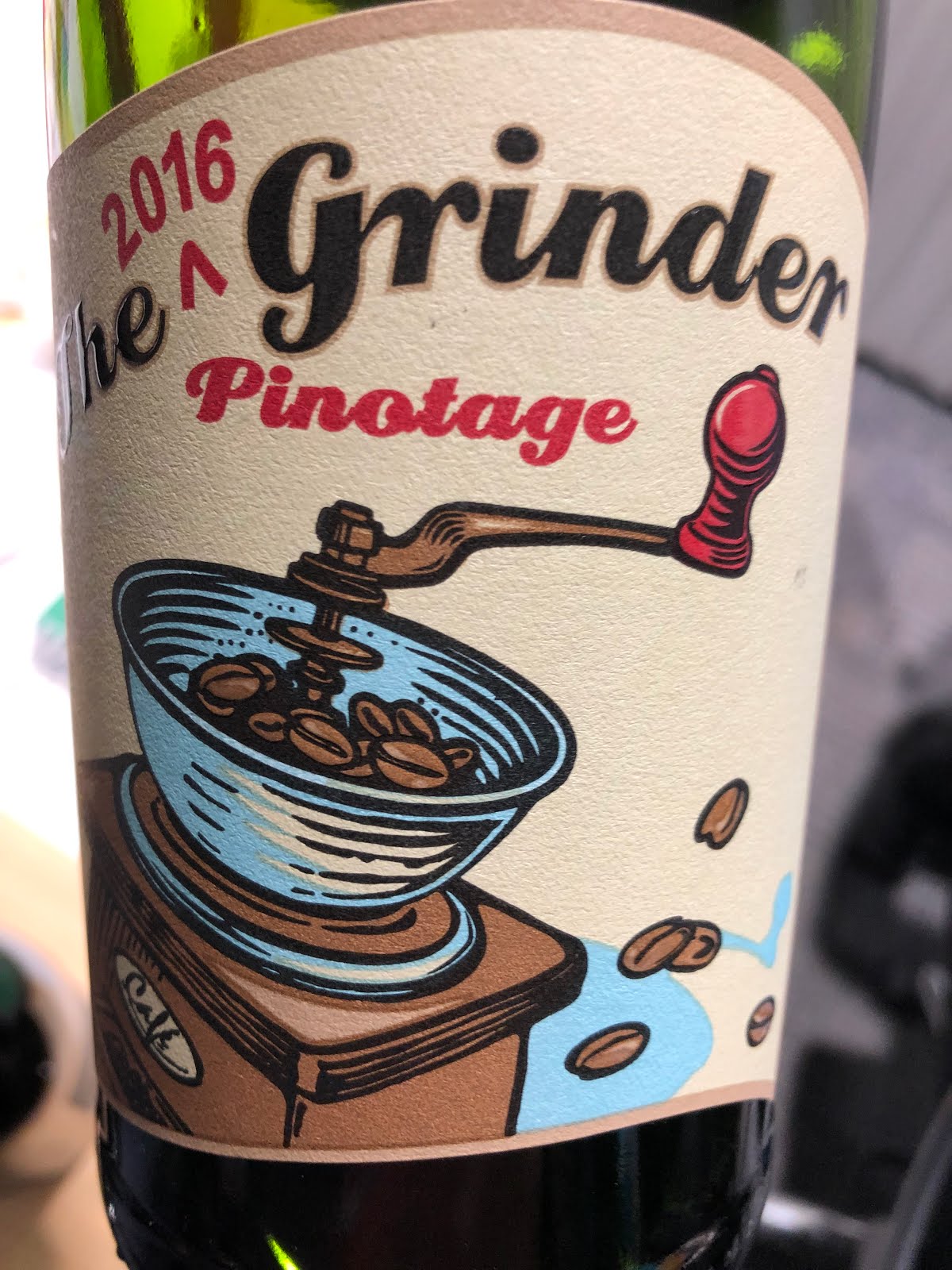

The other South African wine we had was their signature grape, Pinotage. Someone, a bunch of years ago, decide that, since it was too hot for Pinot Noir in South Africa, they should cross it with a hardier grape - say, Cinsault (also called Hermitage in South Africa).  They came up with what some call a franken-wine, Pinotage. It's got a bad rap - as many don't have the best taste - however, I have tasted a wonderful one in the Okanagan made my Stoneboat - but that's another story. The one we tried was a 2016 The Grinder Pinotage ($16). I would rather have another bottle of Beaujolais Nouveau, thanks. This did have a lot of aromas - cranberry, cherry, chocolate, coffee, gamey - and on the palate the coffee and blueberry tastes were rather intense. With high alcohol, it had medium acid, intensity, and body with a pretty short finish. I didn't mind it so much during my WSET 2 but now, it was just Acceptable.

A wine down under from a land down under.


Actually, Australia produces scads of wine and most of it is from the South East part. It's a hot country but there are lots of cool breezes to moderate the areas that grow wines that need moderating. Our first wine from Australia was a 2014 Mitchell Clare Valley Riesling. On the nose, it was, "WOW PETROL!" There was also rubber, pear, green apple and wet stone but I had a hard time getting past that petrol smell. On the palate, it was dry like most Australian Rieslings and had apple and spice - probably from lees stirring - as well as high acid, high alcohol, a medium finish, and a pronounced intensity of flavours. That petrol smell is a great indication that this is a developing wine tat could age a long time. It was rated as Very Good.


We had a Very Good Hunter Valley Semillon - which is an interesting wine. It is a rather neutral wine in its youth but develops amazing flavours of toast, nuts and honey. The one we had was a 2011 Tyrrell's Vat 1 ($68). I struggled with the notes on this - but there were notes of grapefruit, peach and brioche as well as some toast and honey. It had medium alcohol and medium plus intensity on the palate as well as high alcohol and a fairly strong finish. This wine could age for 10, 20, even 30 more years!


I do like a tasty Cab Sauv, as you may or may not have noticed from my blog. I love Bordeaux wines and I love Meritage blends from the Okanagan and I love big California Cab Sauvs. Well, add to that ones from Coonawara in Australia which may be hot but, man, they make great wine. We had a 2014 Yalumba "The Menzies" Coonawara Cab Sauv ($99). It was wonderful! On the nose was black currant, black plum, smoke, barnyard, black pepper, menthol and eucalyptus. On the palate, there was also spice and tobacco. This dry wine had strong tannins, high acid, high alcohol, almost full body, a medium plus finish and a pronounced intensity. It could definitely age for awhile and it was rated Outstanding - maybe a good splurge?


Australia has been famous for it's big, bold Shiraz wines - and so we tried a 2015 Glaetzer "The Bishop" Shiraz from the warm Barossa Valley ($51). This had some good aromas including blueberry, vanilla, pepper and black plum as well as an overall jammy taste. I don't mind a little jam but it does take it away from the "Outstanding" category. On the palate there was blueberry and charred wood as well as medium plus tannins and acidity. This wine was fine to age with its long  finish and strong intensity of flavours and was rated as Very Good. 

There are also more restrained Shiraz wines form Australia but we didn't try one  in class. 


Finally, we went to New Zealand. It's not a huge place but they make a heckuva lot of wine. On the cooler South Island is where Marlborough is - and that means, Sauvignon Blanc, New Zealand's most famous grape. We tried a 2017 Cloudy Bay Sauvignon Blanc ($36).  This wine had lots of green fruit, asparagus, grapefruit, and lemon on the nose with similar tastes on the palate. It had high acid, medium body, medium alcohol, and a pronounced intensity of flavour as well as a longish finish. This was a youthful wine and, like most Sauvignon Blancs, didn't have any ageing potential but was still a Very Good wine. 


Also from Marlborough, we tried a 2017 Villa Maria Pinot Gris ($22) which was OK. I also struggled with this one a bit but there were notes of peach, apricot, lemon, honey and floral aromas. This was an off dry wine and had high acidity, medium alcohol, as well as medium intensity and finish. Not suitable for ageing, this wine was rated as just Good. 


Finally, we had a wine, also from the South Island, but away from the effects of the ocean. From Central Otago we had a 2016 Matua Pinot Noir ($42 - pretty label award). This was a pretty standard Pinot Noir with red cherry, cranberry, and strawberry notes. It was mostly medium although it had a longish finish. Overall this was just a Good wine - and definitely not worth the price. 

Well, that's it for my WSET 3 classes. All that's left is the test. I have been studying hard and have these things to say on the three parts. 

The blind wine tasting: This all depends on my palate - some classes I have been bang on and some I have been right off. I need to focus on the aromas and tastes rather than trying to jump to conclusions and try to figure out the varietal. 

Multiple choice: I think this will be my strongest part. I have gone over the book many times as well as flashcards from me, my son-in-law Dan, and online cards. I have a very good general knowledge of wines of the world. 

Essay questions: This is my big worry. Even doing the few practice ones online, I find that I can't always think of everything that a question asks - and sometimes I draw a blank. I spent time today doing comparative analysis of the same grapes from different countries so I am hoping that will help me study for the last few days. 

I keep remembering what my classmate, Sarah, said during our tasting group and, again during last week's class - at the end of the day, we have learned so much about wine, tasted some fantastic wine, and met some wonderful people. 

But, damn it, I really want to pass!

Wish me luck...


Thursday, August 31, 2017

Hosting a Wine Tasting Party - How It Went!


Everything was almost ready - the pulled pork smelled heavenly, the cheeses were all laid out, water on the table, wine tasting mats all ready. I just needed to put the tasting glasses out that I had bought at IKEA. OK - ten guests means 2 glasses each so 20 glasses....

Oh no, I only have ten! Ugh....

Luckily, I had bought some other glasses that I was going to use for after the tasting but they would have to be tasting glasses as well!

The guests arrived, bringing the required bottle of wine as well as a tasty cheese and some crackers. Luckily, all arrived around 6pm and I had them drop off their cheese and wine at the kitchen counter and have a seat at the table where everything was set up.

I explained the tasting mat and what we could do to help us compare the wines. Above all, I cautioned, this is about friends getting together and having fun - and that is exactly what happened!

I had purchased wine pourers from the local liquor store - and these helped a lot. They slowed down the rate of wine coming out of the bottle and looked very professional as well! I bought two different colours so it was easy to differentiate who was pouring which wine. All wines were placed in paper bags with a label of what kind of wine it was. Due to the rather warm day (26°C.) the Sauvignon Blancs were refrigerated until needed, the Pinots were refrigerated for 20 minutes before serving, and the Shiraz wines were refrigerated for just 7 minutes.

The first two wines were Sauvignon Blancs. I didn't know if there were any big drinkers of SB but I thought that this would be a good one to start off with.


The first was an 2016 Oyster Bay Sauvignon Blanc ($20)  from New Zealand. It tasted crisp and had nice fruit flavours with some complexity. It was medium in intensity and our group rated it between Good and Very Good. One of our number, Anna, said that she thought is was a Sauvignon Blanc from New Zealand - Oyster Bay! Truly amazing! Apparently that is one of her 'go to' wines but, still!


The second of the pair was a 2016 Les Fumées Blanches ($15)  from France. It is a Vin de France so is classified as table wine. This Sauvignon Blanc had a low intensity nose and lacked much of the fruit and flavours of the Oyster Bay. There was a subtle minerality underlying this wine but the overall taste was just not that great. Combined with a short finish, it was a bit of a disappointment.

Of our group of ten, nine were in agreement that the Oyster Bay was the better Sauvignon Blanc due to its nose, taste, balance and complexity.

The second two wines were both Pinot Noirs, one Old World,, and one New World.


The first was a local wine from the Okanagan - a 2016 See Ya Later Ranch Pinot Noir ($20). It had some very nice red fruit both on the nose and on the palate. It had a good long finish and was fairly complex. This was a very enjoyable Pinot Noir and was rated Very Good.


The second was a 2014 Joseph Drouhin Pinot Noir from Burgundy ($26). I had bought this one and I thought that it would be a great choice. As it turned out, it was Ok but the flavours seemed a bit too subtle and a bit overwhelmed with the acidity of the wine. There was almost an astringent taste on the finish which was really noticeable to most of us. The harsh finish and lack of real character put this one between adequate and good - it wasn't balanced, nor complex, nor had a good finish. The aroma was a bit intense and the wine was somewhat expressive of Pinot Nor.

Overall, it was another no brainer - nine of ten agreed that the Okanagan Pinot Noir was much better due to its taste, complexity, finish, and balance.

Our final two wines were Shiraz/Syrah. I had intentionally gone from less bold wines to more bold wines so I felt that the Shiraz/Syrah would be a nice way to finish off.


The first was a 2011 Domaine des Lises (no website found - owned by Maxim Graillot)  Crozes-Hermitage ($34) that I also had bought. I had purchased a Crozes-Hermitage last month (surprisingly, an Ogier Heritage Crozes-Hermitage - might have been a 2012) and it was super disappointing - flabby, watery and characterless. I was worried about shelling out $34 for what could be another stinker but thought I'd give it a try.

This was a whole different animal. It had great structure, complex taste of black cherries, black berries and tobacco. The only thing that really stopped it from being an outstanding wine was the fact that it smelled like canned peas! Yes, that's right - canned peas! Once you got through that initial aroma, however, it was an amazing wine. Actually, it was a little short on the finish as well. Still, a Very Good wine.


The second Shiraz was a 2015 Shingleback Red Knot from the McLaren Vale of Australia ($20). This started out very promising with a great bouquet but lost that boldness on the palate where it was rather average. It had some structure but not a lot of complexity of flavours. For all that I've heard of Australian Shiraz's, this one was not overly impressive. It did have a nice, deep, dark purple colour, though. This was rated as a Good wine.

Finally, in the third round, France came up with a victory. This was a bold drinking wine that would do justice to barbecued meats and even a nice, juicy steak.

After our tasting, I set up the bottles with the remaining wine ( about half in each) and we had a variety of cheeses while we chatted, discussed the wines, laughed, and generally had a great time. Another hour later, we brought out the pulled pork and cole slaw and our guests tucked into this offering. Finally, another hour later, out came the peach crisp, coffee, tea and some nice port.

It was past eleven when the last wave of guests left. I high-fived my wife after such a good evening and we went to bed, content in our first-time hosting of a wine tasting party.


Wednesday, May 17, 2017

Sauvignon Blanc- not just cat pee - Carmenere, and Malbec - WSET Class #4 - Part 1

I left early for this week's class. I had a couple errands to do but I figured I would have time to try out a new place that my wine group had told me about. Unfortunately, by the time I got to Pokéritto, there was a giant lineup and I was running out of time. I ended up at Tim Hortons for a chicken wrap which was rather tasteless and I could only choke down half. What do you pair with disappointment?

A few minutes later, sitting in class, Rajen (the guy whose family owns Desert Hills), asked our table group if we were interested in joining a monthly tasting group. I definitely agreed and am actually looking quite forward to it. Each person brings a bottle of wine in a paper bag and then the group does a blind tasting. Sounds like fun!

Our table group is quite friendly now, especially after discussing all of the different wines that we have tasted. Some of us shared about our weekends as well as other small talk.

This week we looked at a bunch of wines. The first two were the white wines Sauvignon Blanc and Semillon.  By the way, Sauvignon Blanc has a bit of a reputation of smelling like cat pee. I guess I haven't smelled enough cats peeing because I didn't really notice it....

Sauvignon Blanc is a very aromatic white wine which is usually dry and is a crisp wine that ranges in taste from grassy (think fresh cut grass) to tropical aromas. It is found in many places in the world, mostly in cooler or moderate areas. It is also found in Bordeaux and is one of only three white wines in Bordeaux. In the New World, New Zealand is the place that grows great Sauvignon Blanc. Unlike Chardonnay, it is much more consistent in its taste. Interestingly, it is one of the few wines that is supposed to pair well with sushi.

Semillon is a much more neutral grape that is sometimes added to Sauvignon Blanc. Sauvignon Blanc doesn't age very well but Semillon ages really well and blends well with Sauvignon Blanc. Semillon is also found in Bordeaux.

Our first tasting had three wines - one was a Semillon, one a Sauvignon Blanc from Bordeaux and one a Sauvignon Blanc from New Zealand.


The first was a wine with a pronounced nose with aromas of stone fruit, green apple, green pepper, grass, and floral hints. On the palate, it had the same flavours as well as  grapefruit and some smokiness. It was definitely dry, had high acidity, medium body and a medium plus finish. It was rated as Very Good and was a 2015 Bordeaux Sauvignon Blanc from Sancerre by Hubert Brochard and had the name Terroir de Silex. This wine had definite aging potential and cost $40.


The second wine also had pronounced intensity and had aromas and flavours of bell pepper, mint, green apple, tropical fruit ( I noticed pineapple), and peach. It had high acidity, medium body and a medium minus finish. It was also rated Very Good and, I think, was one of Dave, our instructor's, favourite Sauvignon Blancs as he was wearing a t-shirt from the winery! It was a 2015 Spy Valley from New Zealand priced at a mere $21. It was a very agreeable wine and our group enjoyed it.


The final wine tasted different than the first two - that was the first hint that this was a different wine. Where the other two were pale, this was medium in colour. It was a medium intensity wine on the nose with aromas and flavours of cut grass, apples, green peppers, smokiness, and toast - even though it was unoaked! It had medium body, high acidity, and a medium plus finish. It was Very Good. It was, of course, the Semillon. It was a 2009 Peter Lehmann from the Barosa Valley ($32). Semillon on its own is best aged and this particular winery only releases it aged - so it basically ages in the bottle for seven or eight years before being released. In fact, Semillon in general should age from seven to ten years before popping the cork!

The next post will deal with more Bordeaux wines but I will fast forward to the last two.

We spent some time looking at some other red grapes that originated from Bordeaux but were not that important in Bordeaux anymore. Both Carmenere and Malbec have been adopted by two different countries, Chile and Argentina, respectively.

The Carmenere grown in Chile was originally thought to be Merlot as Carmenere had basically been wiped out everywhere else in the world thanks to a virus. It makes purple wine and tends to have a bit of mint to its character.

Malbec is Argnetina's signature grape and has very dark fruit. It also makes purple wine and is a bit spicy, sort of like Syrah.


Our first tasting was deep purple and had a medium plus intensity on the nose. I noticed spice, black currant, cassis, prune and a general aromatic nose while there was black cherry and even toast on the palate. It was a full body wine with medium acidity and tannins and a medium plus finish. This 2013 Carmenere from Vina Tarapaca was rated as Very Good and cost $25. The words "Gran Reserva", however, don't have a great deal of meaning when it comes to Chilean wines. This wasn't a particularly popular wine with my table group but I didn't mind it too much.


The last wine was, of course, a 2014 Malbec from Catena in Argentina ($24). It was a medium to deep purple had a much lighter intensity nose than the Carmenere. I found it really hard to discern aromas and flavours but did come up with red fruit such as red currants. It had light tannins, medium body and medium acidity with a medium finish. It was rated Good. I have had quite a few different Malbecs and this one just wasn't that great to some of the others that I have had.

Next time, the tasting will look at Bordeaux reds - some of my favourite wines in the world!


Time to Taste an Albariño from Catalonia, Spain!

  Today we're drinking an Albariño — but there's an interesting twist. This 2024 Raimat Albariño doesn't come from the cool, Atl...