Showing posts with label carmenere. Show all posts

Tuesday, June 11, 2019

Tasty Reds from Australia and Chile - Both Under $20!

Before wine tasting, we always paint plein air. This week was Kanaka Park in Maple Ridge.

Almost twenty years ago I went on a teacher exchange, with my family, for a year. Being Canadian, we had several countries like the US as an option as well as English speaking members of the Commonwealth. We focussed on those Commonwealth countries as we searched for a great place to live for a year.

We eventually settled on the UK - where we applied for the south of England but ended up going to the north of Scotland - but one of the countries we seriously considered was Australia.

There are so many things that are attractive in Australia;  people, sights, animals, food, and culture, to name a few. However, there are a lot of things that can kill you; spiders, snakes, jellyfish, giant centipedes, crocodiles, sharks, snails, and stonefish. Looking at our 7 and 10 year old children, at the time, we figured that we didn't want to lose either of them so we opted against Australia.

Even during that time in 2000, Australia had already garnered a reputation for excellent wines. The way to really test that out, of course, is in a wine tasting. The other wine we tried was from another place  I haven't been, Chile.


Starting with the wine from Chile, we had a 2017 Undurraga Sibaris Gran Reserva Carmenere ($18.50). On the nose I noticed black currant, pepper, black plum, black cherry and a hint of mushroom. On the palate, the same fruits were there with the addition of strawberry. It was a touch astringent, which I think was because it had pretty high acidity. It was a dry wine that had medium tannins and a medium finish. It was excellent with the cheese and crackers we were having (brie and Boursin) so  that is why I felt it would be a good match with food. My guess on this was that it was a Syrah from Languedoc. Oh well! This was a Good wine.


The second wine blew me away! It was a Quarisa Caravan Durif Petite Sirah from Australia ($15.99). Petite Sirah is the offspring of Syrah and another, near-extinct, grape. Durif is the grape's original name but was renamed when it was first imported to the states. As a warm climate grape, it loses a fair bit of acidity so isn't really a good wine to age.

But is it good to drink? Hell, ya!

This wine had aromas of pepper, pencil shavings (first time I've noticed that!), black plum, blackberry, and cassis.  On the palate there were additional flavours of pepper, leather and vanilla from oak. This had medium minus acidity, medium plus tannins, and quite a strong finish. This was nice on its own and would b e good with food as well. I think this is a steal for the price and may very well back up the truck so I can grab a load of this wine. I thought this was a GSM blend from Cote du Rhone - a village class, at least. Wrong again! I would rate this wine as Very Good.

I have been avoiding Australian wines of late as I have had too many overly bold reds that tends to turn me off, unless I am having a fatty steak. The Petite Sirah has definitely given me pause. I think it is worth delving into Aussie wines once again... just stay away from that Yellowtail!

Tuesday, April 2, 2019

Soft and Velvety Margaux - Bordeaux Wine Touring Part 1 - Chateau Brane-Cantenac


France is a marvellous country.

I just returned from a two week trip with my wife where we visited Lyon, Bordeaux and Paris. All were amazing places to visit (or, in the case of Paris, revisit) but for wine, Bordeaux was a dream come true. 

The view from our balcony.

We stayed in a wonderful apartment in Bordeaux - it was spacious, clean, centrally located and, most importantly, had a balcony, This was important because the weather while we were in Bordeaux was unseasonably warm - around 20°C. in the afternoon.  We managed to spend a couple of lunches with a baguette, cheese and a bottle of rosé sitting on the balcony, watching life unfold. 

How French!

One of the days we spend in Bordeaux was on a wine tour with Bogdan who is the guide for Bordeaux Vertigo. This was not a cheap day - the tour guide alone was €480 plus there were fees for tasting and the cost of lunch - but it was well worth it. It's not easy to get into the Chateaux in Bordeaux. They sell mostly to negociants who sell their wine and have no real desire to have people traipsing through the winery. For that reason, it is good to have a guide who can get you in and knows the ins and outs of getting appointments. 

Bogdan also knew his stuff - he was an expert on the region and we talked about many things - wine, schooling, the yellow vests, and politics to name a few. 

After picking us up at our apartment, we headed out from the urban centre of Bordeaux, a medium sized city, and watched the scenery change from buildings and pavement to fields and trees. Many of the wine areas are on reclaimed land, diked by the Dutch in the 1600s. The land that is still swampy sits empty of vines, with trees like poplar planted to suck up the moisture.

One of the many Bordeaux chateaux - this one is Chateau Brown-Cantenac
In Bordeaux, there is the left bank and the right bank. We were focusing on the left bank - where wines have a higher concentration of Cabernet Sauvignon than Merlot. The upper part of the left bank is called the Medoc. The better part of Medoc is the Haut Medoc (Upper Medoc). And the best parts of the Haut Medoc are named after the villages. 

The four main villages are St. Estephe, Paulliac, St. Julien, and Margaux - the three brothers Steven, Paul, and Jules and their sister Marg. 

Our first stop was in Margaux - the soft, velvety sister of the four siblings.


The winery we went to is called Chateau Brane-Cantenac. But first, some history. 

Way back in 1855, Napoleon (the third, not the guy with the hand in his jacket) wanted to catalogue all of the wineries in Medoc for a World Exposition - because even then Bordeaux had some of the best wine. The wineries that were part of this classification were given a classification of first, second, third, fourth or fifth growth of the Grand Cru Classé. With a minor exception, this has not changed since then. The first growths were the super famous chateaux like Lafite Rothschild. 

Chateau Brane-Cantenac is a second growth. 

As with most chateaux in Bordeaux, the double-barrelled name has meaning to it. Brane was the name of a Baron that bought the chateau in 1833. Cantenac is the name of the region. 


Our guide for this winery was Claire. We started outside, looking at the vineyards, and talked about the history of the winery and the grapes. The French have a passionate belief in the concept of terroir - that the varietal of the grapes is just one factor when growing grapes. The soil, weather, moisture, climate, slope, topography,. organisms, and sun exposure all affect the taste of the grape. 

The optical sorter, popular in many chateaux.

Once the grapes are ready to pick, at Brane-Cantenac they are sorted three times; once in the vineyard during the picking, again in the winery as they move through the sorting table and finally with this fancy machine called an optical sorter. It uses a laser to check the size, colour, weight, etc. and selects just the grapes that are perfect. 


The grapes are fermented in a number of different vessels in Bordeaux. At Brane-Cantenac they use either large oak vessels (which introduce some oxygen) or stainless steel tanks. Most of the wineries in the Okanagan use stainless steel for fermenting.


One thing that I noticed in almost every winery that we visited was that there was a concerted effort to try new things and to experiment. I guess I thought that they would just keep doing things the same way because their wines fetch such high prices but apparently not. At this winery, they are experimenting with fermenting in smaller oak barrels. 


Once the grapes have finished fermenting, and after a bit more time on the grape skins, the wine goes into barrels - both new and a year or two old - for ageing. Brane-Cantenac uses barrels from seven different producers and each barrel, even if they are the same French Oak, has a different flavour. 


A couple of the barrels are very cool as they have a glass 'stave' that you can see the wine. You can see how the density of the red colour changes over time as the wine matures.

Most chateaux have a first label, their wine that is the top wine, which is made from the best and oldest wines, and a second label which is usually wines made from younger vines. Chateau Brane-Cantenac has two second label wines. We tried three different wines in all. 


The first was their second label called Chateau Notton. They don't make this wine anymore as they have changed the name. This was a 2011 Chateau Notton. It was made from 55% Cabernet Sauvignon, 40% Merlot, 4.5% Cabernet Franc and 0.5% Carmenere. The average age of the vines is 35 years and the wine was aged for 12 months in oak, of which 20% were new barrels. 

There were tastes and aromas of jam, black berries, cassis and other rich, black fruit. This was a very enjoyable drinking wine and I quite enjoyed the taste of it at only 8 years old. It could probably stand a couple more years but was good to drink now. 


The second was the other second label, a 2008 Baron de Brane. This wine is 58% Cabernet Sauvignon, 40% Merlot, and just 2% Cabernet Franc.  It was aged 12 months in oak, of which 30% were new barrels. 

This wine had tastes and aromas of blackberry, black cherry, and cassis as well as some definite oak. It was more complex that the Notton and had some tertiary flavours such as forest floor and leather that weren't as noticeable with the first wine. This had some definite tannins that had rounded somewhat and could probably age for another five years.


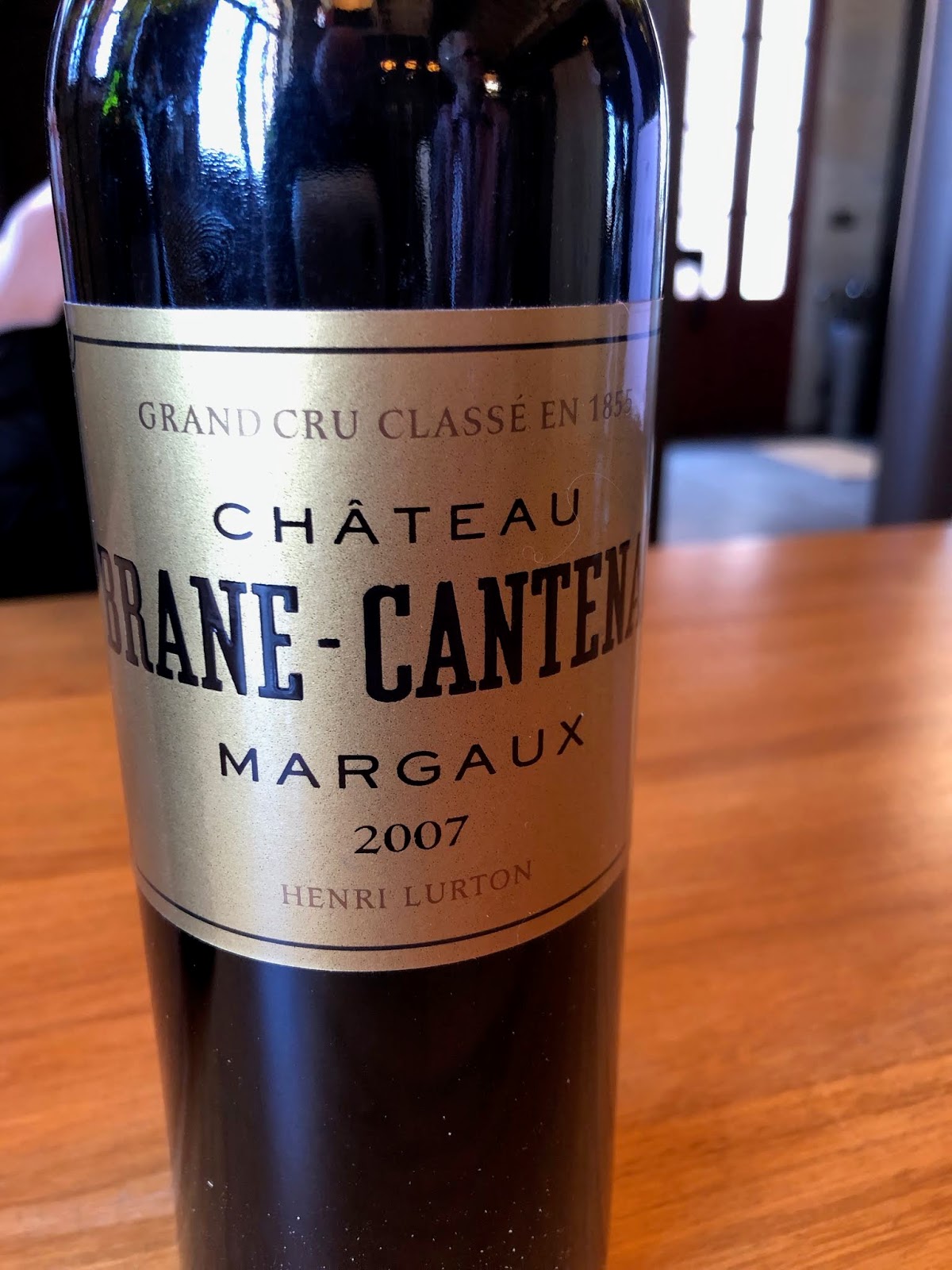
The final wine we tasted was the first label, the 2007 Chateau Brane-Cantenac. The year 2007 wasn't a particularly wonderful year because of a lot of rain earlier in the year but the summer ended up being dry and the grapes were actually pretty good by harvest time.  Claire wanted to show us how well it had aged and that it had turned out to be a really nice wine - which it was. It was 53% Cabernet Sauvignon, 39% Merlot, and 8% Cabernet Franc. This wine was aged a bit longer - 18 months in 60% French Oak. 

Claire, our wonderful chateau guide

Right from the first whiff, you could tell that this was a different wine. It had a powerful nose that really grabbed your attention. This complex wine had tastes and aromas of cassis, blueberries, raspberries, black cherries and a hint of violet. There were great tannins that made it supple and smooth with tertiary flavours of leather and cedar. This wine was already 12 years old but could probably sit in the bottle for another 5 years. I don't think I can wait that long, though, as I bought a bottle of it and will try to hang on for a couple more years. 

It was easy to see how passionate the people from the winery are about their wine. I remember when a tasting in the Okanagan was always preceded by a tour of the winery. Now, it's just a tasting and then onto the next one. In Bordeaux, the chateaux want you to see all the steps of how their grapes are grown and their wine is made so that you will have an appreciation of what goes in the glass.

Not a bad idea.


Thursday, December 20, 2018

WSET Celebration Dinner - with a Brilliant Bordeaux!

wine celebration

My WSET 3 exam is done - and now it's time to celebrate!

It's been an exciting 15 weeks - I've learned so much about wine making, grape growing and wine regions, I've tasted a whole variety of exceptional wines and I've met and befriended some wonderful people.

I've also studied harder than I ever have before and I've written a test that is as tricky as they come.

On the weekend, I decided to get a really nice wine to celebrate as well as a tasty meal. Off I went to Everything Wine and I picked up a Bordeaux wine and then went to a reputable butcher to get a couple of New York steaks.

I realize that some people would have a bottle of Champagne to celebrate and others would have a Burgundy or a pricey Napa Cab, but I love Bordeaux blends.

wine map of Bordeaux
Courtesy AllFranceInfo


The Left Bank is famous for its Cabernet Sauvignon driven blends which have grippy tannins and include some Merlot for smoothness and Cabernet Franc for fruitiness. The Right Bank wines are predominantly Merlot with some Cabernet Sauvignon and/or Cabernet Franc added in. In all of Bordeaux, there can be three other grapes added in by law - Petit Verdot, which is only added in during warmer years as it needs a lot of heat to ripen, Malbec, which is not used a lot, and Carmenere, which is rarely used anymore.

In between the Left and Right Banks is an area called Entre Deux Mers - literally, Between Two Seas (although it's actually between two rivers - oh, those French!). The particular wine that I bought was from this area which would make it Merlot driven and a lot cheaper than the Left or Right Banks.

Tasty wine from Bordeaux

The wine was a 2011 Chateau de Reignac Grand Vin Cuvée Special ($50 from Everything Wine). I thought that it was a pretty fair price for a seven year old wine from Bordeaux. I opened it and decanted it for about 40 minutes, leaving the small amount of sediment that I saw behind.

The aroma of this amazing wine was complex with wonderful black fruits like cassis and blackberry with black plum, tobacco, and vanilla as well as some savoury notes of leather. This wine was still developing. On the palate, it was not overly dry with balanced acidity, silky smooth tannins, tastes of leather again as well as the other flavours mentioned for aroma, full body, with a glorious long finish. It could age for a few more years but was definitely great to drink now. I rated this wine as Outstanding.

Wine from Bordeaux

It was even better with the food pairing! A grilled steak with a simple rub and baked potatoes were the perfect complement for this wine as the acid and tannins of the wine did a great job of cutting through the fat and saltiness of the steak. The pre-dinner glass, though, was pretty damned good as well!

I'll be honest - I wasn't sure where in Bordeaux this wine was from and might have passed it up if I'd known it was in the Entre Deux Mers region. Now that I've tried it, though, that region is going to be on my radar for (relatively) reasonably priced Bordeaux wines.

Oh, and I got an email from Fine Vintage today - I only have to wait 12 weeks for my exam results! Twelve weeks!

I think I need a glass of wine....

Thursday, November 22, 2018

Half the World in an Evening? Preposterous! Wines of North and South America - WSET 3.11

This week's map homework - nice map but maybe on blank paper next time?

This week's readings were insane - all of North and South America!

How the heck am I going to remember all of this info?

With just four weeks to go, it's pretty intimidating. Not at all like WSET 2.

In the mega-wine week, we covered bits about Canada, Oregon, New York, and Washington but spent most of our time looking at California, Chile, and Argentina.

Yes, we did leave out lots of areas but I guess those are the main ones.


The first wine we are going to look at, however, came all the way from the Okanagan, Mission Hill. We tried a 2016 Mission Hill Reserve Viognier ($22). This youthful wine had peach, melon and ginger spice aromas. On the palate, it was a really medium wine with medium acidity, body, intensity, and finish but did have high alcohol (just). It was rated as a Good wine and one that was good to drink now but not suitable for ageing.


I've already done a whole blog posting about our trip to the Willamette (rhymes with, "Damn it") Valley in Oregon - if you are interested in that, it is here. We tried one wine from there - a 2015 Sokol Blosser Pinot Noir ($48). This wine had aromas of red cherry, red plum, smoke, vanilla, and perfume. On the palate, I also tasted some leather. This wine had medium body, medium minus tannins, medium plus acidity, and a long finish. It was balanced, complex and pretty intense and would garner a Very Good rating.


If you want to try an outstanding wine from the Willamette Valley, try the 2014 Domaine Serene Evenstad Reserve that we had on our trip to Oregon. Although it cost close to $100, my wife and I opened a bottle we had squirrelled away from the trip last weekend and it was an intense, wonderful wine. I might have to buy it again, despite the hefty price.

On to California.

Courtesy Wine Folly
California was the most detailed area of the night but also the one I related to the most since I've actually been to Napa. Napa is just one of the wine counties that includes, in the North Coast, Sonoma and Mendocino as well. There are also many AVAs (American Viticultural Areas) which are the smaller wine area inside the region.

Napa County is probably the most highly regarded region with a multitude of different AVAs. The wines here are expensive and prestigious. For example, there's Los Carneros which extends into Sonoma and is famous for its Pinot Noir and Chardonnay - both still wine and high end sparkling. Three big AVAs that are famous for Cabernet Sauvignon are Stags Leap, Oakville, and Rutherford, although wines from these areas are super pricey. St. Helena and Calistoga AVAs are home to Cab Sauv, Syrah, and, California's grape, Zinfandel.

Zinfandel is a tricky grape - it ripens unevenly so it has to be hand picked but when it dries a bit and turns into a bit of a raisin, it is concentrated, full bodied, with wonderful red and black fruit as well as liquorice.

Sonoma County is the other big region with AVAs such as Russian River (Pinot Noir and Chardonnay), Dry Creek Valley (Zinfandel and Sauvignon Blanc), Alexander Valley (Cab Sauv), and Sonoma Coast (elegant Chardonnay and Zinfandel). The area of Sonoma County is actually bigger than Napa.

Mendocino County includes Anderson Valley which is very cool and is home to aromatic wines like Riesling and Gewürztraminer while Mendocino AVA has full bodied Cab Sauv, Zinfandel, and Syrah.

The Central Coast hosts the Santa Cruz Mountains AVA (elegant Cab Sauv), cool Monterey (Pinot Noir and Chardonnay), Pablo Robes AVA (Cab Sauv, Merlot, and Syrah), and Santa Maria Valley (Pinot Noir and Chardonnay - concentrated fruit and high acidity).

The last area we checked out was the Central Valley. This is a mostly flat area that is hot and dry and is a lake of cheap jug wine. However, the Lodi AVA has cooling breezes from San Francisco Bay and has some of the oldest and best Zinfandel vines in California. I would LOVE to try a Zin from Lodi!


So, let's look at the Zinfandel we did try! It was a 2015 Ridge Dry Creek Zinfandel ($74). This wine burst with aromas of black plum, cassis, raspberry, violet, vanilla, and liquorice. On the palate, there was also tobacco and plum - both red and black. It was a high alcohol wine with a long finish and pronounced flavours as well as medium body and tannins. Due to its lower tannins, it was not considered suitable for ageing but it would definitely be a wine to drink now! Although our instructor rated it as Very Good, I would have to go with Outstanding.


We also tried a 2013 Darioush "Caravan" Cab Sauv from Napa Valley ($89) and it was spectacular. It had aromas of black plum, cedar, forest floor, earth, black pepper, black currant, and coffee. On the palate, this developing wine had addition tastes of tobacco and mushroom. It was a high alcohol, high acidity, medium plus tannin wine with a pronounced intensity of flavours and a long finish - a classic Napa Cab! We rated this wine as Outstanding.


Before we leave North America, we did try a wine from Washington State - if you are interested in that blog entry, it is here. I would definitely revisit that area, as I would with Oregon. The wine we tried in class was a 2013 K.Vintners Syrah from the Columbia Valley ($67). This was another really enjoyable wine with black plum. black currant, white pepper, cedar and leather on the nose. This developing wine had cedar, blackberry and cooked fruits on the palate and was a high tannin, high alcohol, medium plus body, medium plus intensity, high acid wine. It was a bit astringent with the high acid as it could have been a little more plush or ripe. This was rated as a Very Good wine with ageing potential.

For such a skinny country, Chile has a fair number of wine regions to know. First, though, the grapes that are grown there. Cab Sauv and Merlot are big grapes in Chile as well as their signature grape, Carmenere. An interesting thing about Carmenre is that it is originally a French grape that fell out of favour after Phyloxera hit. Meanwhile, in Chile, thanks to being surrounded by ocean, mountains, desert, and ice fields, Phyloxera never came there. Wine growers in Chile thought they were growing a lot of Merlot but realized that it tasted different than other Merlots. That's because it was Carmenere!

White grapes of Chile are mainly Sauvignon Blanc and Chardonnay.

The regions of Chile are hard to remember so I will just review the four big areas - Coquimbo (Sauvignon Blanc, Syrah and Chardonnay), Aconcagua (Carmenere, Syrah, Cab Sauv and some Sauvignon Blanc), Central Valley (Cab Suav, Syrah, Carmenere) and Curico and Maule Valleys (Carignan). The smaller areas to watch for when you buy wines from Chile are Casablanca, San Antonio, Leyda Valley, Maipo, Cachapoal Valley, and Colchagua Valley.


We tried just one wine from Chile. It was a Carmenere and, if you want to revisit the Carmenere in a blog post that I thought was amazing, the link is here. This one was a 2016 Calina Carmenere from the Central Valley ($24). It definitely tasted of red fruit such as cherry, plum and cranberry as well as red liquorice. It had a certain herbaceousness about it that detracted from the overall flavour. It hit all the medium spots in acid, tannins, body, etc. and was just rated as a Good wine.

There is so much to learn about Argentina but I will just hit the things that relate to the wines I tried. First, the white grape that Argentina is famous for is the Torrontes grape. It is an intensely fruit and floral grape and is definitely and aromatic grape. It is found in a number of areas including Mendoza, San Juan, La Rioja and Salta.


We tried an 2015 El Porvenir Torrontes from La Cafayate in Salta ($22). I had a difficult time deciphering the aromas of this one so I will go with the group's descriptors. On the nose were honeysuckle, melon, elderflower and orange blossom aromas in a pronounced intensity. On the palate it was dry with medium plus acidity, medium body, finish and alcohol. This 'drink now' wine was rated as Very Good.

The black grape from Argentina that is their flagship grape is Malbec. This deep purple, oaked grape is grown in Argentina more than anywhere else in the world. If the flavours are extracted gently, it can be a very elegant wine with floral aromas and spice. It can also be blended with Cab Sauv, Merlot, Cab Franc, and Petit Verdot. I have had lots of Malbecs before form Argentina and have not been overly impressed by them.


The last wine we tried, however, did impress me. It was a 2014 Bramare Malbec from the Lujan de Cujo in Mendoza ($67). Name a black fruit and it was there. I loved this wine. Black plum, blueberry,  black currant - and more. It was definitely oaked with lovely cedar and tobacco but it also had that ageing flavour of barnyard, mushrooms, and earth. It was our last wine of the night so I just leaned back and sipped the contents of my tasting glass - no spitting with this one! This full bodied wine had intense  aromas on the nose and pronounced flavours on the palate. This wine was balanced, had length and was complex, deserving an Outstanding rating.

Now, back to my studying!

Friday, March 30, 2018

Walla Walla - A Wine Good Enough to be Named Twice....


On our Spring Break trip, the last destination before re-entering Canada was Walla Walla, Washington.

Rewind to the Wine Festival - we tried some wines from Charles Smith that were so good - and that they didn't have in the on-site liquor store - that we decided to change our itinerary so we could stop in Walla Walla.

Ah, can't resist this brief film clip....


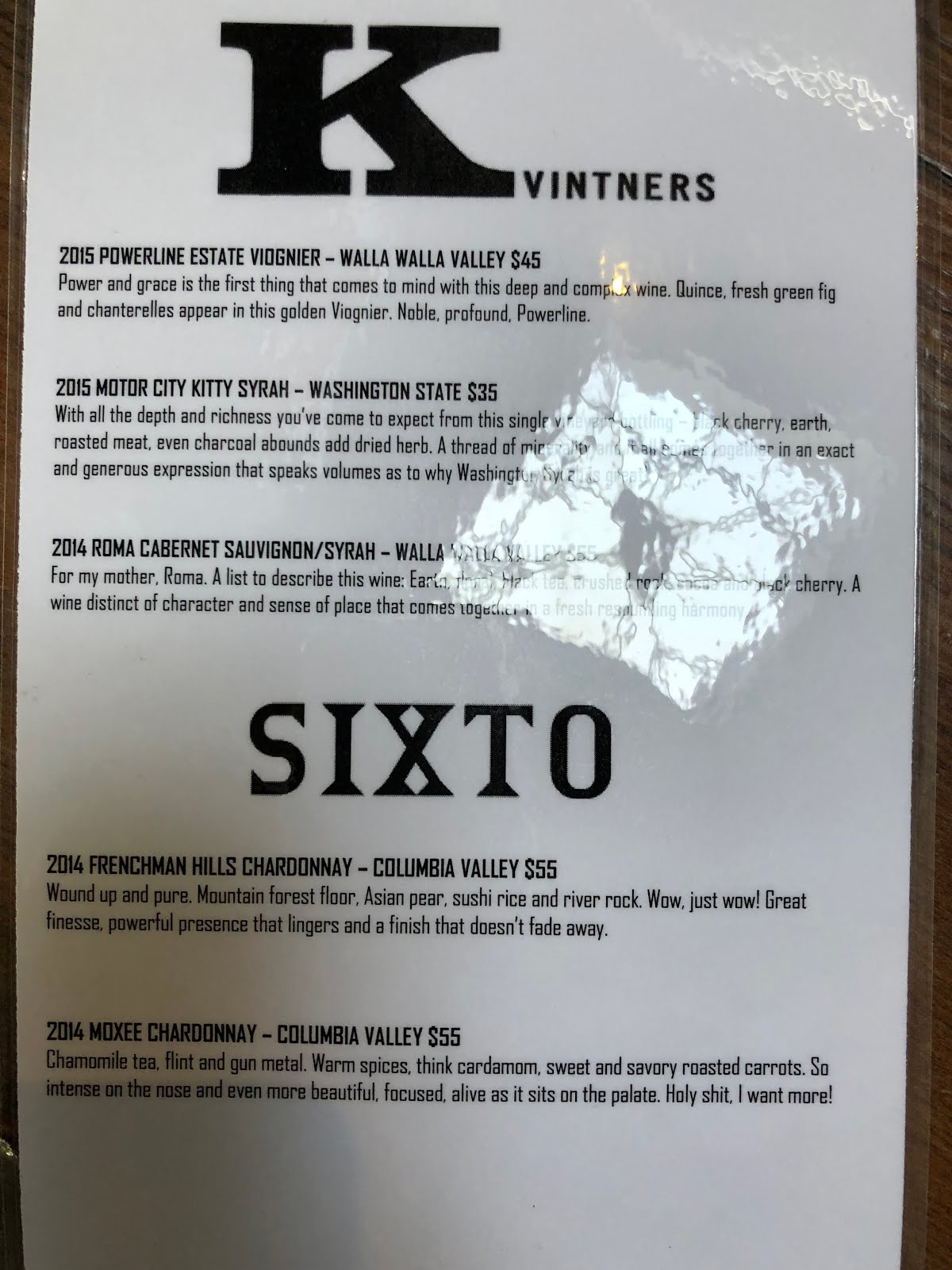
The wine that we loved at the festivals was called Motor City Kitty and is made by a winery in the Charles Smith group called K Vintners. We went to K Vintners and were shocked to find that the winery was closed! Upon careful examination, however, we found a small note telling us that their wine was available in the tasting room in Walla Walla. 

The tasting room was lovely. Charles Smith has a real love of old cars and the tasting room is in a building that was originally built as the Johnson Auto Electric Building in 1917.  The was also how Motor City Kitty (MCK) wine got its name - because of Charles Smith's love of cars. 

Kayla, our wonderful wine taster!

We got all of this great information from Kayla, our wine tasting room associate. She did a wonderful job of telling us the story behind each wine, not just the number of points or the flavours we were supposed to taste. 


The first wine was the wonderful Motor City Kitty ($35 US). It is a big, giant Syrah that makes you stand up and take notice!  I absolutely love this wine - and  purchased two bottles of our precious four bottle duty free wine allowance. 


The tasting moved along wonderfully - we had some very enjoyable wines but the other one that stuck was the Stoneridge Vineyards Cabernet Sauvignon made by Wines of Substance - a winery that is also part of Charles Smith, like K Vintners. This one is their high end Cab and it is big and bold. There is a cheaper version available in BC Liquor Stores - it's good but not as good as the Stoneridge. Mind you, the cheaper one is only $25 while the Stoneridge is $45 US. 

Well, we bought a bottle of that as well - together with the two MCKs and the Oregon Pinot Noir, we had our full allotment. 


The thing I really like about American tasting rooms is that they are a bit like craft breweries here. Not only can you buy the wine and taste it, you can also buy a glass and have a snack. Which is exactly what we did. We both had a glass of the Cab and had a wonderful charcuterie plate. We were in heaven!


Afterwards, we wandered around Walla Walla for a bit - not too long, however, as it was getting a bit chilly. 


We eventually stumbled on a boutique winery called Eternal Wines. This was not the same slick operation that was Charles Smith. However, the wine taster was passionate about her wines and the prices were a bit better. The wines were all hand labelled so I was a bit hesitant at first but the wines turned out to be quite tasty. 

We purchased a Carmenere, a red blend, and a Cab Sauv. All were just $26. All were good. 

The next day, we came to the tiny border at Oroville and confessed that we had 3 bottles too many. The kind border guard ended up cracking a joke and let us through without paying extra duty - wonderful!

I really enjoyed the wines from the two wineries that we tried in Walla Walla but there are a lot we didn't get to. I would like to come back and spend a couple of nights - which would mean a whole lot of tasting rooms - and get a better sense of the industry in the Columbia Valley. 

It was a great end to the holiday!


Saturday, December 16, 2017

Old World vs New World wines - again- and some Christmas wine suggestions

This is one of those things that I have realized - or maybe, it's better to say - had an epiphany about. I know I've blogged about it before but it is such an important thing that I have realized that I am going to go on about it once again.

I have slowly grown to notice this, and thanks to taking my WSET course as well as tasting wine thoughtfully - one might even say, mindfully.

What is it? There is a big difference between Old World and New World wines and one way to look at it is this:

In the Old World - and here, I'm talking largely of France and Italy, although this may apply to other European countries - wine has grown up as an accompaniment to food. When you look at a fine French wine - say, a Chablis - the next thing that you do is figure out what you are going to pair it with - say, a whitefish or some shellfish with a cream sauce. These wines are really meant to be imbibed with the food of the area that they are close to. A bottle of Chianti? Try it with some Spaghetti Bolognese. A bottle of Bordeaux? Try a grilled steak or some lamb. Nebbiolo? How about a Piedmont fondue with truffles?

These are wines that cry out for a food pairing.

Just last month I had a Bordeaux from Paulliac that tasted ok at first sip but needed something. It turned out that it needed a big, juicy sirloin steak to make it sing.

New world wines, on the other hand, are, for the most part, just fine to drink on their own. It's easy to just sip away before dinner until the darn thing is gone and dinner isn't even on the table! This happens far too often at our house and with friends. On occasion, I bring a bottle of wine to a party, after asking what is being served, because it will go well with the food. Unfortunately, 9 times out of 10, it will be gone or mostly gone by the time the first course hits the table.

Now, just because many New World wines are good on their own, it doesn't mean that they aren't good with food. Many of them make fantastic pairings. On occasion, though, the wines just don't sing like one from the Old World.

Here are some wine suggestions as Christmas approaches (but good anytime):


First is one that I've had before - but probably a couple of months before I started this blog. It was a (New World) 2014 Terrunyo Block 17 Carmenere from Chile - and I bought it for my (now) son-in-law because it was written up as the best Carmenere in Chile. At the time, I shuddered to pay $38 for a bottle of wine - now I don't shudder so much if I know it is going to be a special wine. When we bought this particular wine I actually purchased three bottles, one to give, one to drink, and one to hold on. Last night, we had the one to hold on.

It was a wonderful wine - even better than the first bottle. It was a super dark rich, purple wine with wonderful black and red fruit flavours and some tannins. It had some nice oak and was a wine that really seemed to stand up with a strong intensity of flavours. We had prepared pork chops baked in the oven over a potato and tomato gratin but, unfortunately, by the time dinner was on the table, guess what?


Next up is a tasty Tuesday night wine. Yes, it is good to drink fancy wines such as the Carmenere but the reality is that most of us can't afford to drink a $40 bottle every night.  This one I chose because somebody gave it 89 points (although there's a large contingent of experts who are not particularly please with the point system - for an excellent view on this issue, check out this article by Jancis Robinson) and it was an Old World Cotes du Rhone. It is a Pere Anselme La Fiole from the Cotes de Rhone - the producer is actually from Chateauneuf de Pape. Although my Vivino app thinks it' is an actual CNP blend, it is actually a $17 bottle that tastes pretty good - specially for a Tuesday night. Nothing too intense or complex and definitely goes better with some food.

The third wine was recommended to me by a pretty reliable source at one of my favourite liquor stores. It was a New World Argentinian Fuego Blanco Cabernet Franc Malbec that I was pretty excited about. I love Cab Franc and was intrigued about the addition of the Malbec. Unfortunately, I found this wine to be rather dull or thin - not awful but not worth the $35 I paid for it. I was defintely disappointed and would not consider purchasing it again - wth or without food. I was surprised that it was rated pretty highly in the  Vivino app (and that someone on the bottle had given it 93 points) but my advice is - stay away from this one.


Finally, a fantastic (Old World) port! For the 325th anniversary of the company, Taylor Fladgate has come out with a tawny port that is a mix of 10, 20, 30 and 40 year old tawny ports. It is incredible! It has complex tastes and is not overly sweet so you can really enjoy sitting back and sipping. It also comes in a commemorative bottle which reflects the design of the original port bottle when the company started (my wife loves the bottle and won't let me throw it out). At $48 a bottle, it's a bit of a splurge but is actually a great price for tawny port. I swear I can taste elements from each decade as I savour this wonder. If you have a port drinker on your Christmas list, I recommend that you check your local liquor store stock and buy what you can. There's a reason why there's four bottles in the photo!


Wednesday, May 17, 2017

Sauvignon Blanc- not just cat pee - Carmenere, and Malbec - WSET Class #4 - Part 1

I left early for this week's class. I had a couple errands to do but I figured I would have time to try out a new place that my wine group had told me about. Unfortunately, by the time I got to Pokéritto, there was a giant lineup and I was running out of time. I ended up at Tim Hortons for a chicken wrap which was rather tasteless and I could only choke down half. What do you pair with disappointment?

A few minutes later, sitting in class, Rajen (the guy whose family owns Desert Hills), asked our table group if we were interested in joining a monthly tasting group. I definitely agreed and am actually looking quite forward to it. Each person brings a bottle of wine in a paper bag and then the group does a blind tasting. Sounds like fun!

Our table group is quite friendly now, especially after discussing all of the different wines that we have tasted. Some of us shared about our weekends as well as other small talk.

This week we looked at a bunch of wines. The first two were the white wines Sauvignon Blanc and Semillon.  By the way, Sauvignon Blanc has a bit of a reputation of smelling like cat pee. I guess I haven't smelled enough cats peeing because I didn't really notice it....

Sauvignon Blanc is a very aromatic white wine which is usually dry and is a crisp wine that ranges in taste from grassy (think fresh cut grass) to tropical aromas. It is found in many places in the world, mostly in cooler or moderate areas. It is also found in Bordeaux and is one of only three white wines in Bordeaux. In the New World, New Zealand is the place that grows great Sauvignon Blanc. Unlike Chardonnay, it is much more consistent in its taste. Interestingly, it is one of the few wines that is supposed to pair well with sushi.

Semillon is a much more neutral grape that is sometimes added to Sauvignon Blanc. Sauvignon Blanc doesn't age very well but Semillon ages really well and blends well with Sauvignon Blanc. Semillon is also found in Bordeaux.

Our first tasting had three wines - one was a Semillon, one a Sauvignon Blanc from Bordeaux and one a Sauvignon Blanc from New Zealand.


The first was a wine with a pronounced nose with aromas of stone fruit, green apple, green pepper, grass, and floral hints. On the palate, it had the same flavours as well as  grapefruit and some smokiness. It was definitely dry, had high acidity, medium body and a medium plus finish. It was rated as Very Good and was a 2015 Bordeaux Sauvignon Blanc from Sancerre by Hubert Brochard and had the name Terroir de Silex. This wine had definite aging potential and cost $40.


The second wine also had pronounced intensity and had aromas and flavours of bell pepper, mint, green apple, tropical fruit ( I noticed pineapple), and peach. It had high acidity, medium body and a medium minus finish. It was also rated Very Good and, I think, was one of Dave, our instructor's, favourite Sauvignon Blancs as he was wearing a t-shirt from the winery! It was a 2015 Spy Valley from New Zealand priced at a mere $21. It was a very agreeable wine and our group enjoyed it.


The final wine tasted different than the first two - that was the first hint that this was a different wine. Where the other two were pale, this was medium in colour. It was a medium intensity wine on the nose with aromas and flavours of cut grass, apples, green peppers, smokiness, and toast - even though it was unoaked! It had medium body, high acidity, and a medium plus finish. It was Very Good. It was, of course, the Semillon. It was a 2009 Peter Lehmann from the Barosa Valley ($32). Semillon on its own is best aged and this particular winery only releases it aged - so it basically ages in the bottle for seven or eight years before being released. In fact, Semillon in general should age from seven to ten years before popping the cork!

The next post will deal with more Bordeaux wines but I will fast forward to the last two.

We spent some time looking at some other red grapes that originated from Bordeaux but were not that important in Bordeaux anymore. Both Carmenere and Malbec have been adopted by two different countries, Chile and Argentina, respectively.

The Carmenere grown in Chile was originally thought to be Merlot as Carmenere had basically been wiped out everywhere else in the world thanks to a virus. It makes purple wine and tends to have a bit of mint to its character.

Malbec is Argnetina's signature grape and has very dark fruit. It also makes purple wine and is a bit spicy, sort of like Syrah.


Our first tasting was deep purple and had a medium plus intensity on the nose. I noticed spice, black currant, cassis, prune and a general aromatic nose while there was black cherry and even toast on the palate. It was a full body wine with medium acidity and tannins and a medium plus finish. This 2013 Carmenere from Vina Tarapaca was rated as Very Good and cost $25. The words "Gran Reserva", however, don't have a great deal of meaning when it comes to Chilean wines. This wasn't a particularly popular wine with my table group but I didn't mind it too much.


The last wine was, of course, a 2014 Malbec from Catena in Argentina ($24). It was a medium to deep purple had a much lighter intensity nose than the Carmenere. I found it really hard to discern aromas and flavours but did come up with red fruit such as red currants. It had light tannins, medium body and medium acidity with a medium finish. It was rated Good. I have had quite a few different Malbecs and this one just wasn't that great to some of the others that I have had.

Next time, the tasting will look at Bordeaux reds - some of my favourite wines in the world!


Time to Taste an Albariño from Catalonia, Spain!

  Today we're drinking an Albariño — but there's an interesting twist. This 2024 Raimat Albariño doesn't come from the cool, Atl...