Showing posts with label malbec. Show all posts

Wednesday, May 29, 2019

Small Wineries Equals Great Wines - St. Emilion Wines -Bordeaux Wineries Part 6


St. Emilion is wonderful. It is nestled on the Right Bank of the Bordeaux region and is a beautiful medieval town with narrow, twisty roads, a wonderful church spire and is not overrun by tourists.


The day we went, it was a beautiful, warm, sunny day without a cloud in the sky.


We weren't even sure what some of the ruins were - this one looks like it might have been from another church - and we didn't have a lot of time as it was actually a stop between our visits to two wineries that day.


Many of the streets were cobblestoned and were a bit challenging to walk on, especially this steep downhill street. It must have been very exciting in times of old when it rained and residents had to negotiate the slippery streets. 


As I said, we stopped here for lunch, We booked online at Lard et Bouchon and had a wonderful meal.


My favourite part of the meal was the Oeufs en Meurette - basically a special wine sauce with bits of Beef Bourgignon in it with a couple of toasted bread crostinis which had a slab of foie gras on each one topped by a poached egg. I have never had anything like it before and it was heavenly! We both had a tasty piece of duck next and then, my wife's favourite, the deconstructed lemon tart. 


So, what did we do to earn such a wonderful meal? Visited some wineries, of course!

The Right Bank is not so showy as the Left Bank was. The chateaux are often just houses, not castles. The wine production is smaller. The wines are less expensive. 

But the wines are just as good. 

Practical information - unless you take a wine tour, you will need to rent a car. You will also need a good GPS (I used my iPhone and wayyy too much data) to find the wineries. It's also important to book ahead which I was able to do online by sending an email.


When we rolled up to the first winery, Chateau Cantenac, we knew it was a different. The chateau was nice but looked, well, lived in! We were greeted by our host, A.J., who was from California. When we asked her how she ended up in St. Emilion, she told us this story. 

The parents, who own the winery, have three sons. A few years ago, they had interns come each summer to help with the wine season. A.J. came from California - and married one of the sons. Another intern came from Toronto - and married another one of the sons. Another intern came from the States - and married the last son! By that time, the parents had asked that no more female interns be sent, but it was too late! All of the sons have had daughters so, in a few years, maybe there will be some male interns sent to the winery!


A.J. took us out to the vineyard and we spent at least a half hour schlepping around the vines while A.J. regaled us with stories of the wine. My wine nerd meter was at 10 - I loved every minute of it - but even my distinctly less nerdy wife also enjoyed this part.


A.J. talked about the different types of pruning, wine varietals, and grafting among other things. She really knew her stuff and I wish I'd been able to see all of this when I was doing my WSET. It all made so much more sense, because we were actually in the vineyard!

Founded in 1870, Chateau Cantenac has always been a family winery with the current family purchasing the winery in 1937.  They grow predominantly Merlot and some Cab Franc with a little Cab Sauv on just 19 hectares. 


Inside the winery, we first saw their concrete tanks. These are used to ferment the wines at the beginning of the wine cycle and used to blend the different wines near the end.  A.J. told us how the intern has to clean out all of the grape skins and other leftovers after the wine has finished fermenting. It's a crappy job, with the additional danger of carbon dioxide asphyxiation, which necessitates oxygen being pumped into the tank during cleaning. 


The barrel room in Chateau Cantenac is not only for wines. There are concerts (of the classical type) held in the barrel room during different times of the year. What a great idea! 

The wines were, overall, more approachable than the Left Bank wines - meaning that they don't require a lot of ageing.


The first wine we tried was from another St. Emilion winery in the family, a 2015 Chateau Moulin de Grenet ($20) from Lussac. This wine is 75% Merlot and 25% Cab Sauv and was aged for 18 months. This was the most approachable wine of the tasting, being a fruity and fresh wine that was ready to drink now. It had aromas of blackberry, black currant, and cherries as well as some earthiness. On the palate, there was medium acidity, a slight taste of oak, medium tannins, and a medium finish,. Overall, a Good wine. 


The next wine was a 2015 Chateau Cantenac Grand Cru Selection Madame ($32).  This wine is made with 95% Merlot selected by the mom of the winery (the other 5% is Cab Sauv).  This wine has lots of dark fruit like plum and blackberry as well as cedar, vanilla spice, and some earthy characteristics like leather. This is another fruity wine that should be drunk in the next couple of years rather than waiting ten years. There were some medium to medium plus tannins, medium acidity , and a medium plus finish. I felt this wine was balanced, complex and fairly intense - so I would give it a rating of Very Good. 


The final wine of this chateau was the 2015 Chateau Cantenac Grand Cru Grand Vin ($34) - the best wine of the property.  This wine was 70% Merlot, 18% Cab Sauv and 12% Cab Franc.  On the nose, this wine had black cherry, blueberry, plum and blackberry. On the palate, this wine had additional flavours of oak, cedar, smoke and earth and had medium tannins and acidity. It had complexity, balance, and a nice medium plus finish. I would rank this wine as Very Good. 

They had a deal at the winery - all three wines for €50 - guess what we bought?

In the afternoon, we went to Chateau Coutet for our final tasting. Luckily, we had my iPhone because it was hard to find - narrow roads, dirt roads, and finally driving by the vineyards on what seemed like a trail, we managed to find winery. We got out of the car and were greeted by a couple of smelly farm dogs and the sound of bird song in the air. What a great start!


We finally found the entrance to the winery and we were given a private tour by Capuchine, an intern.  Dating from Roman times, the current family has owned this chateau for 400 years.

She first took us to the vineyard where she showed us that tulips were able to co-exist with the vines due to the organic nature of the winery. In fact, the property had a thick hedge going all the way around it, preventing contamination from other farms. They have been organic for a long time and are proud of their legacy.


This grape press is over one hundred years old and is still used today to extract the juice from the grapes. The 13 hectares of grapes are 60% Merlot,  30% Cab Franc, 5% Cab Sauv and 5% Malbec. 


This winery did not have such a fancy place to store their barrels. However, the room smelled good and the wine ended up being a great product.


Ah, again, the dusty collection of amazing old wines. One that isn't here is a bottle that was found recently under a pile of dirt when a winery worker was fixing a broken wine rack. The bottle has been determined to be from around 1750! During this era, most wine was aged and sold in barrels, not bottles - but some special bottles were made - with glass stoppers. Because glass is airtight, the wine inside that bottle will taste just like it did when it was bottled over 250 years ago.  


Capuchine gave us a very interesting tour but the best part, of course, was in the modest tasting room. 


The first wine we tried was a 2015 Chateau Belles-Cimes Saint Emilion ($25). It was a fruity wine with aromas of black plum and black pepper. It had medium tannins and medium acidity and had some vanilla on the palate. It was a balanced wine, but not overly complex, with a medium finish but good intensity. I would rate this wine as Good.


The second wine was the 2015 Chateau Coutet Grand Cru ($42). This somewhat tannic wine had aromas and tastes of blackberry, black cherry, blueberry, plum, cedar, tobacco, coconut, as well as mushroom, smoke and leather. What a complex wine! With medium plus acidity, a long finish, intense flavours, and a balance of flavours, I would rate this as Outstanding and will hold onto it for a few years.


The final wine we tried was the 2015 Chateau Coutet St. Emilion Grand Cru Cuvée Desmoiselles ($98).  This wine is made the traditional way - including interns' bare feet to work the cap during fermentation! This wine had aromas of blackberry and black currant as well as black plum, cedar and vanilla. It was bit more tannic than the last wine so would benefit from more ageing time. This had a long finish, was balanced and had good intensity of flavours. I would give this wine a rating of Very Good. 

We ended up with a bottle of the Grand Cru - a wine I think was a great deal for the money. 


As we left the winery, we emerged outside into the wonderful sounds of birds chirping and dogs romping around in the sunshine. If you look closely, you'll see some ducks and geese in the distance at the top of the photo. 

We both loved St. Emilion. We would definitely come back here to explore the village some more and to try out more of the great wineries in this region. A great day!

Santé!


Friday, May 3, 2019

Travels with Bogdan - Our Final Left Bank Winery in St. Julien - Bordeaux Wine Tour Part 4

Ah, Bogdan, you're a good man!


Way back while I was doing my WSET 3 last year, I mentioned to some of my classmates that I was going to Bordeaux. Verity's sister had been to Bordeaux and had gone on an excellent wine tour. Bordeaux Vertigo was the name of the tour company and Bogdan was the name of the guide.

I had already booked another tour company at this point - the number one guy in Trip Advisor - but I hadn't actually paid yet. Neither company was cheap but this was a once in a lifetime opportunity so I wanted to make sure that I made the right choice. I started emailing Bogdan and, really, had a very nice impression of the man so I decided to go with him.

That was not a mistake.

Bogdan is from the area and has a very good  knowledge of, not only the wine, but also of the history of the area. We spent time discussing terroir, wine growing, French schools, culture, the Yellow Vests, cuisine, and wine making. He had many interesting stories and anecdotes that he shared with us during the tour. And he selected four excellent wineries that were somewhat different but all made great wine.


The final winery that we went to was with the quiet brother - Julien - or St. Julien. The winery is called Chateau Gruaud Larose and was a great way to finish off our tour.


We met our very sparkly and entertaining guide, Sarah, and our first experience was to go up the elevator of a tower, next to the winery, so we could get a great view of the surrounding land. It was a beautiful day and we had quite the lovely view from the top.


She also snapped a photo of the two of us standing at the top of the tower.


Like the other wineries, we spent time with their fermenting tanks at the beginning of the tour. It wasn't repetitive, though, as we heard something different from each tour that we did. 


We first went to this barrel room. Do you know why the middles of the barrels are red? That's so when the winemaker is tasting or topping up and there is a bit of wine spilled, you won't have this unsightly streak running down the barrel. 


Wineries in Bordeaux, since they are so sought after, are often bought and sold by wealthy families or big companies. In 1993, a big industrial group bought Gruaud Larose. They poured a whack of money into the winery, including building this show barrel room. With its gothic arches and careful lighting, it looks more like a cathedral of wine than a barrel room. It was a wonderful place to hang around for, even for just a few minutes! Unfortunately, the industrial company had financial difficulties and sold to the current owner in 1997 - leaving this wonderful barrel room.


I have to say that I love going into all of these libraries of amazingly old wine. Chateau Gruaud Larose has a pretty large library with the oldest being a bottle from (gulp) 1815. Oh, for an hour with me, the library room, a corkscrew and a glass....


Our guide, as I mentioned before, was Sarah. I'm glad she wasn't trying to sell us something because I would have bought five of whatever. She was very personable and had a great sense of humour. When you meet somebody in French, you sometimes say 'enchanté' which mean enchanted. I was a bit enchanted with Sarah!

Sarah poured us two different wines, their second label and their first label.


The first was a 1996 Sarget de Chateau Gruaud Larose ($36). On the nose there were dark fruits like blackberry, blueberry and cassis. On the palate there were additional flavours of oak and cedar as well as a bit of leather. There was also a hint of red fruit. The wine was 57% Cab Sauv, 31% Merlot, 8% Cab Franc, 3% Petit Verdot, and 2% Malbec.This was not a terribly complicated wine but was very enjoyable. It was really smooth and round and, with its beautiful garnet colour, was ready to drink. I would rate this as Good to Very Good. 


The other wine was a 2003 Chateau Gruaud Larose Grand Cru Classé ($325). This ruby wine had black fruit flavours such as plum, blackberry, cassis, and blackcurrant. It also had a bit of jamminess (but in a good way) with interesting flavours such as caramel and vanilla. There were also those wonderfully complex tertiary flavours such as leather, mushroom, earth and forest floor. This velvety smooth wine - smoother than the first wine - really struck me as a food friendly wine. The grapes that went into this wine was exactly the same proportion as the '96 Sarget - 57% Cab Sauv, 31% Merlot, 8% Cab Franc, 3% Petit Verdot, and 2% Malbec. It;'s a testament to the terroir that two wines with the same composition could taste quite different.  This wine was complex, balanced, intense in its interesting flavours, and had a wonderful long finish. Although I don't think I could quite afford a bottle of this (although I am so glad that I got to try this) I would definitely rate this as Outstanding.

And that was the end of our wine tour. Bogdan drove us back to town and we had several spirited conversations about a variety of topics. He finally arrived back at our apartment and, after everyone thanked each other for such a great tour, we said goodbye.

Yes, this tour was a splurge. But for me, it made sense. We had the benefit of someone who knew the area really well and could get us into the wineries for private tours - something that we could not do on our own. We did do some touring on our own in Graves and St. Emilion which I will blog about later and they were fine to do on our own. But visiting the three big brothers (Estephe, Julien, Paulliac) and the soft, velvety sister (Margaux) was a once in a lifetime experience with Bogdan.

Santé!


Tuesday, April 2, 2019

Soft and Velvety Margaux - Bordeaux Wine Touring Part 1 - Chateau Brane-Cantenac


France is a marvellous country.

I just returned from a two week trip with my wife where we visited Lyon, Bordeaux and Paris. All were amazing places to visit (or, in the case of Paris, revisit) but for wine, Bordeaux was a dream come true. 

The view from our balcony.

We stayed in a wonderful apartment in Bordeaux - it was spacious, clean, centrally located and, most importantly, had a balcony, This was important because the weather while we were in Bordeaux was unseasonably warm - around 20°C. in the afternoon.  We managed to spend a couple of lunches with a baguette, cheese and a bottle of rosé sitting on the balcony, watching life unfold. 

How French!

One of the days we spend in Bordeaux was on a wine tour with Bogdan who is the guide for Bordeaux Vertigo. This was not a cheap day - the tour guide alone was €480 plus there were fees for tasting and the cost of lunch - but it was well worth it. It's not easy to get into the Chateaux in Bordeaux. They sell mostly to negociants who sell their wine and have no real desire to have people traipsing through the winery. For that reason, it is good to have a guide who can get you in and knows the ins and outs of getting appointments. 

Bogdan also knew his stuff - he was an expert on the region and we talked about many things - wine, schooling, the yellow vests, and politics to name a few. 

After picking us up at our apartment, we headed out from the urban centre of Bordeaux, a medium sized city, and watched the scenery change from buildings and pavement to fields and trees. Many of the wine areas are on reclaimed land, diked by the Dutch in the 1600s. The land that is still swampy sits empty of vines, with trees like poplar planted to suck up the moisture.

One of the many Bordeaux chateaux - this one is Chateau Brown-Cantenac
In Bordeaux, there is the left bank and the right bank. We were focusing on the left bank - where wines have a higher concentration of Cabernet Sauvignon than Merlot. The upper part of the left bank is called the Medoc. The better part of Medoc is the Haut Medoc (Upper Medoc). And the best parts of the Haut Medoc are named after the villages. 

The four main villages are St. Estephe, Paulliac, St. Julien, and Margaux - the three brothers Steven, Paul, and Jules and their sister Marg. 

Our first stop was in Margaux - the soft, velvety sister of the four siblings.


The winery we went to is called Chateau Brane-Cantenac. But first, some history. 

Way back in 1855, Napoleon (the third, not the guy with the hand in his jacket) wanted to catalogue all of the wineries in Medoc for a World Exposition - because even then Bordeaux had some of the best wine. The wineries that were part of this classification were given a classification of first, second, third, fourth or fifth growth of the Grand Cru Classé. With a minor exception, this has not changed since then. The first growths were the super famous chateaux like Lafite Rothschild. 

Chateau Brane-Cantenac is a second growth. 

As with most chateaux in Bordeaux, the double-barrelled name has meaning to it. Brane was the name of a Baron that bought the chateau in 1833. Cantenac is the name of the region. 


Our guide for this winery was Claire. We started outside, looking at the vineyards, and talked about the history of the winery and the grapes. The French have a passionate belief in the concept of terroir - that the varietal of the grapes is just one factor when growing grapes. The soil, weather, moisture, climate, slope, topography,. organisms, and sun exposure all affect the taste of the grape. 

The optical sorter, popular in many chateaux.

Once the grapes are ready to pick, at Brane-Cantenac they are sorted three times; once in the vineyard during the picking, again in the winery as they move through the sorting table and finally with this fancy machine called an optical sorter. It uses a laser to check the size, colour, weight, etc. and selects just the grapes that are perfect. 


The grapes are fermented in a number of different vessels in Bordeaux. At Brane-Cantenac they use either large oak vessels (which introduce some oxygen) or stainless steel tanks. Most of the wineries in the Okanagan use stainless steel for fermenting.


One thing that I noticed in almost every winery that we visited was that there was a concerted effort to try new things and to experiment. I guess I thought that they would just keep doing things the same way because their wines fetch such high prices but apparently not. At this winery, they are experimenting with fermenting in smaller oak barrels. 


Once the grapes have finished fermenting, and after a bit more time on the grape skins, the wine goes into barrels - both new and a year or two old - for ageing. Brane-Cantenac uses barrels from seven different producers and each barrel, even if they are the same French Oak, has a different flavour. 


A couple of the barrels are very cool as they have a glass 'stave' that you can see the wine. You can see how the density of the red colour changes over time as the wine matures.

Most chateaux have a first label, their wine that is the top wine, which is made from the best and oldest wines, and a second label which is usually wines made from younger vines. Chateau Brane-Cantenac has two second label wines. We tried three different wines in all. 


The first was their second label called Chateau Notton. They don't make this wine anymore as they have changed the name. This was a 2011 Chateau Notton. It was made from 55% Cabernet Sauvignon, 40% Merlot, 4.5% Cabernet Franc and 0.5% Carmenere. The average age of the vines is 35 years and the wine was aged for 12 months in oak, of which 20% were new barrels. 

There were tastes and aromas of jam, black berries, cassis and other rich, black fruit. This was a very enjoyable drinking wine and I quite enjoyed the taste of it at only 8 years old. It could probably stand a couple more years but was good to drink now. 


The second was the other second label, a 2008 Baron de Brane. This wine is 58% Cabernet Sauvignon, 40% Merlot, and just 2% Cabernet Franc.  It was aged 12 months in oak, of which 30% were new barrels. 

This wine had tastes and aromas of blackberry, black cherry, and cassis as well as some definite oak. It was more complex that the Notton and had some tertiary flavours such as forest floor and leather that weren't as noticeable with the first wine. This had some definite tannins that had rounded somewhat and could probably age for another five years.


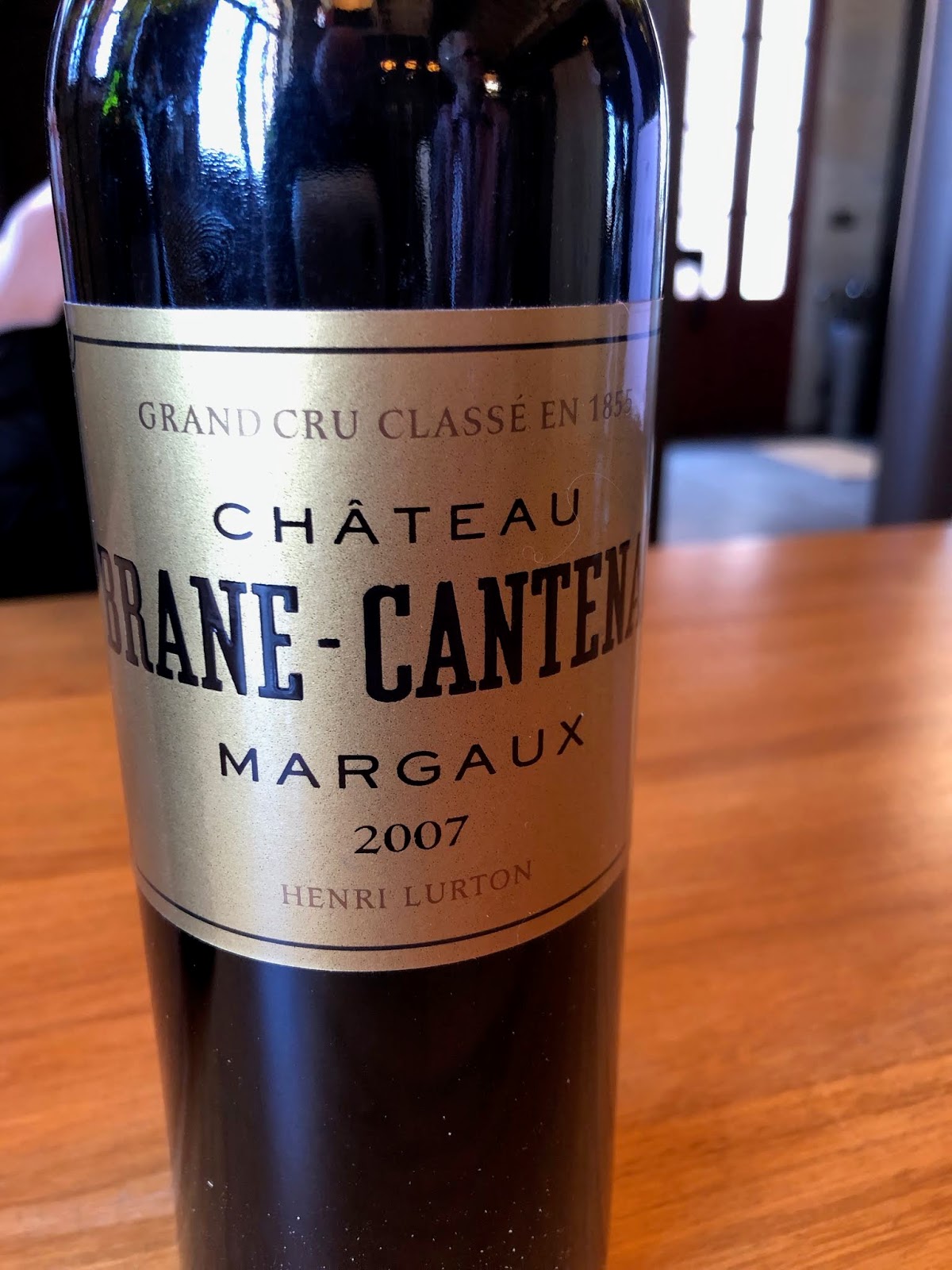
The final wine we tasted was the first label, the 2007 Chateau Brane-Cantenac. The year 2007 wasn't a particularly wonderful year because of a lot of rain earlier in the year but the summer ended up being dry and the grapes were actually pretty good by harvest time.  Claire wanted to show us how well it had aged and that it had turned out to be a really nice wine - which it was. It was 53% Cabernet Sauvignon, 39% Merlot, and 8% Cabernet Franc. This wine was aged a bit longer - 18 months in 60% French Oak. 

Claire, our wonderful chateau guide

Right from the first whiff, you could tell that this was a different wine. It had a powerful nose that really grabbed your attention. This complex wine had tastes and aromas of cassis, blueberries, raspberries, black cherries and a hint of violet. There were great tannins that made it supple and smooth with tertiary flavours of leather and cedar. This wine was already 12 years old but could probably sit in the bottle for another 5 years. I don't think I can wait that long, though, as I bought a bottle of it and will try to hang on for a couple more years. 

It was easy to see how passionate the people from the winery are about their wine. I remember when a tasting in the Okanagan was always preceded by a tour of the winery. Now, it's just a tasting and then onto the next one. In Bordeaux, the chateaux want you to see all the steps of how their grapes are grown and their wine is made so that you will have an appreciation of what goes in the glass.

Not a bad idea.


Time to Taste an Albariño from Catalonia, Spain!

  Today we're drinking an Albariño — but there's an interesting twist. This 2024 Raimat Albariño doesn't come from the cool, Atl...