Showing posts with label left bank. Show all posts

Saturday, September 29, 2018

Je t'aime, Bordeaux! WSET 3.4


I loved this week's class.

This week was all about Bordeaux - and I think Bordeaux is my very favourite wine.

Bordeaux is on the west coast of France and is split into two main regions, the left bank and the right bank.

The right bank is mostly clay soil so Merlot is the primary grape with some support from Cab Sauv and Cab Franc. There are places like Pomerol and St. Emillon that are very famous producers of this style of wine. It is excellent wine, undoubtedly, but my preference is for the other side of the Garonne River.

The left bank, ooh - la - la, is the home of the Cabernet Sauvignon focused blends which grow in more gravelly soils. There is still Cab Franc and Merlot (and, optionally, Malbec and Petit Verdot) but the driving force of these grippy, structured wines is Cabernet Sauvignon. The famous places include St. Estephe, Paulliac, St. Julien, and Margaux in the upper (Medoc) region and Pessac-Leognan, and Graves to the south. These might possibly be my favourite wines to drink in the world.

Courtesy the Wine Cellar Insider
Bordeaux wines can be pretty pricey - there are some that are thousands of dollars - but you can pick up a decent one for $40 to $60 - particularly something like a Cru Bourgeois, which chateaux have to apply for each year based on the quality of their wine. If you were to spend around $100 (definitely special occasion) you could find some exceptional wines. Only thing is, you probably would want to wait five to ten years to drink them!

The ranking system is interesting. In Medoc only, the top wines are called Grand Cru Classé. This category is divided into five 'growths' with first growth being the top wines. All of this ranking came from Napoleon III and the classification he directed in 1855. Little has changed since then. There's also Cru Bourgeois for those wineries that were too small or weren't around 150 years ago. In Graves, the better wines are just called Cru Classé - there are no growths. And in St. Emillon, they have another system with St. Emillon AOC at the bottom, then, St. Emillon Grand Cru Classé, and finally Premier Grand Cru Classé which is divided into A and B. All of these classifications had had their problems over the years.

Courtesy Wander and Wine
The other area we looked at was Alsace, a region of France bordering on Germany, which is home of mostly white wines including Riesling (dry style), Gewürztraminer, Pinot Gris, Muscat and some other grapes (Auxerrois, Pinot Blanc, Sylvaner). It is the only French region that I am aware of that has the varietal of wine on the label. They do have some sweet wines - Vendages Tardine which is basically Late Harvest wine where the grapes have undergone passerillage (drying of grapes on the vine) and Selection de Grains Nobles where wines have undergone Noble Rot.

When buying an Alsace wine, there is the Alsace AOC (must be 100% varietal) and then the Alsace Grand Cru AOC (which must be made from one of the four Noble Grape varieties (Riesling, Pinot Gris, Gewürztraminer, Muscat). Much simpler than Bordeaux!

And now, some tasting....

We started off with wines from Alsace. We were given three and told that each was a different Noble Grape. Our group was able to easily figure out which wine was which.


The 2015 Trimbach Riesling ($60) was a bone dry Riesling with high acid, high alcohol, medium body, medium plus flavour and a medium finish. Definite tastes of apple, lemon, honey, flint and even a bit of petrol. I couldn't decide between Good and Very Good but this one could probably age a bit.


The Pinot Gris was a 2016 Domaine Mersiol ($36) from Alsace, of course. It had some nice fruit flavours including peach, apricot, nectarine and honeysuckle as well as some floral notes. Lynn, our instructor,  felt it was a Very Good wine and had ageing potential although I really like my Pinot Gris wines to be as fruity and floral as possible. I feel that way about most white wines.


The final wine of the three was a 2017 Late Harvest Gewürztraminer from Kuhlmann-Platz ($25). Although youthful, this wine had a complex array of flavours including peach, apricot, pineapple, lychees, roses and ginger. I thought it was high alcohol but Lynn, our instructor, said that it was probably because of the ginger that I was tricked into thinking it was higher than it actually was. I thought it was Outstanding but I think the consensus was Very Good as not everyone felt it had a long enough finish. It was, however, balanced, intense, and complex. A steal for $25!

The next three were from Bordeaux - my faves! One was a white, one was left bank and one was right bank.


The white was a Sauvignon Blanc and Semillon blend (about 80% SB) and was a 2011 Les Hauts de Smith from Pessac Leognan ($83). This wine had some great flavours but I missed a few of them so I will put what the class consensus was - grass, peach, lemon, pear, toast, mushroom, and vanilla. This was aged in barrels on the lees to give it a nice, buttery finish. This is another wine that had ageing potential and was rated Outstanding (although I had only rated it as Very Good).


The right bank wine was a 2012 Chateau Barde-Haut Grand Cru from St. Emillon ($96). There was both red and black fruit on this including cherries and plums as well as toast, leather, and wet leaves. It had less tannins than the next wine, surprising as it is two years younger, and also had a wonderful velvety mouth feel. If all Merlots tasted like this, I would drink it a LOT more often!


The left bank wine was a 2010 Chateau Capbern Gasqueton from St. Estephe ($126). I tasted black cherry, black plum, cedar, tobacco, and green pepper. It was an earthy wine that had some grippy tannins but still had great structure to it. Definitely could age and was rated Outstanding. My favourite wine of the course so far....

We had another Bordeaux and a wine from Cahors to round out the reds.


The Bordeaux wine was a 2010 Cru Bourgeois from Chateau Dasvin-Belair in Haut Medoc ($45). This was a great price and it had some interesting aromas and tastes including red cherry, green paper, pepper, black plum, toast, tobacco and cedar. Although its finish wasn't as long as the previous two, it was balanced, intense, and complex and definitely ready to drink - Very Good!


The wine from Cahors was a 2016 Gouleyant Malbec. It was OK - red berries, red currant, cranberry, and some smoke - but was a bit of a let down after the previous three. It was a Good wine and was ready to drink. 


Finally, we had a sweet wine from Sauternes. Unfortunately, this 2013 Chateau Armajan Des Ormes  ($39) at the end of the class and was a bit rushed. Suffice it to say that it was quite sweet due to noble rot and had oak and vanilla amongst its flavour profile as well as high acid.

A good wine but Bordeaux reds is where my heart is.

This weekend, our provincial liquor stores are having a release of the 2015 Bordeaux wines. I already bought a couple last week at Everything Wine but I have my eye on two or three in the special catalogue that they produced. Looking forward to some grippy, structured, wonderful wines!

Sunday, November 5, 2017

Wine for Drinking, Wine for Food - A Bordeaux from Paulliac


One thing that has really been made apparent to me since I have taken my WSET and since I have been sampling wines a bit more critically. Some wines are meant to be drunk all on their own, and some wines cry out for food.

A simplistic view of this - but one that is not completely out of line - is that Old World wines - say, from France, Italy, etc. - are meant to be drunk with food and so they have a taste that's fine on its own but they really need, for example, shellfish or coq au vin, or a big, juicy steak. A Chablis from France (which is a Chardonnay) has a certain flavour - an almost steely taste - that perfectly compliments a plate of scallops or some grilled shrimp. It just tastes a whole lot better with food and doesn't really sing on its own.

A lot of New World wines, on the other hand, are made for sipping before dinner or, maybe, with an appetizer. A bold Napa Valley Cab Sauv or a tasty Cab Franc from the Okanagan is great on its own at a party. Yes, these wines pair well with different foods but you don't really need the food to taste their character.  It's a different drinking experience.

I really noticed this when I first tried a Chablis just before taking my WSET course (link is here). The taste of that wine was definitely good but soared when I had it with the garlic shrimp I had prepared.

Last night, both kids were home (a rather unusual experience) so I threw on some tasty top sirloin steaks on the BBQ and decanted some wine.

During the summer, I spent a few days in Birch Bay in the US and was fortunate enough to stop at the American Costco where wine is bountiful (as opposed to Canada where wine is tightly controlled). I picked up a few bottles including a Nebbiolo that I drank last month and a Bordeaux,  last night's beverage.


The wine was a 2014 Chateau d"Armailhac Grand Cru Classé from Paulliac. Incidentally, Paulliac, the village which the area takes its name from, is actually a small port with about 5000 people on the left bank of the Gironde. This is the first Grand Cru that I have ever bought but it will definitely not be my last! It cost me around $40 - $45 US at Costco but is listed at $72 CDN in Canada according to Vivino.

I decanted this wine for an hour before, knowing that I should have probably waited a few more years, rather than a few months, before drinking this wine. However, I wanted to try it and the occasion seemed right.

The colour was deep and clear and was ruby. The nose was complex  and, because we were eating dinner, I didn't take the time to pick out all of the different characteristics although I did smell some wonderful black fruits. I poured wine for the table and then tasted. This wine has some solid structure. It had black fruits on the palate as well as a richness that was lovely. However, it had fairly strong tannins and I worried that they would overwhelm the rest of the wine.

Then I had some rare steak. And drank another sip.

It was an amazing transformation. The tannins disappeared due to the salt and fat in the steak and the wine took on a taste that was almost ethereal. This is a wine made for food. Steak definitely fit the bill but I think that other rich dishes like roast beef, duck and game would also be magnificent with this wine. This wine also had a wonderful, long finish.

The wine was a mix of Cab Sauv (50%), Merlot (36%), Cab Franc (12%) and Petit Verdot (2%).

I probably seemed a little strange, taking a piece of steak, eating it, then sipping the wine, and repeat. But this was truly fantastic! The experience alone would have me rate this wine as Exceptional. Now, where can I find another bottle?


Thursday, May 18, 2017

Bordeaux Red, Red, Wine - Merlot and Cab Sauv - WSET Class 4 - Part 2

When I backpacked in France over thirty years ago, I really wasn't much of a wine drinker. Even back then, however, I knew that France was ground zero for wine. As mentioned before, I spent a couple days in Burgundy and had some record of my time there. I also spent time in the Bordeaux region, but I have no photos, no pamphlets, no information at all from that time. Perhaps I imbibed a bit too heavily on, what some people think are, the best wines in the world....

This week, we looked at some of the grape varietals in Bordeaux. We looked at both reds and white but the two main grapes that many people associate with Bordeaux are Cab Sauv and Merlot.

In Bordeaux there is the left bank - this is the the west side of the Gironde estuary and of the Dorgdogne  and Garonne Rivers. On the left bank they grow mostly Cabernet Sauvignon with some Merlot added in. I have really enjoyed the wines form the left bank as they have at least medium tannins and a lot of complexity.

On the right bank they grow mostly Merlot with some Cabernet Sauvignon. These are also good wines as they are a little more fruit forward and are ready to drink a little sooner.

The first tasting at my WSET course tonight was a comparison of two Merlot based wines. One was a Bordeaux right bank wine and the other was a New World Merlot.

I do have to admit I got a little side tracked. Dave, our instructor, talked about elegant and international styles and I think I mixed up the two in terms of Bordeaux and New World. Unfortunately, I chose that moment to announce to the group, boldly, what I thought - and was ultimately way off base. It was especially galling because I really like Bordeaux wines and I knew, deep down, which was which but got sidetracked by my own notes. Oh well!

The following tasting notes are a combination of what I thought that was actually correct and the group consensus which was much more correct that my evaluation.


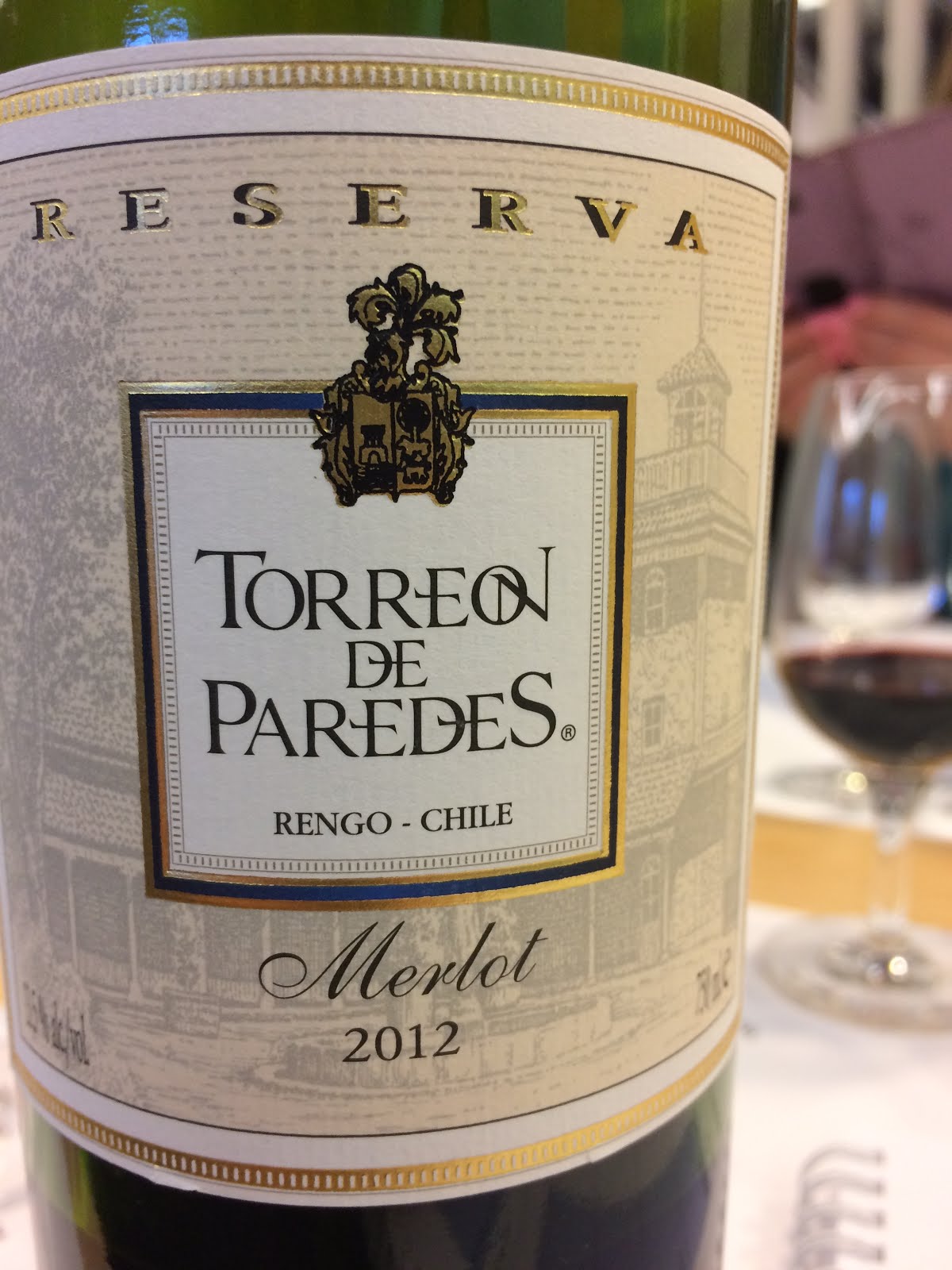
The first wine was medium ruby and medium intensity on the nose. It was more of a red fruit wine with cranberry, raspberry and plum and had mint on the nose. On the palate there was black cherry, medium body, light tannins, medium acidity and a medium finish. It was rated as Good and was a Chilean Merlot by Torreon de Paredes that had 13.5% alcohol and cost $22. Maybe a wine to have with pasta on a Wednesday night.


The second wine was also a Merlot - a Bordeaux wine from the right bank. It was deep ruby - almost purple - in colour. It had medium plus intensity on the nose and had flavours of cherry, currants, tobacco, black fruit, wet clay, and jam. It was full bodied with medium plus tannins and medium plus acidity. It had a gloriously long finish! It was a 2010 Chateau Fleur Cardinale Grand Cru Classé from St Emilion which had a whopping 15% alcohol and cost $126! It was rated Very Good - almost Outstanding - and I would be happy to drink it with a variety of dishes, so long as I didn't have to pay....

That was the right bank - all Merlot. Finally, we did the left bank - Cabernet Sauvignon - where I did a lot better with my tasting notes....


The third wine was medium ruby - almost purple. It had medium intensity and had a variety of aromas including red currant, plum, mint, herbaceous notes, and some oak. On the palate, there was black fruit, black cherry, and tobacco. It had high acidity, medium tannins, medium body, and medium plus finish. It was rated as Very Good. I liked this one quite a lot and found it was from Graves (same place as Chateau de Callac). It was another Grand Cru Classé, this time from  Pessac-Leognan by Chateau Malartic made in 2013 and cost $90. Did I mention that I liked this one?

The fourth and final one was deep ruby in colour and was medium intensity on the nose with black currants and cassis and an almost earthy note. Tasting, there was black cherry, black pepper, cooked fruit and tobacco. It had full body, medium plus tannins and medium plus acidity. It had a medium plus finish and was rated at Very Good. It was a 2013 Darioush Caravan Cabernet Sauvignon for Napa valley which had 14.8% alcohol and cost $80. Another pricey wine that just may be worth it.....

I enjoyed the class a lot this week. I think Bordeaux wines are possibly my favourite French wines and it was great to taste them and compare to the New World wines.


Time to Taste an Albariño from Catalonia, Spain!

  Today we're drinking an Albariño — but there's an interesting twist. This 2024 Raimat Albariño doesn't come from the cool, Atl...