Wednesday, February 27, 2019

Great wines under $20 - Italy, Spain and France

This week's painting - a vineyard - from a photo on my iPad...

Each week, my friend, Keith, and I go out somewhere into nature and we paint - it's called plein air painting.

Lately, we've been painting in Keith's basement - when it's below freezing, it's just too darned cold to paint outside!

After we paint, we taste a couple of wines while we eat lunch. Thanks to my Coravin, we only have a small sample of wine while the rest of the bottle stays fresh.

The past few weeks have been really quite good for wine tasting so I thought I'd briefly share the wines that we've tried. In most cases, the wines are under $20.


When I backpacked in Europe at the tender age of 24, I recall taking a ferry from Brindisi, Italy, to Greece. I remember it being rather chaotic getting on and off the ferry and having to share a cabin with a couple of strangers as well as my friend. Little did I know that they make a very nice wine there - the 2015  Corte Ottone Brindisi Riserva ($16.99). 

Riserva, happily, means something in Italy - it is a better wine that has to meet certain minimum requirements in ageing (unlike most countries where it has no legal definition). In this case, it means that it has been aged a minimum of two years. Brindisi is in the Puglia region of Italy so it should be no surprise that this wine is mostly Negroamaro (with some Sangiovese and Malvasia Nera). There were tastes of dark fruit like black cherry, black plum, and maybe a hint of dark fruit with vanilla and spice on the nose.Tannins were medium with medium acidity and a medium finish. I would definitely suggest this one with food - especially Italian - anything from pasta to pizza. It was also quite drinkable all by itself. Rated Very Good.  


Staying in Puglia, there is the Codici Masserie Fiano ($14.99) which was a fresh and floral wine, with aromas and tastes of peach, pear and apple. There was also a minerality - like a stone taste - that was a bit unusual. The Fiano grape is usually found a bit farther north, in Campagnia, so I'm not certain if this is the typical taste for Fiano. High in acidity, this would be a great food wine. Interestingly, when I poured this wine, I accidentally poured it again for our second wine. By this time, the wine had opened up considerably and the floral nature and complex flavours were much more apparent - we initially thought it was a different wine! Rated Very Good.


The actual second wine we tried that day was another Italian, a 2016 Bolla Soave Classico. Soave is the name of a wine made in Veneto where wine is made from mostly the Garganega grape. Classico means that this wine is made in the original area of the DOC (designated wine area - sort of like VQA) and is the better wine of the area. 

This wine was an absolute steal at $12.99. It has lots of wonderful fruity aromas and tastes including pear, apple, honey, lemon and pear. It also had medium acidity that would help it be a wonderful food pairing wine. I wouldn't count this out as a sipper, though, as it had a nice, round flavour that would be excellent for slurping on the patio - or maybe in the kitchen, considering the weather right now. I would rate this one as Good to Very Good - and suggest that it would be a good one to stock up on. 

Yesterday's tasting was one where I thought it would be interesting to try two wines that were made from the same grape but from different countries. This can be challenging as we try to limit our purchases to under $20 a.bottle and we also need a wine with a cork so we can Coravin the wine. The grape I decided on was Grenache (or Garnacha) - particularly became Keith had stated that he really didn't like Southern Rhone wines because they were a bit dull and boring. He was a bit surprised by our tasing!


From the Rioja region of Spain, we tried a2016  La Maldita Garnacha ($18.99). This wine tasted of dark cherries, black plums, and had an earthiness and spiciness that was good. It had high acidity, a medium finish, and some smokey notes as well. This wine was a food friendly wine but was bit rustic in its spiciness - almost a bit too strong - but it would go well with a strongly flavoured dish. I would rate this wine as Good. 


The second Grenache wine we tried wasn't actually just Grenache. It was a blend of Grenache and Syrah and was a 2015 Boutinot Les Coteaux Côtes du Rhône Villages ($19.99). This wine had all of the wonderful black fruiit flavours of the the Garnacha - black cherry, black plum - but also had a roundness and sophistication that the Syrah brought to it. There were medium tannins along with medium plus acidity and additional flavours like vanilla and spice - but not too much spice. The flavours were much more integrated with this wine. This wine would be an excellent food wine as it would go with a fairly wide range of food - from pork chops to lamb to steak to duck. It is also very nice to drink on its own. I reviewed the 2013 vintage of this wine a couple years ago and was a bit lukewarm on the rating - the 2015 vintage, however, is much better - even Vivino agrees with me, giving its best rating for the 2015 vintage.  A great deal for a wine that is almost as good as some more expensive Chateau Neuf des Papes wines, I would rate this wine as Very Good to Excellent. Fill your boots!

Cheers.


Saturday, February 16, 2019

WSET 3 results - are in!!!!!


I passed!

After waiting over two months, I opened an email today from Fine Vintage that told me that I passed my WSET Level 3 - both tasting and theory!

There's no breakdown of marks telling me how I did in each section - but I don't really care! I've got my level 3!

I was pretty certain that I had passed the theory but I was not certain about the tasting - it was a true challenge. But it all worked out in the end. I will find out more when they send out my results in the snail mail.

Now, off to find a really nice bottle of wine to celebrate!!!!!

Friday, February 8, 2019

Superb Wine at Martin's Lane - Riesling and Pinot Noir


Our family tasting group at Martin's Lane

Just last summer, I enjoyed a visit to an amazing winery, right here, in the Okanagan.

Martin's Lane is owned by Anthony von Mandl of Mission Hill fame and their first wines were actually made at Mission Hill. Then, in 2014, the Martin's Lane winery was build on Lakeshore Road, just above Cedar Creek (also owned by Anthony von Mandl). It is a stunning winery with amazing wine and I was impressed by the experience.


Outside the winery, there is a large sculpture of Van Gogh's head (sculpted by Douglas Coupland of Generation X and Microserfs fame), with his missing ear to the ground. There was a contest to find a suitable subject for the statue and Vincent  is apparently listening to the grapes growing. The whole story of 'Project Redhead' is quite fascinating and you can read about it here.

As you can tell, it was an unusual start to our visit.


After giving the sculpture the heads up (argh), we headed towards the giant door that allowed us to entire the winery. By the way, Martin's Lane is a certified organic winery and the winemaking philosophy is one of non-intervention from the vineyard to the bottle.


I loved this spiral staircase right by the front door. There were  many interesting and unique architectural features at Martin's Lane.


Our first actual stop was a room with windows opening to the barrel room below. This was a place to watch the cellar hands work and look at the barrels of Pinot Noir and Riesling as they aged. Martin's Lane only grows those two varietals, similar to another von Mandl property, Checkmate, which only has Chardonnay and Merlot.  


Sitting on a table in the room was our first taste - a 2014 Naramata Bench Riesling ($65). This wine is made with grapes from old vines and was our favourite Riesling. There was a touch of sweetness and tastes of apples and pears with a wonderful minerality that balanced the fruit. Outstanding.


After one last look down at the barrel room, where we noticed another head of Van Gogh (insert joke here), we continued our tour of the winery. 


We saw this tiled floor with gold (probably real gold) tiles which represents the Pinot Noir and Riesling that is processed in their approximate ratio. 


I was also impressed by the display of different sizes of wine bottles. Just for kicks, it goes...
Piccolo or Split- 187.5 ml
Demi or Half - 375 ml
Standard - 750 ml
Magnum - 1.5 L
Double Magnum. - 3 L
Jeroboam - 3 or 4.5 L
Methuselah or Imperial - 6 L
Salamanazar - 9 L - that's a case of wine
Balthazar - 12 L
Nebuchadnezzar - 15 L
Solomon or Melchoir - 18 L


We then ended up in the tank room. 

One of the unique things about Martin's Lane is that it is on a slanted hill - the grapes are delivered to the top and work their way down the hill of the winery. The grapes are crushed and then the juice is gravity-fed to the stainless steel fermentation tanks. 


Then, down the slope to what looks like concrete ageing vessels. They actually might be clay/porcelain, as my vague notes have suggested. 

Speaking of concrete and stainless steel, there's lots of controversy. Stainless is very easy to control in terms of temperature and oxygen exposure but can impart a slight harshness to the wine. Concrete, on the other hand, gently oxygenates with little harshness but doesn't have quite the same amount of control that stainless had. Clay/porcelain, to further confuse things, apparently doesn't impart any tannins or minerality that concrete can.


Our tour over, it was time to taste some wines. Lauren, our guide, was knowledgable, experienced, humorous and personable. We really enjoyed our tasting experience with her. 


The 2015 Simes Vineyard Riesling ($55) was dryer than the first Riesling with a minerality complimenting the apple, pear and peach flavours as well as the floral aromas. This French clone also had some citrus notes. Very good. 


The final Riesling that we tried was the 2015 Fritzi's Vineyard Riesling ($75).  This wine had a complex nose and leaned towards tropical fruits. It was a drier wine as well and had some herbaceous notes as well as citrus flavours. There was also a touch of that wonderful petrol aroma to this wine. Very good. 


The first Pinot Noir we tried was the 2014 Naramata Ranch Pinot Noir ($100). It was a very aromatic wine with aromas and tastes of red fruit, especially cherries. It had medium tannins and a wonderful earthiness. Very good. 


Our second wine was a 2014 Simes Vineyard Pinot Noir ($100). This wine was both less floral and less tannic than the first wine. It was more refined  - even austere. Medium tannins. There were tastes of red fruit including cranberry and raspberry. Very good. 


Our final wine was the 2014 Fritzi's Vineyard Pinot Noir ($150). This wine really made me think of the Domaine Serene Evenstad Pinot Noir that I had had from the Willamette Valley. It was another complex wine with cherry as well as darker red fruit on both the nose and the palate. It had softer tannins than the other two and had a wonderful mouth feel. This wine is ready to drink but has definite ageability,. Outstanding. 

So, what did I buy? Well, even though I am always looking for a great deal, I bought two of these rather pricey wines because the quality was so high. I bought a Naramata Bench Riesling and a Fritzi's Vineyard Pinot Noir. The Riesling was opened for a special occasion - and was beautiful - and the Pinot Noir is in my cellar awaiting another special occasion. 


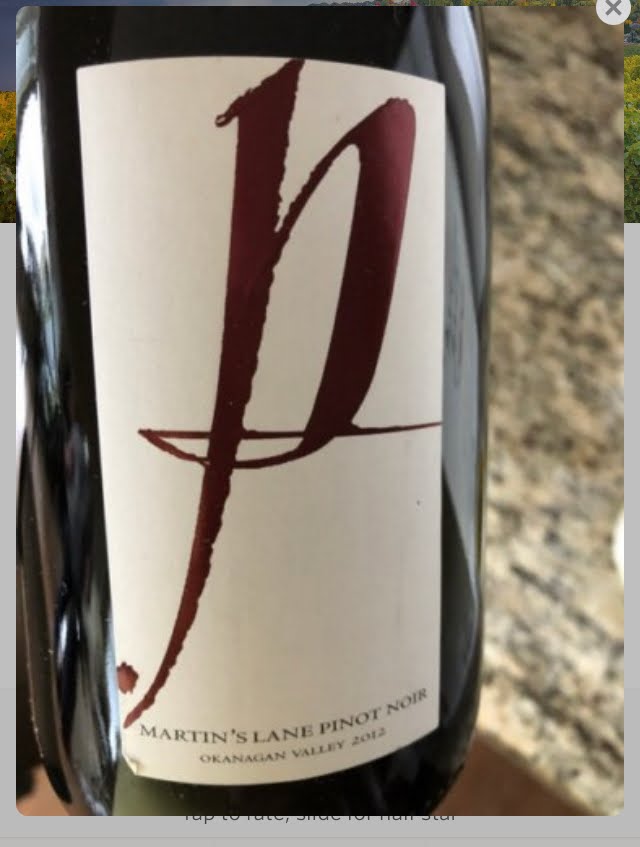
I also have this Pinot Noir that my son-in-law gave me - a 2012 Martin's Lane Pinot Noir. Could be time to pop this one...

Cheers!

"I can't hear the grapes!"

Thursday, January 24, 2019

Mini Wine Tasting - Four wines under $30 from around the world

Wine and Plein Air DO mix!

Ah, my WSET course is a faint wisp of smoke that has gone. It's been over a month since I've written my exam.

But I still don't know if I passed!

One thing that I did during my WSET course was weekly wine tastings with my friend, Keith, usually after a plein air painting session. We have continued to do so and have tasted some pretty interesting wines, as well as paint3ed some fairly good little studies. We taste two different wines each week and the last two weeks have had us taste some of the best.

So I thought I'd share them....

Last week was my week - and I picked two wines from two very different places.


The first was a 2013 Unanimé Gran Vino Tinto ($30) from the Uco Valley in Argentina. This was a Bordeaux-ish style blend of 60% Cab Sauv, 15% Cab Franc and 25% Malbec and was a delicious wine. It definitely had some strong tannins but also had enough fruit to back it up. Medium plus acidity, black fruits, and a nice long finish. Incidentally, this wine was a present from the parents of a student I taught for two years - and I think this wine was from the first year. Vivino rates it as one of the top 1% of wines in the world and I'm not surprised with its aromas and tastes of blackberry, plum, cassis, tobacco, and leather.  This wine would age well for a few more years but I liked the boldness of it right now! A complex, intense wine, I would rate this as Outstanding.

Unfortunately, for some reason, I didn't take a photo of the next wine. That's too bad because this wine is a bit hard to track down.


For taking care of their dog, my daughter and son-in-law gave us a bottle of Jabulani (not 100% sure of the year) MCM blend ($25?) from Ottawa in Ontario. This wine was very interesting because it is a blend of Merlot, Cab Sauv and Marquette grapes. Marquette is a hybrid grape which means that it is a hybrid of Vitas Vinifera (the wine grape species) and another, North American grape. This is like crossing  a wine grape like Merlot with Welch's Concorde grapes.

The result is a fruit forward, easy drinking, interesting wine. Unlike some other non-wine-grape grapes, Marquette is not 'foxy' or musky in it's taste - it is just fruity! This wine is low in acidity with medium tannins and is great to slurp away, despite its shorter finish. I'm not sure you can buy this outside of Ontario but if you find it, grab a bunch! It's a lovely red patio sipper.  A Very Good wine.

This week was my friend's turn. He picked a couple of excellent wines. Interestingly, they both tasted quite fruity and I mistook the first one for a new world wine.


The first one was an 2016 Zabu Il Passo Nerello Mascalese from Sicily in Italy.($23). The il passo might refer to the passito method. In this wine, the grapes are left on the vine to wither and raisinate, which concentrates the flavours and sugars. As a result, this wine is a little sweet (although I had a hard time telling if it was fruity or sweet), and quite rich in flavour. The Nerello Mascalese grape is one of the two main grapes in the Mount Etna appellation but it appears that this wine is made in the Sambuca di Sicilia area which is on the west side of Sicily while Mt. Etna is on the east side.

There were aromas and tastes of blackberry, plum, and black cherry as well as vanilla and some tobacco. This had medium tannins and medium minus acidity. The finish was medium and it was a fairly intense wine. This would go well with a number of dishes from steak to duck to pasta with meat sauce. I commented to my friend that I would prefer this with a pasta dish over many of the Chianti wines I have tasted! I would rate this wine as Very Good.


The other wine that we tasted this week was a 2014 Gerard Bertrand Saint Chinian from Languedoc, France ($24). The Languedoc region has a bit of a bad name for wine as it is part of the 'wine lake' of France where an ocean of cheap wine (like Fat Bastard and Arrogant Frog) is made. There are, however, some areas of really good wine and the region is making progress towards reinventing itself as a quality region. Saint Chinian is the name of the village and also the appellation so this is better quality wine. The grapes used to make this wine are Syrah and Mourvédre which are destemmed, pressed, and then a third of the grapes are aged in oak for nine months.

This was another wonderfully fruity wine although a bit more austere than the Sicilian wine. You could definitely taste the Syrah but the Mourvédre added some complexity to the mix. There were aromas and flavours of blackberry, plum, and black currant and, perhaps, some cherry. There was also tobacco, oak, a spiciness - including pepper - and some earthy, leathery characteristics with this wine. It had medium tannins (a bit surprising as Mourvédre can be a tannin bomb), medium plus acidity, and a medium plus finish. I really enjoyed this wine and felt it performed above its price point. I would rate it as Outstanding.

Continuing to swirl, sniff, sip, and slurp after my WSET is done is an important way to keep up the tasting skills I have (hopefully) developed. And, no matters how the painting goes, I always have something to look forward to!


Wednesday, January 9, 2019

Amazing holiday wines - for anytime!


Holidays are the time to bring out the big guns in terms of wine.

Now that things have settled down, it's time to reflect on the past couple of weeks and think about the wonderful wines that I drank. There were many, many excellent wines but three definitely stood out.

California Dreaming

I had my retirement bash at the end of June and, what a number of my friends and colleagues did was, give me a bottle of wine that was special to them.

Fast forward to just before Christmas - our anniversary. After (mumble mumble) years of wedded bliss, we thought we'd stay in downtown Vancouver (the Four Seasons, no less, but we got a killer deal). We decided to go to the Absinthe Bistro on Commercial Drive for, what turned out to be, a spectacular - and I mean spectacular - French meal.

When I was booking our reservation, I had asked if it was OK to bring our own bottle of wine and what the corkage fee was (corkage means the price charged by the restaurant to serve your wine - to basically to take the cork out and pour it). The cost was $24 so I figured it would have to be a pretty darn good bottle of wine. Then I thought of the special wine my friends Dale and Jodi gave to us.


The wine was a 2014 Emmolo Merlot from Oak Knoll in the Napa Valley ($64). We had the server decant it and could only wait about 20 minutes before we had to have some. It was a superb wine - much better than any other Merlot I've ever had. On the nose there were plenty of black fruits, a fig or raisin scent as well as definite leather and smoke. These were also apparent on the palate with chocolate, liquorice and toast adding to the experience. This medium tannin, medium minus acidity wine was Outstanding - it was balanced, had a long finish, was super intense with its fruit flavours and was definitely a complex wine. 

What did we accompany it with? We had a couple different appetizers and it went fine with those but the real winner was the main course. We ordered cassoulet - which is a wonderful French stew with sausages,. duck, white beans and a bunch of other stuff. Every restaurant has a slightly different version and Absinthe did not disappoint. The fruitiness of the wine combined with the elegant structure was a great complement to the salt and fat of the meats. 

A postscript on this wine - I am not usually such a big fan of Merlot but I liked this one so much that, just before Christmas, I bought another bottle. It currently resides in my cellar.

Happy New Year

My son-in-law, Dan, is a big wine lover - and actually completed his WSET level 3 a couple of years ago. For Christmas, his parents gave him a nice bankroll of money to buy wine. I was lucky enough to come along to the BC Signature Liquor Store and see what he was picking.

That night was New Year's Eve and we spent it with my daughter and Dan. We drank champagne, watched some of the festivities on TV, played Settlers of Catan, drank some more wine, and played a movie version of Cards Against Humanity. At one point, Dan opened up one of the wines he had bought - and it was excellent!


The wine was a 2000 Chateau Clarke Baron Edmond de Rothschild Listrac-Medoc Bordeaux ($70). First of all, after it was opened, I thought to myself - wow - 19 years old! Incredible! And it was another Outstanding wine! This medium plus tannin, medium plus acid wine had mellowed over time and would probably be good to drink for a few more years. This wine had aromas and tastes of black currant, black berry, leather, liquorice, toast, and a host of spices. Although the tannins were still in evidence, I still thought it was a wonderful wine and not too strong. It was balanced, had incredibly intense flavours, was complex and had a nice long finish. 

We probably should have had it with beef bourguignon but ended up having it with a charcuterie board which was still a good match. I sipped and smelled and savoured this wine and it happily took me a lot longer to drink than it would usually. This wine was decanted but we probably should have left it for an hour or so. I may have to pick me up a bottle of this one! The grapes in this wine were Cab Sauv, Merlot, and Cab Franc. 

Local hero

The three kings of the holiday were crowned with a wine made from a grape that my wife and I have always enjoyed - even before I started studying wine in earnest. Syrah is a grape that I love as it makes wines that are so drinkable and have character, in my humble opinion. 

\

The one we discovered was a 2016 Le Vieux Pin Syrah Cuvée Violette ($40) made from mostly Syrah with a little bit of Viognier. This wine, from our own Okanagan, had aromas and tastes of blueberry, blackberry, pepper, raspberry, leather, and, yes, violets. This is a fairly fruity wine with medium tannins and medium acid. I think it has the capacity to age for several years - my problem is that it tastes so wonderful now, I don't want to lay it down! This is another Outstanding wine from Le Vieux Pin as it has everything you would want in a great wine - balance, complexity, length and intensity.

I became aware of this wine when listening to a blog or reading a wine column in the newspaper. It sounded like a good fit so I searched on the BC Liqour Store app - nothing,. Then I went to Everything Wine - nothing. I checked the winery - sold out. Then I thought - well, Save On sells wine - what are the chances? Rather good, it seems, as the Lakeshore Save On in Kelowna had some. As part of our stay over New Years, I picked up a few bottles of this wine. Now, to cellar or not to cellar?

All three of these wines were fantastic. They are certainly priced higher than most wines I drink but their exceptional quality makes them well worth the money.

Have a happy and wine filled new year!

Thursday, December 20, 2018

WSET Celebration Dinner - with a Brilliant Bordeaux!

wine celebration

My WSET 3 exam is done - and now it's time to celebrate!

It's been an exciting 15 weeks - I've learned so much about wine making, grape growing and wine regions, I've tasted a whole variety of exceptional wines and I've met and befriended some wonderful people.

I've also studied harder than I ever have before and I've written a test that is as tricky as they come.

On the weekend, I decided to get a really nice wine to celebrate as well as a tasty meal. Off I went to Everything Wine and I picked up a Bordeaux wine and then went to a reputable butcher to get a couple of New York steaks.

I realize that some people would have a bottle of Champagne to celebrate and others would have a Burgundy or a pricey Napa Cab, but I love Bordeaux blends.

wine map of Bordeaux
Courtesy AllFranceInfo


The Left Bank is famous for its Cabernet Sauvignon driven blends which have grippy tannins and include some Merlot for smoothness and Cabernet Franc for fruitiness. The Right Bank wines are predominantly Merlot with some Cabernet Sauvignon and/or Cabernet Franc added in. In all of Bordeaux, there can be three other grapes added in by law - Petit Verdot, which is only added in during warmer years as it needs a lot of heat to ripen, Malbec, which is not used a lot, and Carmenere, which is rarely used anymore.

In between the Left and Right Banks is an area called Entre Deux Mers - literally, Between Two Seas (although it's actually between two rivers - oh, those French!). The particular wine that I bought was from this area which would make it Merlot driven and a lot cheaper than the Left or Right Banks.

Tasty wine from Bordeaux

The wine was a 2011 Chateau de Reignac Grand Vin Cuvée Special ($50 from Everything Wine). I thought that it was a pretty fair price for a seven year old wine from Bordeaux. I opened it and decanted it for about 40 minutes, leaving the small amount of sediment that I saw behind.

The aroma of this amazing wine was complex with wonderful black fruits like cassis and blackberry with black plum, tobacco, and vanilla as well as some savoury notes of leather. This wine was still developing. On the palate, it was not overly dry with balanced acidity, silky smooth tannins, tastes of leather again as well as the other flavours mentioned for aroma, full body, with a glorious long finish. It could age for a few more years but was definitely great to drink now. I rated this wine as Outstanding.

Wine from Bordeaux

It was even better with the food pairing! A grilled steak with a simple rub and baked potatoes were the perfect complement for this wine as the acid and tannins of the wine did a great job of cutting through the fat and saltiness of the steak. The pre-dinner glass, though, was pretty damned good as well!

I'll be honest - I wasn't sure where in Bordeaux this wine was from and might have passed it up if I'd known it was in the Entre Deux Mers region. Now that I've tried it, though, that region is going to be on my radar for (relatively) reasonably priced Bordeaux wines.

Oh, and I got an email from Fine Vintage today - I only have to wait 12 weeks for my exam results! Twelve weeks!

I think I need a glass of wine....

Thursday, December 13, 2018

WSET 3 Exam - The Day of Reckoning

Celebrating the end of the WSET 3 course and exam


I really do believe that it is all about the journey rather than the destination. But yesterday was a BIG destination.

It was the day of my WSET 3 Exam and I was appropriately stressed out. Our teacher, Lynn, had done an excellent job of making sure that we were taking this completely seriously. The tasting guru from our tasting group, Andrew, had taken his WSET 3 a couple weeks ago and said it was really difficult. I have spent the last three weeks studying pretty hard and lamenting the fact that I don't have an eidetic memory. I was s t r e s s e d!

I arrived in Vancouver super early - I did not want to be late and miss out. I had my final dinner at Pokerrito (which I have done most nights through both courses) and then went to the BCIT building to - well - study some more.

It's amazing to be thrust into this kind of exam stress after so many years. Yes, my WSET 2 did require me to study but I ended up with 96% and felt very confident going into it. This exam was different.

There is so much material, so many grape varietals, so many geographical and environmental and winemaking and vine growing things to know that there is no way that I could remember every bit of information. I was very worried that some of the parts that I didn't study that much (Southern France, Argentina) would have major questions but I had to focus somewhere.

I really think that I haven't studied this hard since I was in university - so... 35 years ago! Hell, most of the people in the photo above are much younger than that! I have written my fair share of tests as a teacher and it was rather humbling to be on the other side.

It's a different kind of test than I would ever give - as a teacher I have been moving towards projects and in class assessments where students can access the information they need but how they present it and process it is what gets assessed. That's because there is so much information out there that it is crazy to get students to memorize scads of information. Students of today need to know how to manage the giant repositories of data that are out there.

However, there are still lots of tests like the WSET where you are required to memorize a lot of facts. And memorize is what I tried to do.

Before the test, members of the class gathered together. We were all anxious about the coming test and sort of resigned ourselves to the fact that it might be extremely hard.

Then, it was time.

The first part was the blind tasting. I'm not sure what the wines were and I wanted to blog about this before I find out. The white wine started off smelling like peaches and stone fruit to me, then become citrus, and then came back to peaches. I always struggle with white wines and if I fail the blind tasting, it will be because of the white.

The red was more in my bailiwick. I could pick out the black fruits in it quite easily and I am confident I nailed most of the components - although it's hard to know if, for example, a wine has medium plus body or medium.

If  I do, in fact, fail the blind tasting, I would take it again.

After that, we had the written.

The first part was 50 multiple choice questions. I whipped through that pretty fast. There were maybe 5 or 6 questions that I wasn't sure on and had to make an educated (not wild) guess but, overall, I was really confident.

The second part was the written test - the most feared part of the evening. I do not intend to rewrite the test if I fail so I put all my effort into this difficult section.

For reasons of not wanting to piss off WSET, I will be very general about the four questions.

The first question was about a famous German wine. I think I did well on that although there were parts where I was reaching for an answer. There were labels to interpret, varietals to describe and winemaking processes to discuss and I certainly didn't get everything but I think I did pretty well.

The second question was about a wine area in the US. Most of the questions I found pretty easy except for one table that you had to fill out that related to its geography and environment.  Still, I did quite well, overall.

I thought I would do really well on the third when I found out it was an area in France. Unfortunately, some of the grapes that they focussed in were ones that I wasn't solid on so I did just OK on this section.

The final section dealt with sparkling and fortified wines. The syllabus on the course does say that they will be examined in the written questions so I am glad that I studied this area. I think this was my best section.

I answered every question to the best of my ability, even if I had to guess or make up what I hoped was the answer. I did not have a question where I couldn't write anything, much to my relief.

It was a pretty fair test, overall, and I think I passed - but three months from now, when I get the results, I will know.

Afterwards,  a bunch of us (the people in the photo) went to the St. Regis Hotel for a drink - a place I probably haven't been in for 35 years as well! We talked about keeping the tasting group going and doing one in January which I think is a brilliant idea.

Back at the pub, the server asked what I wanted. I thought of all the different wines we had tasted and learned about over the past 15 weeks. We had sipped and spat around the world with some wonderful, strange and new wines. I pondered my choices.

So what did I order?

A beer!


Time to Taste an Albariño from Catalonia, Spain!

  Today we're drinking an Albariño — but there's an interesting twist. This 2024 Raimat Albariño doesn't come from the cool, Atl...