Showing posts with label mosel. Show all posts

Wednesday, May 24, 2017

Riesling Evening with some Blanc Plonk - WSET Class 5 - Part 1

It was a lovely day on Tuesday.

I was able to combine two of my favourite things - riding my scooter and drinking wine!

It was a nice, sunny day and I hopped on my scooter and headed out to my WSET class in Vancouver. I even got there about a half an hour early and I was able to try a new restaurant, Pokérrito. This restaurant serves Hawaiian poké - sort of a Hawaiian version of sushi - on rice, salad or in a burrito. 

I really enjoyed poké when I was in Maui and was very excited to see it arrive here in recent weeks. When I entered the restaurant - sort of a take out place with a couple of tables - I was a bit concerned about the 12 people in front of me but the line went fast. I ended up gobbling half of the rice and accompanying wonderful ingredients before class started. 

This was class number 5 - time is definitely going far too rapidly! 

We started off with Riesling a wine that can range from bone dry all the way to sugar-sweet. The best ice wine in BC, as a matter of fact, is made from Riesling. Riesling is also one of the few white grapes that lends itself to ageing. 

Most Riesling comes from Germany. There's Mosel that has the lightest and most delicate, somewhat sweet, Rieslings grown on steep slopes in places like Piesport and Bernkastel. Then there's Rheingau which is a smaller region that makes drier wines where all the grapes only grow on the north side of the river to catch the sun. Next up is Pfalz which has off dry, medium body wines in places like Forst and Deidesheim. Finally there's Rheinhessen which is the largest area which is flat and produces the cheaper Rieslings. 

The Germans have Qualitatswein which is the first level of their better wines and then they have Pradikatswein which is their higher quality wine. I have to learn this, so you might as well, too! Within the Pradikatswein category, there are grape quality levels going from almost dry to very sweet. They are kabinett, spätlese, auslese, beerenauslese, trockenbeerenauslese, and eiswien.

In Alsace,  the French label the wines with the grape varietal but also have the better wines from Villages and then from Grand Cru. They are usually dry or sweet wines. Other areas include Austria, New Zealand, and Australia where Riesling smells like a lime popsicle - and petrol!

Our first three wines were all Riesling and we had to blind taste them. 


The first wine we tried was from Alsace and sort of replaced our wine that had cork taint during the first night. It was clear, pale, lemon, with a pronounced nose, lots of stone fruit and apple, a dry wine with high acidity, medium body and a medium minus finish. It was rated Good. It was made by Trimbach and dost $36. 


The second was a Kabintett level German wine that was medium lemon, with medium intensity on the nose and had some stone fruit (nectarine, peach, apricot) as well as petrol and lychee. It was an off dry wine with high acidity and a medium finish It was a 2014 Weingut Max Ferd Richter from Mosel  that was rated Good and cost $40 and had a whopping 9% alcohol. 


The last Riesling was Auslese - so it was pretty sweet!  It was pale lemon, medium intensity on the nose, lots of stone fruit (apricot, peach, pear) as well as a hint of lime. It was medium in sweetness, had high acidity, medium body and a medium finish. This wine was a giant seven and a half percent alcohol and was a 2011 Joh. Jos. Prüm Bernkasteler Badstube Auslese that was rated Good and cost $85.

After the Rieslings, we looked at some different white grapes that are all grown in France. 

First was Chenin Blanc which is the grape grown in Vouvray. It is famous for its 'wet wool' or funky smell and is also South Africa's most planted grape. 


The wine we tried was pale lemon with medium intensity on the nose, a lot of stone fruit, off dry in taste with high acidity and a medium body. It had a bit of a funky taste (apparently - I couldn't sense it, though) and a medium finish. It was a 2015 Vouvray made by Baron Bernard (couldn't find a web site), was rated Very Good, and cost $28.

The next grape was Melon Blanc, grown in Muscadet. It is a neutral grapeshot is not aromatic and lends itself to sur lie - absorbing dead yeast cells - for 6 months to a year.


This Clos de Briords old vines Muscadet was pale lemon, with a medium minus nose, and had apple, peach, floral aromas, and tastes of lemon, peachy and apricot. It's smokiness was complimented by light body and a medium plus finish. This wine was rated at Very Good and cost $30. 

The last was Viognier which is a big sugar, full bodied wine with low acid and none of the spiciness of, say, a Gerwurztraminer. 
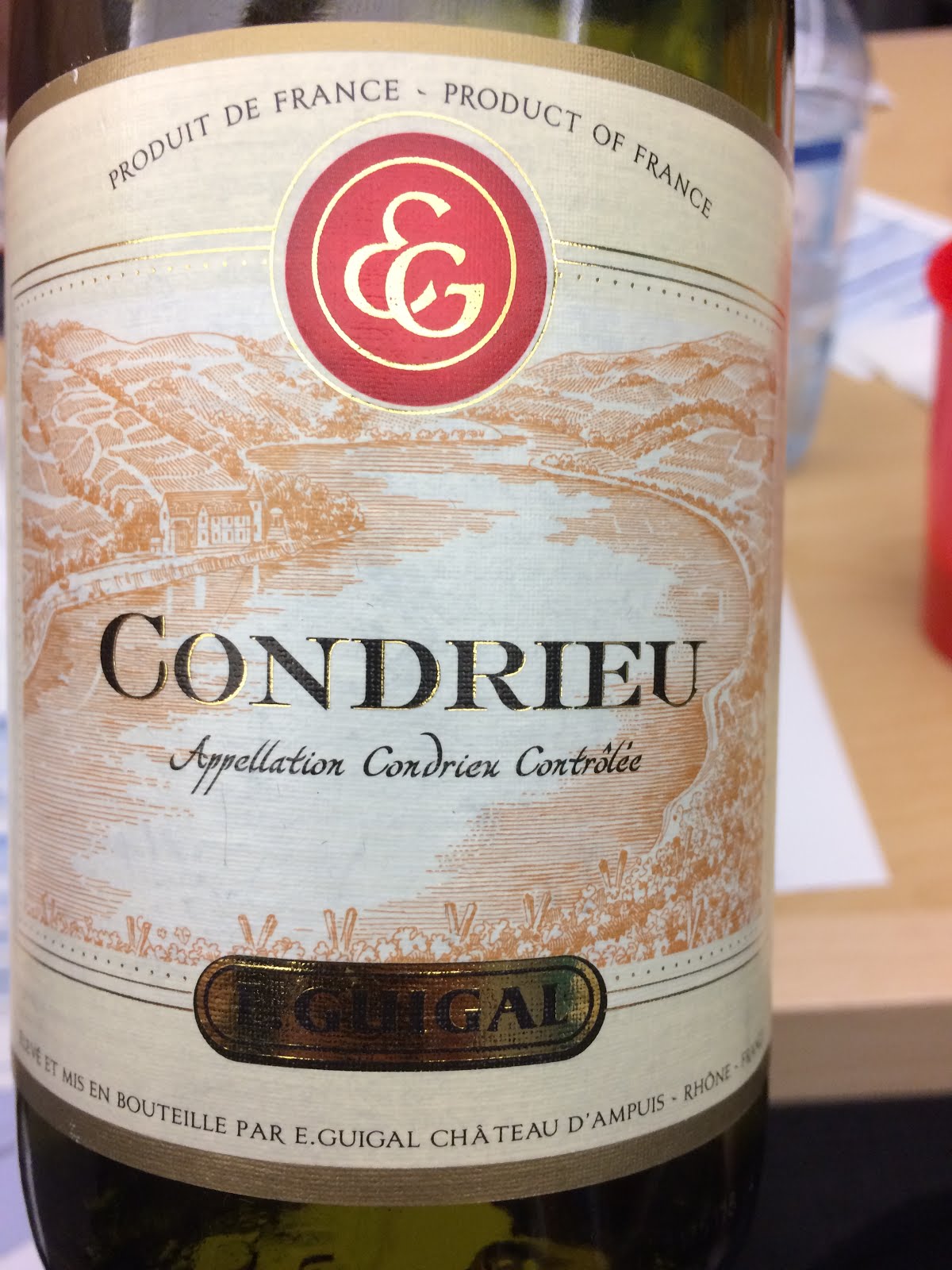
 

The Viognier we tried was medium lemon, had pronounced floral, apple and stone fruit aromas, some additional apple and toasty flavours on the palate, and had medium acidity, full body, and a medium plus finish.  This was a Condrieu made by E. Guigal which was rated at Very Good and cost $82. 

Those were the whites that we tried that night - next come the reds!


Wednesday, April 26, 2017

"I have a dead thing in the middle of my face" or WSET Class 1, Part 1

Last night, I embarked on my wine journey in earnest.

The WSET level 2 course offered by Fine Vintage was held last night in Vancouver. Thinking I had plenty of time, I left home and arrived around 6:15 for the 6:30 class. Damn, I thought, I hate being the first one there. To my surprise, the classroom was packed with only a two seats left! Not your typical school crowd....

I sat down at my table and met my fellow wine aficionados for the evening. Across from me was a woman from White Rock who had just sold one business and I think was getting ready to start another one involving wine. Beside me was a guy that grew as part of the family that owns Desert Hills Winery in the Okanagan and wanted to improve his knowledge of wine. Finally, at the end of the table, was a woman who works at Capilano Golf Course - I think in the restaurant. Everyone was quite friendly at the beginning of the evening but our table was pretty quiet through most of the night - I think that people take this course very seriously and it's probably good that I'm not chatting to someone while the teacher is teaching, so to speak, as I do tend to get distracted.

Speaking of our teacher, his name is Dave Munro and he is did a great job the first night, keeping us interested, using lots of humour, and showing an expert understanding of wine.

Right off, we tasted two fizzy wines. I had come to the course with the intention of spitting out the wine that I tasted but that didn't last past the first glass. I did manage to spit or dump half of most of the wines so I felt fine by the end of the evening.  Interestingly, the wine tastings were all blind. It's a really good way to train the palate and not bias yourself to a particular type of wine, but it's also really difficult!


The first wine in our fancy ISO tasting glasses was a nice bubbly champagne. It had lots of baked apple, even apple crisp and also the smell of toast caused by having the dead yeast cells (lees) being in contact with the wine. This is called autolysis and I think this info will be on the exam.....  It was not too sweet and had a high acidity and was a dry wine. Dave rated it as a very good wine - which is not hard to believe as it is a Grand Cru - the highest rating, I believe, for Champagne.

It was revealed as a Charlemagne Grand Cru Champagne that was a blanc de blanc - all Chardonnay grapes - made in 2010. The price? $96.00.


The comparison wine had an amazing almost perfume nose. There were tropical fruits, melon and even lychee in the nose. It was a sweet wine which, I found out, usually means high acidity to balance the sweetness. This was also a very good wine and Dave noted that it would make a very good breakfast wine!

This was a La Serra Moscato D'Asti from Italy made in 2015. It was only 5% so you could drink it all day! It was also just $32 a bottle.


After covering some more information about tasting, we tried that next two wines.

And this is when I realized that I had a dead thing in the middle of my face.

I thought I was doing pretty well with the tastings of the first two wines, when the third wine was passed around, I couldn't smell a damned thing! The little tasting glasses makes it difficult to jam your nose in the glass but, try as I did, I couldn't smell anything.

Of course, the know-it-alls from the course sagely nodded and pronounced "cork taint" which was so frustrating to me because I had always wanted to find out what it smelled like. And, thanks to my dead thing, it didn't't smell.

Happily, when instructed to drink (and spit) this spoiled wine, it truly tasted hideous! Few things have ever tasted this bad!

This was an Alsace Riesling made by Gustave Lorentz, and it costs $38 for a hopefully unspoiled batch!


The final wine before the break was another Riesling. This was a clear wine that was German so it was rated as a "spatlese" that was medium sweet with high acidity, and a medium finish. The pronounced nose included green apple, apricot and petrol (!). Stone fruits like peach and apricot were also noticeable in the tasting notes.

This was a German Riesling from a Mosel producer called St. Urbans that was 11% and cost $82.

I was interested by the range of people and also the knowledge of wine. One woman said that she only knew the difference between red and white wine while others knew so much, especially about the wine tasting, that I felt as dead as my nose.....

Next time, I will look at the reds we tasted and a special kind of wine that I have never tried before!

Time to Taste an Albariño from Catalonia, Spain!

  Today we're drinking an Albariño — but there's an interesting twist. This 2024 Raimat Albariño doesn't come from the cool, Atl...