Showing posts with label zweigelt. Show all posts

Saturday, August 17, 2019

New to Old - Two Very Different Okanagan Wineries


It’s been a crazy, busy summer.

But I’m happy to say that I have successfully moved from the coast (Maple Ridge) to the Okanagan (Kelowna).

We dealt with the usual things of packing, unpacking, figuring out where the hell everything is going to go, and then making the place livable - the most difficult part being getting rid of a bunch of big, old pots and plants and preparing big, new pots and plants and bags and bags of dirt.

It was a welcome change, then, when we went on a very nice wine tour today, with the first and last of the day

We left Kelowna and headed south - to Checkmate Artisanal Winery just outside of Oliver. This winery is the brainchild of Anthony Von Mandl, owner of Mission Hill and many other wine related ventures. They only make Chardonnay and Merlot.

I had been to Checkmate two years ago and was eager to see how it was growing. Back then, we basically did our tasting in an office - this time, it was in their pop-up tasting room - a temporary building that has been open almost two years but will be replaced by an appointment only tasting room.

The tasting was $20 per person - but you do get the money refunded if you buy a bottle of wine. Mind you, while we were there, a couple came in for a tasting, blanched at the price, and hurriedly left.

It’s a bit different - we were at a table and could sit down. We were tasting four different wines and so had four glasses each in front of us. Our pourer (didn’t catch the name) was friendly and knowledgable.

First up was the 2015 Queen’s Taken Chardonnay ($125). This was an oaked Chardonnay and had a nice, smooth taste. There were stone fruits such as peach on the nose and palate as well as a hint of tropical fruits. There was also a definite mineralogy about the wine. Very Good.

Next was the 2015 Knight’s Challenge Chardonnay ($85). This was a less oaked Chardonnay - and had stronger tastes of citrus fruit as well as butter. It was quite lively on the palate, something I don’t usually mind, but this did not like as much as the first one. Good

The first Merlot was the 2014 Silent Bishop ($85). I have a 2013 vintage of this wine in the cellar and it was easy to see why as this wine had powerful fruit tastes of blackberry, blueberry and black cherry as well as underlying tastes of coffee, vanilla, and tobacco.  Outstanding.


The final Merlot was a 2014 Opening Gambit. This was all black fruits like cassis and blackberry with medium tannins and integrated oak. This was a wine to age, as is the other Merlot, and, since it was my wife’s favourite, we bought a bottle. Very Good.


As a bonus, we also got to taste the Bear’s Move Chardonnay ($60). This wine is natural, open ferment. The first year it was made, a bear opened the top of the fermenter but got scared off by the venting gasses! This is a wonderful, funky wine that has the stone fruit that you associate with Chardonnay but has a whole bunch of other, earthy, funky flavours intermingling with the wine. In fact, I bought two bottles! Outstanding.

After visiting two other wineries on the way back towards Kelowna, we stopped in at Hainle Winery in Peachland.

My wife and I had visited Hainle Vineyards about 30 years ago so it was interesting to see what it was like now. ]

When they opened in the 1970s, I believe it was one of the few wineries that actually knew what they were doing and made good wines. They were the first winery to make ice wine in Canada and were the first certified organic winery in Canada in 1988.
The original owner, Walter Hainle, was originally from Germany, and was winemaker and owner until his passing. In 2002, Walter Huber (the other Walter), bought Hainle Winery and combined it with Deep Creek Winery to make one winery. Walter Huber sold the winery in 2006 but has stayed on as winemaker ever since. He is a very charming man and we were privileged to have both Walter and our pourer, Barbie, for our tasting.

We had many different wines there and I don’t quite recall everything about all of the wines but here are my notes

2009 Deep Creek Ehrenfelser  ($30)- A very aromatic wine with some stone fruits. A bit subdued in taste, overall. Acceptable.

2016 Gewurztraminer ($25) - Another very aromatic wine. This one did not disappoint in the fruit as the tastes of stone fruit, tropical fruit and roses. Good.


2016 Estate Zweigelt ($31) - This is a crossing between Blaufrankish and St. Laurent in Austria. The wine had definite red and blue berry tastes balanced with high acidity. A good food wine that would satisfy a number of people at a dinner party. Very Good.


2008 Reserve Pinot Noir ($477) - This was an amazing Pinot Noir! There were wonderful aromas and tastes of cherry, strawberry, and even some tropical fruit. There were also underlying earth flavours as well as leather and tobacco. The price was a bit high but the 2009 Reserve Pinot (regularly $370) was on sale for $99 so I bought one (which is why the 2009 is pictured here). Outstanding.

We also tried some fortified wine (OK) and some Madeira that was more of a barrel taste (has potential). I think that’s all we tried….

Overall, it was a good tasting day with our two bookends, Checkmate and Hainle, contrasting as one of the newest wineries versus one of the oldest in the Okanagan. Both of them were well worth the visit.

Cheers

Tuesday, July 2, 2019

Sex on the Vine - Crossings and Hybrids


The reproduction of grapes is a strange and wonderful thing.

Grapes are hermaphrodites - that means they have both male and female parts. When it comes time to fertilize, they don't need bees to pollinate them - they do it on their own. Truly self-sufficient! That makes sure that the grapes are identical - clones - year over year.

If you want to plant a new vine, you can simply cut off a hunk of vine and plant it somewhere else. Usually, that hunk of vine is grafted onto another type of vine so that it is resistant to phylloxera, the nasty little bugger that almost wiped out all the grapes in Europe in the nineteenth century.  There's other ways of propagating vines, but that is the one most commonly used.

A recent trip to Arrowleaf Cellars with the family.
If you take a grape seedling of a species (most wine vines, for example, are from the species vitis vinifera),
 and cross it with another seedling from the same species, you get what is called a crossing. For example, Cabernet Sauvignon is actually a crossing of Cabernet Franc and Sauvignon Blanc that happened in nature. There are lots of crossings, however, that happen in a lab. The South African grape Pinotage, for example, is a crossing of Pinot Noir and Cinsault, made so it would taste like Pinot Noir but could stand hotter temperatures like Cinsault.

Weirdly, even if you take a seedling from a certain type of grape and cross it with another seedling from the exact same grape, you will get something different. Crazy!

Zweigelt, an Austrian grape, is a crossing of two well known Austrian grapes, St. Laurent and Blaufrankisch. It is now the most common red grape varietal in Austria.


The Zweigelt that we tried was from Arrowleaf in Lake Country, just east of Kelowna. The 2017 Arrowleaf Zweigelt ($23) had aromas of blackberry, blueberry, plum, pepper, and spice, It had a faint aroma of acidity as well and had a medium plus intensity on the nose. On the palate were similar tastes to the nose with the addition of leather. It was quite acidic with medium tannins and a medium finish. This was a pleasant, easy-drinking wine that was rated as Good.

Now, here's where it gets a little  crazier.

If you take a grape vine seedling from one species (like vitis vinifera) and cross it with a grape from another species (think, grape juice grapes), this is called a hybrid. The advantage of hybrids is that they are resistant to phylloxera as well as other nasty things like nematodes and mildew. The Canadian icewine grape Vidal, for example, is a hybrid grape.

Our second wine was a Marechal Foch - a hybrid of Goldriesling (a crossing between Riesling and another grape) and another grape that is a different species, which itself is a cross between the river grape and mountain grape.


The wine was a 2014 Little Straw Single Vineyard Marechal Foch from West Kelowna ($19.90). This wine had aromas and flavours of red cherry, blueberry, spice, a lot of pepper, some leather, and a definite minerality. The intensity of the nose was medium and this wine had medium plus acidity, medium minus tannins, and a short finish. The pepper aspect of this wine combined with its spiciness would make it a great food wine, accompanying a nice soft cheese or some chicken. This was also rated as a Good wine.

So why aren't there a ton of hybrid grapes? The problem with many of them is that they develop a 'foxy' or musky aroma in wine which is definitely not desirable. Although the Marechal Foch is a pleasant grape, that is not always the case.

There you have it - reproduction, propagation, crossings and hybrids. For grapes, sex is a complicated and fairly unique process.

I think I'll light up a smoke and have a glass of wine....

Tuesday, May 21, 2019

Rosé All Day - A Friendly Rosé Challenge - France vs BC!

Some tasty Rosés from the cellar.

Every week, my friend Keith and I try to get out in the great outdoors and paint.

Neither of us is an expert - in fact, we both have so much to learn - but we enjoy getting out and trying to paint. The idea is not to make a great painting; the idea is to do some aspect of the painting well - or at least improve. Sometimes that happens, and sometimes it doesn't.

Today's plein air attempt at Mission Heritage Park.

Today was not a bad day for painting. I was happy with my tree - especially the leaves - and with the grass in front. The background wasn't so bad, either. A good couple of hours spent.

So then, it was time to have some Rosé.

A much younger version of me and wife with Rosé and Pastis.

Rosé is so popular now but it wasn't always that way. I discovered Rosé (not the sugary stuff like Mateus) in 2005 when my family was on a house exchange in Nimes, France. It was August and it was hot. Really hot.

At that time, my wife and I were red wine drinkers exclusively. But it was not red wine weather. Too hot! We looked around and people in Nimes tended to drink Kir (wine and cassis), Pastis (Pernod or Richard and water), beer, or Rosé. So we adapted.

After that, it became (and still is) our summer wine drink.

Two weeks ago, I was in Kelowna at the Salt and Brick restaurant for lunch with family. I had their Rosé flight which I really enjoyed. For today's tasting, I thought we'd do a mini flight of Rosé - one from France and one from BC.


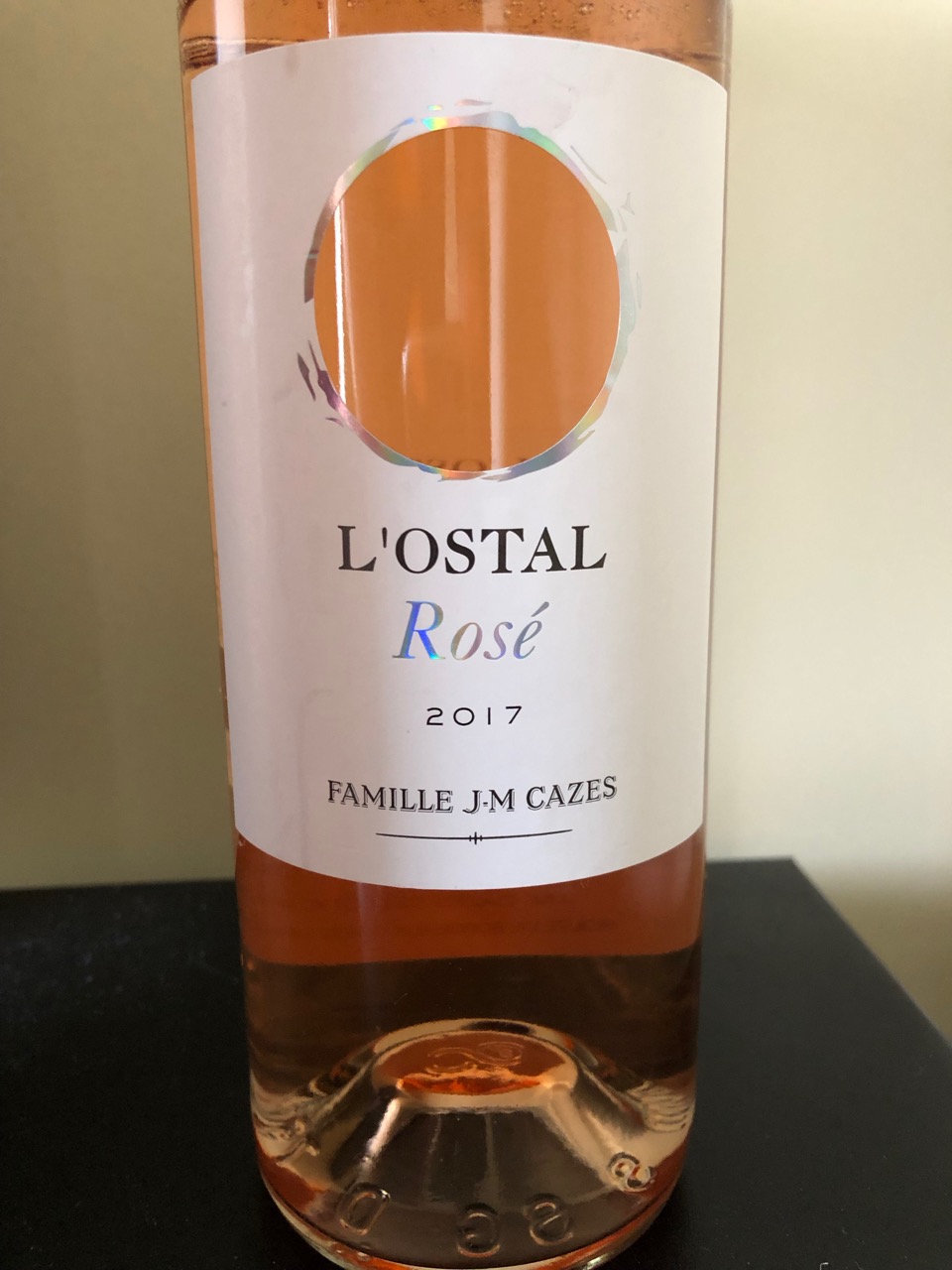
The French wine was our first wine of the tasting. It was a 2017 Domaine De L'Ostal Rosé ($16)  from Pays D'Oc which is basically country wine from the Roussilon-Languedoc Region of France - just west of Nimes. This pale salmon wine made of 50% Grenache and 50% Syrah had a medium intensity aroma and smelled of cherry, strawberry, red liquorice, cinnamon and red jujubes. You can see that I struggled to use the usual descriptors!

On the palate there were some tastes of the same as the aroma as well as a bit of cotton candy and a slight syrupy flavour. Interestingly, the fruitiness of the aromas were not nearly that strong on the palate. It actually tasted just a hint off dry but on second tasting, that went away. This had medium acidity, a medium minus finish, medium alcohol and medium intensity. I would say this is between Acceptable and Good.


The BC wine in this friendly battle was a 2018 Mt. Boucherie Rosé ($22)  from West Kelowna.  I'm not sure what grape is in it but the 2017 was made with Zweigelt (an Austrian crossing of St. Laurent and Blaufrankisch)  so it's likely the 2018 was made with the same grape.

On the nose, which was pronounced in intensity, there were aromas of grapefruit, lemon, blood orange, strawberry and a minerality. On the palate, there were these same flavours as well as watermelon. This high acidity wine was dry,. intense, had a short finish, and medium alcohol. It was a great patio sipping wine and was very refreshing. I would give it a Very Good rating,.

Both wines had their pluses but the BC wine was overall a better wine, in our humble opinion. The French wine would make a nice pairing to different summer foods, especially grilled food. The BC wine was great on its own and would probably stand up to most light summer meals. The only problem with the BC wine is that it is only available online or at the winery. Road trip...

Rosé all day!


Time to Taste an Albariño from Catalonia, Spain!

  Today we're drinking an Albariño — but there's an interesting twist. This 2024 Raimat Albariño doesn't come from the cool, Atl...