Showing posts with label tokaji. Show all posts

Friday, October 19, 2018

Das ist gut, ya? German, Austrian, Hungarian and Greek wines - and Mock Test Results! WSET 3.7


This week's class basically marked the half-way point of the course. I might not be too bad off...

The class started with Lynn returning our marked Mock wine tasting and exam. We had four questions on the exam and I nailed three of them. The fourth was pure guess work (Bandol is in what region and produces what kind of wine?) and I only got the region (Provence).  The wine tasting was OK - I was off a bit on some things like sweetness and alcohol as well as my overall assessment but I was mostly pleased with my first stab at a marked blind tasting.

We started off the class looking at German wines. There is some good Pinot Noir (Spätburgunder) and a few other grapes but the king - or the kaiser - is Riesling. There are several levels but the best for dry is Qualitatsweine which has a GG (for Grosses Gewachs - basically Grand Cru) on the label. For wines that have some residual  sugar, there is the Pradikatsweine system which ranges from Kabinett (fully ripe) to Spatlese (late harvest) to Auslese (select harvest) to Beerenauslese (select harvest of berries) to Trockenbeerenauslese (select harvest of dried berries. The last two are really sweet due to both late harvest and noble rot, and don't come along all that often.

The main areas that we have to know are the Mosel (light Riesling), Nahe (between Mosel and the others in terms of the body of the Riesling), Rheingau (medium to full body Riesling - best sweet wines), Rheinhessen (good wines but also crappier Rieslings like I used to drink in high school like Blue Nun), and Pfalz (a lot like Alsace).

I used to dislike sweet wines but the sweet Rieslings are amazing. We tried two.


The first was a 2016 Robert Weil Kabinett Riesling ($47) from the Rheingau region. This wine was almost clear and had aromas of apple, pear, honeysuckle, wet stone and an overall minerality. On the palate it was elegant, light and delicate - and had an almost cheesiness to the flavour, according to one of my table mates. It was a medium dry wine with high acidity and a medium plus finish. This wine was rated as Very Good and had ageing potential (as do most Rieslings).


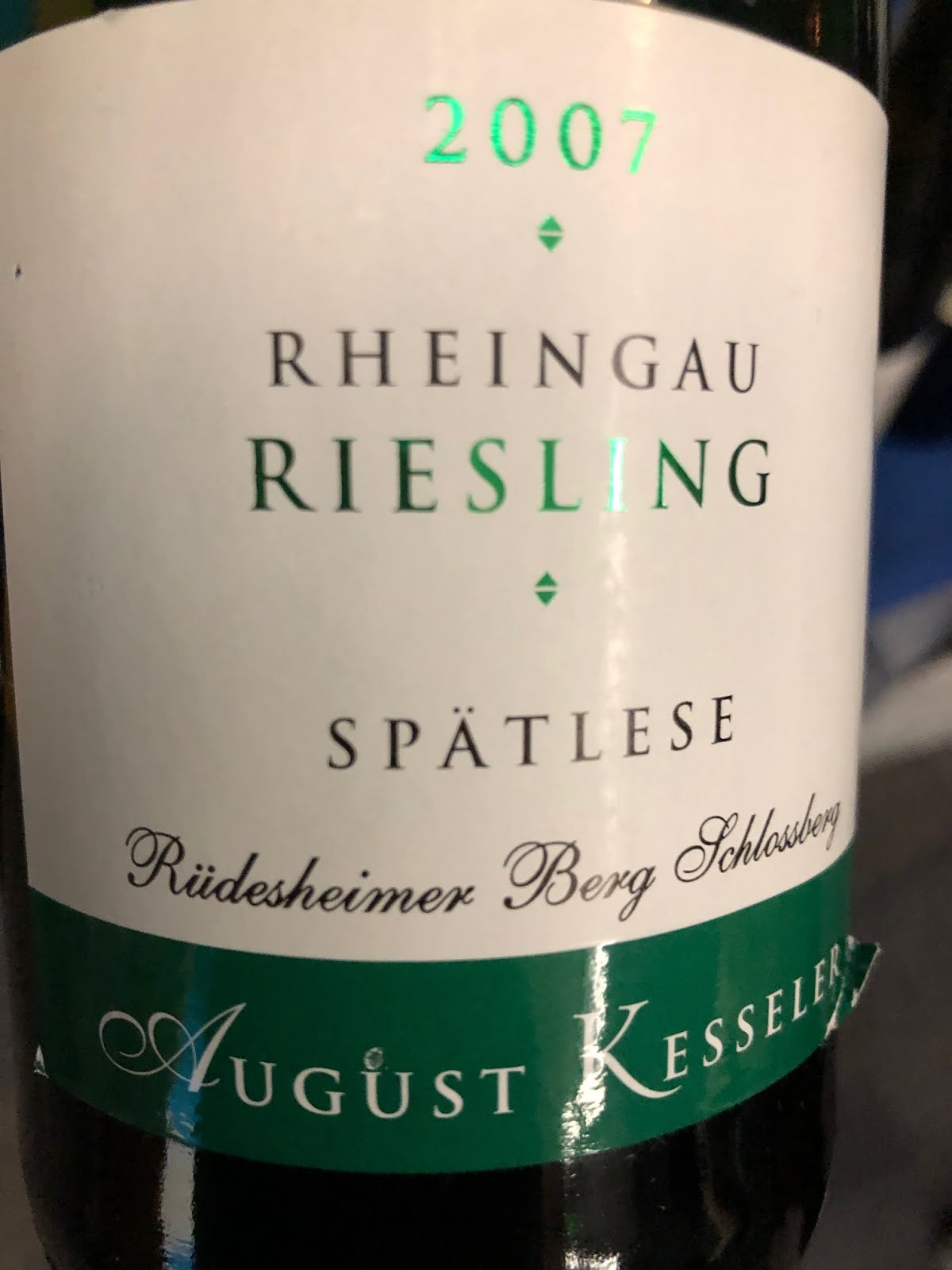
The second was also form Rheingau and was a 2007 August Kessler Spatlese Riesling ($92). As with a lot of aged Rieslings, the petrol smell almost knocked me off my seat. There was a lot of complexity including peach, apricot, honey, and, again, minerality. The sweet wine had long length and was an intense wine so I gave it an Outstanding rating. Great to drink now (11 years in) but also has super potential to age.

We then looked at Austria. Although Riesling is important here, Gruner Veltliner and Welschriesling (not related to Riesling) are also important whites. The reds that are popular are Zweigelt (purple flesh as well as skins so makes really deep colour wines), Blaufrankisch (really great wines) and St. Laurent (similar to Pinot Noir).

Austria has a similar classification system to Germany, especially with their Pradikat system. All of the wine regions are in the east part of the country as the west is full of the Alps.

We tried a red and a white from Austria.


The white was a 2016 Gruner Veltliner from Domaine Wachau ($36). This wine was a Smaragd wine which mean it had higher alcohol. I smelled and tasted nectarine, apple, peach, pepper, and it had an overall steely flavour. It was a Good wine in my opinion. It had some complexity and intensity but the length and body were just OK.


The red from Austria was 2014 Moric Blaufrankisch Reserve ($59) from Burgenland.  I've never had a Blaufrankisch before but I will certainly have one again! It had intense aromas of black currant, black cherry, fig, and clove. On the palate was also black plum, tobacco and cedar. This wine had high acid, medium alcohol, high tannins and a long finish. Ready for ageing and Outstanding!

Greece has been making wine for a long time. A really long time. Of the 200 varieties, we looked at three - two reds - Xinomavro (from Macedonia) and Agiorgtko (north of the Peloponnese) - and a white - Assyrtiko (from Santorini Island). We had the opportunity to try all three!


The first was a 2015 Boutari Agiorgtko ($28). It had some interesting aromas including red fruit, raisin, and sweet spices. Overall, it was a dry wine with high acid, medium tannins and medium body. Although balanced and fairly complex, it was not that intense and didn't have a long finish. Drink now - rated Good.


The second was the white - a 2015 Alpha Estate Assyrtiko ($38). This was a bit better wine with lots of stone fruits as well as lemon and wet stones. It did have a bit of a short finish but had nice ageing potential. It was rated as Very Good.


The final Greek wine was a 2013 Averoff Xinomavro ($39). This one really did taste like Nebbiolo - I could definitely smell roses on the nose, as well as red fruit like cranberry and strawberry. Like Nebbiolo, this wine could age - in fact, probably should as the tannins were gigantic in this wine! Also Very Good. 

The area of Hungary that we looked at was that Tokaj region. Although they make some dry wines, the area is most famous for its wonderful sweet wines. When we were in Las Vegas earlier this year, I had a Tokaji with Foie Gras and I thought that I'd died and gone to heaven!


We tried just one Tokaji - a 2009 Chateau Derezsla ($56) made from Furmint and Harslevlu grapes. It had a 5 Puttonyos sweetness rating which is quite sweet. It is an amazing wine with peach, apricot, cloves, lychee and honey on the nose and passion fruit, marmalade, honey and pineapple on the palate. This wine is Outstanding. You could tell by the fact that, instead of the usual spitting of wines, everyone in the class seemed to be slowly sipping and savouring this fantastic wine!


Monday, June 12, 2017

Sweet Barrel-O-Wine! WSET class #7 - Part 2


Hmm - it seems that Class #7 has a Neil Diamond focus; first it was Cracklin' Rose (well, Cracklin' Champagne ) and then Sweet Barrel-O-Wine (rhymes with Sweet Caroline?).

The second half of the class looked at sweet wines - not my favourite, but important, all the same.

First, the lesson. There are a few ways that you can make wines sweet.

Interrupting the fermentation is the first one we looked at. This can be done by removing the yeast, fortifying the wine (like adding sulphur dioxide or alcohol) which is what they do to Port and to fortified muscats like Muscat de Beams de Venise.

The second way to sweeten wine is to add a sweet component to the blend. One way is to add unfermented grape juice (süssreserve), like in a German liebfraumilch, but the juice has to be made of the same type of grape as the wine. The second way is to add sweet wine. One famous one to add is called PX with stands for Pedro Ximenez which is a super sweet, almost honey-like wine that is used for sweet Sherry.

The last way to sweeten wine is to concentrate the sugars in the grapes. This is done by using dry grapes, either on the vine, like late harvest wines (e.g. spätlese) or letting the grapes dry on racks, etc., until they are like raisins which concentrates the flavours in wines such as Recioto (made form Corvina grape) or PX - the sweetest wine of the world. Another way to do this is by using noble rot  where grapes are in a damp area and develop a specific type of mould. The mould attack the grape and causes it to shrivel. This has to be done with grapes that are highly acidic and thinned skin.  The final way to concentrate sugars is freezing the grapes to make Ice Wine!


Our first wine was from Pantelleria which is an island that is south of Sicily. This wine (I believe it was a Recioto) was deep amber in colour and had medium plus intensity with aromas of raisin, fig, prune and a bit of floral. On the palate, it was nutty, raisin, vanilla, sultanas, and a jammy hint. It was sweet (almost lucsious) had medium plus acidity, full body, and a medium plus finish. This wine was rated as Very Good and was a Passito di Pantelleria made by Donna Fugato ($40 for 375 ml).


The second was a Noble Rot wine. It was from Vouvray (which is in the Loire region) and was made with Chenin Blanc.The colour was medium gold and it had a medium plus intensity on the nose, with aromas of raisin, earth, and lots of stone fruit. On the palate, there was jam, plum, fig, fresh fruit and, again, an earthiness. It was a sweet wine with high acidity, medium plus body and a medium plus finish. This 2005 wine from Nectar Moncontour was also rated as Very Good and cost $72 for 500 ml.


Next up was a Tokaji wine - our instructor's favourite wine! It was medium gold in colour and had medium intensity on the nose with aromas of marmalade, peach, apricot and tropical fruits like mango. On the palate, it had flavours of tech, pineapple and apricot jam with an earth flavour. It was a sweet wine with high acidity, medium body and a long finish. Tokaji wines are rated on sweetness by puttanyos which range from 3 to 6 - this one had 5 puttonyos. This 2009 Tokaji from Chateau Dereszla had 11.5% alcohol,  cost $50, and pairs well with veal and chicken.


The final wine was soooo sweet. If you like sweet wines, this is the one. It was medium gold in colour, and had a medium plus intensity on the nose with aromas of raisin, lychee and pineapple. It was a lusciously sweet wine (the level above sweet is officially called 'luscious') and had tastes of pineapple, raisin and apricot. There was high acidity, full body, and a long finish with 7.5% alcohol. This was a Mission Hill Reseve Riesling Icewine from 2014. It pairs well with cheese and costs $56 for 375 ml.

I definitely learned a lot about both sparkling and sweet wines during this class of my WSET. I was able to pinpoint the tastes that makes sparkling Champagne so desirable and I have an understanding of how sweet wines can really vary.

Our next class deals with Port and Sherry - two wines that I am not all that familiar with. Time for some more learning!

Time to Taste an Albariño from Catalonia, Spain!

  Today we're drinking an Albariño — but there's an interesting twist. This 2024 Raimat Albariño doesn't come from the cool, Atl...